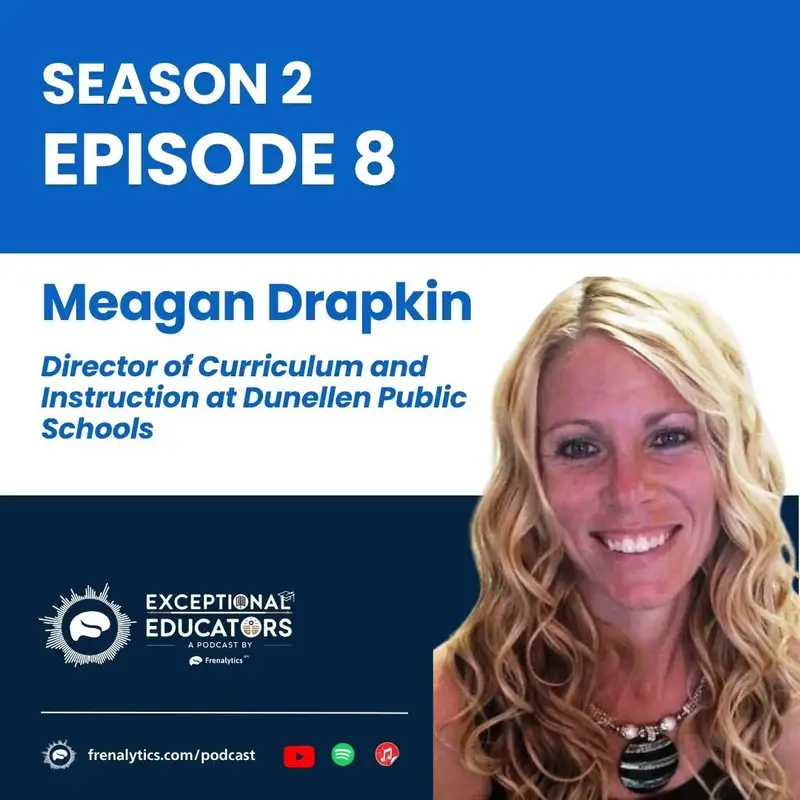
Dyslexia, Data, and the Drive to Lead: Meagan Drapkin's Modern Approach to MTSS & Leadership
Welcome to the Exceptional Educators Podcast by Phrenalytics edu, where innovation meets inclusion in education. I'm your cohost Antonia Ellis.
Matt Giovanniello:And I'm Matt Giovanello, the CEO and co founder of Phrenalytics. At Phrenalytics, we put special education and English language learners front and center. Our award winning Friendalytics EDU platform helps streamline progress monitoring, improve communication and compliance, and offers truly personalized learning to your students' availabilities.
Antonayah Ellis:Each episode of our podcast features candid conversations with district and school leaders, classroom change makers, ed tech founders, and industry executives, dedicated to transforming learning for each student, especially our learners with unique abilities. With a focus on extraordinary educators and the exceptional students they serve, we explore the latest in special education, accessible technology, and inclusive leadership. In this episode, Exceptional Educators is exceptionally thrilled to welcome Megan Drapen, the Director of Curriculum Instruction of the Dunnellan Public Schools in New Jersey. Megan has storied her career in education, starting as a third grade teacher, interventionist, supervisor of language arts, and now director of curriculum and instruction. We want to start off by asking, is your why?
Antonayah Ellis:What got you into education in the first place?
Meagan Drapkin:When I was younger, I just always loved teaching. I used to set up my dolls and teach. It's just something I really fell in love with. In high school, we had a childcare and development class that actually created a childcare and development three and four that allowed us to go work in the schools. So for two years, I would go over and work with kindergarten students.
Meagan Drapkin:I think that just lent itself me going to college for education and then continuing. Here I am twenty years later, graduating in my twentieth year.
Matt Giovanniello:Congratulations, a forever student as we call them. Thank you for committing yourself to this space. It's awesome to hear that you've had this instilled in you since a little kid. Antonaya, I know you had a similar feeling and Megan, ever since I was young, I always thought I wanted to be a teacher. And we come from a family of teachers.
Matt Giovanniello:My grandmother was a remedial English teacher for many years in the New York city public school system, transitioned to pre K and she retired. My aunt is in her twenty fourth year as special education on Land Island. So runs through and through. And while I'm not a teacher, at least right now, we love supporting teachers and we always love hearing coming from your third grade classroom all the way up to the leadership role that you now face. So thank you for that.
Matt Giovanniello:And let's get into that a little bit more. How did that career trajectory happen? What supports did you get along the way? What do you make of your current role? I know you've been in it for a little over two years.
Matt Giovanniello:Now you're in another district. Tell us a bit more about how that transition period was.
Meagan Drapkin:So I was fortunate to get a job out of college in the district that I graduated from. So from there, I started as a third grade teacher and they were hiring teachers to write curriculum and being a new teacher, you know, let me let me apply for everything. And so I did and I didn't know if I'd get the summer writing curriculum, and I got the job because I guess, you know, not everyone loves to write curriculum. I think I I just fell in love with it after my first year. I got to really learn the ins and outs of what makes standards and how to address standards for students and really just look at it a different way.
Meagan Drapkin:So instead of teaching to a book that's in front of me, I can look at certain standards and know what my students have to achieve. After four years in my first district, I went on to another district that had a high ML population of 88%. I worked there as an interventionist and then I became a literacy coach, so I really got to dive in. I became Wilson level one Tranche taught me how to teach students how to read and I was like wow this would have been a great class to have in college. They never really taught us the foundations of how to teach students how to read and I just fell in love with that.
Meagan Drapkin:I asked to go back to the classroom because I really wanted to use my skills there and I worked in a third grade class of a SIOP class, the sheltered English instruction class and I had about 28 out of 32 ML students and I really got to apply those foundational literacy skills with them. I then became a data coach. I was also really into data. From there, I moved on to another district after four and a half years and became an interventionist. So there I got to really hone in on my intervention skills.
Meagan Drapkin:This was around the year that New Jersey passed the dyslexia law so I was a big advocate in that and the leadership team there to create the Dyslexia process and help to refine their NTSS process all as an interventionist. I came there with my Supervisor Cert, so I'd gotten my Supervisor Certification in 2013. I didn't know if I would ever use my Supervisor Cert. I came from district where it was run by the state. I just wasn't sure if I wanted to lead.
Meagan Drapkin:Didn't really know the ins and out of what it looked like, and then I went to my next district, and I was like, wow, I can lead this way. I had a fantastic principal. She's one of my best friends now. I've kept in touch whom made me go back for my principal search. She's like you need to go back and get your principal certification.
Meagan Drapkin:She was a fantastic mentor me what it was like to be a very teacher centered student centered leader. And so I went back for my principal cert and they knew I was there for a stepping stone. Didn't really know and I was like I'm not sure and in 2019 I kind of set my eyes on starting to look for administration. In August 2019 I started as a supervisor of English Language Arts And then in 2021, I became a director of curriculum instruction in my previous district, and I moved here in the 2023. So I'm in my fifth year of being a director.
Meagan Drapkin:My principal really let me see the different type of leader that I could be. That's the one that I set my eyes on making sure that I'm listening to teacher voices, and I'm building them up and building leadership within. Something I've taken into my role is building teacher leadership and strengthening that system, as well as students.
Matt Giovanniello:I'm just, I'm fascinated and congratulations. I think that many people set their eyes on that kind of trajectory and few were able to accomplish it. So first and foremost, thanks for sharing all of that. I hope it serves as inspiration for others trying to achieve the same thing that it is possible. You're here to tell the tale and it's not easy, but it's worth it.
Matt Giovanniello:Yet at the same time, it's doable. So thanks for sharing that, Megan.
Meagan Drapkin:I did just get my superintendent cert, in the spring. So I'm in my mentorship now to get my standard certification. Thank you again, being here in a district with, you know, the support here. I can do things in a different way. I can lead in a way that is collaborative and everyone's on board with the mission and vision of the districts.
Matt Giovanniello:Well, let's get into that some more. So expand on the mission and district of Dunnell and Schools. I know you have about 1,400 students. You have a relatively high multilingual learner population. Let's talk a little bit more first about what your district looks like in terms of student enrollment and the landscape there.
Matt Giovanniello:Then also, it seems so obvious to you that the way your district is run is really different than the way the previous districts you were part of were run. Let's try and unpack a little bit the positive differences that you're seeing here that you just love and want to brag about.
Meagan Drapkin:I didn't think I was going to actually even apply to this district. I was in my old one and I happened to get an itch to look online and I saw an opening and I'm like where's Denellen? Because I live the Jersey Shore and I put it in and I'm like, oh, it's like fifty minutes away and I was commuting about like twenty two to 20 five. The first session was a zoom call and the superintendent. He was new to the district too.
Meagan Drapkin:He had started September 2022. This is November 2022 and we have a lot of the same alignments. I remember telling him I'm sorry I can talk about data all day long. I am probably talking your ear off and I didn't. I didn't know where it would lead right the whole time.
Meagan Drapkin:I'm like I'm not going to Danellen that's far away and I'm here. My graphics here are very similar to a lot of the districts that I have been in. It's we have about 61% Hispanic population. We're about 19% ML population. So I oversee ML department.
Meagan Drapkin:We're about 12% special education, so we have a wide mix from our preschool all the way up through our twelfth grade, and here it's really focusing on getting our families involved in their child's education. We've been really pushing that needle. It's a nice little district, so we have small town vibes we call it. We've been able to expand even our ML department. When I started there was five ML teachers we now have eight.
Meagan Drapkin:We have four in our elementary, two in our middle school, two in our high school. So that has really helped with structuring and just what our classes look like, how we can support our teachers. I do have to say the staff here is very open. I think that was one of the things that I just really took to. They're excited.
Meagan Drapkin:They want to learn. Danellen was a setback. When I came here, it was instructional practices weren't really evolving and they knew it was time for a change and they were excited about change. So I've been able to come in and just bring them along with me. For intervention, when I came here was completely pull out We now have five interventionists, and we do a push and model through MTSS.
Meagan Drapkin:I've created a nice Tier one, Tier two, Tier three, where everyone is in except for our Tier three. We have Wilson groups for our Gen Ed students, So we've really created a nice prevention program for our students. We now, this year, hired an interventionist in our middle school, so she'll be working on there to keep expanding the supports that we need for all of our students, and we're just really bridging those gaps with our special education. We're bringing more inclusion. They're coming into our science and social studies classes.
Meagan Drapkin:I'm stationed at the high school, and the MD class comes to visit me every single day last period. It's the best part of my day. They're very excited. They do I Ready. So we have I Ready contests.
Meagan Drapkin:IReady Curriculum Associate donated tons of stuff, so we have a little toy chest, then they come and they do their punch cards and it's just very welcoming and there's a lot of excitement here. We have adult ESL classes, we're trying to bring our community in, so it's just really getting everyone involved. We have family engagement nights for our literacy, math, ML students, P students. I've gotten about like $10 since I've been here, so we brought a lot of money in to the district. Climate change grant down at Faber Elementary and we have the largest aquaponics system in any New Jersey school.
Meagan Drapkin:It takes a whole entire wall of our preschool wing and being in such a small district that not everyone always gets to hear or see the wonderful things that are going on. We have two aquaponics system, a hydroponics, and we just redid all the outdoor garden beds there.
Antonayah Ellis:That is awesome. I just want to piggyback on your emphasis on change. How, what would you advise teachers who just feel stuck in the classroom, not really knowing they want to stay in education, but they just don't know where to go. They're kind of feeling overwhelmed with the students and the behavior. And it is like such a beautiful story of working I
Meagan Drapkin:think for teachers, it's looking at what is available within the district. So does your district create opportunities for learning? And that's something that I feel is very important here. So I've started a lot of committees. We created learning experience leaders, so we have leadership, we have teacher leaders within our buildings, and so it's looking for those opportunities to lead within the district, and if there's not, what networking can you do within your county or your town depending on your state you're in.
Meagan Drapkin:I know some are county based, some are town based, just networking yourself and getting out there, getting your name out there, meeting other people. I think one of my benefits is that I've kept my connections in different districts, but I also network. So I will pick up my phone and my mentor from when I receive my principal standards, we're still good friends. I'll reach out to her. My network from when I was in Monmouth County, New Jersey, they had a directors supervisor group.
Meagan Drapkin:I stay in touch with a lot of the leaders from there. If someone's looking to grow, it's what do I want to do next and what opportunities are in my district that I can maybe see what I like and if I don't, it's a it's a teachers market here. So what am I looking to do? I added a commute on. I didn't think I would do that but I did.
Meagan Drapkin:It's worthwhile sometimes depending on your personal life looks like. Can I add a little bit of a commute on and what does that district have to offer me? Really research any of the new districts and see what's going on. Is there something online or on Instagram, Twitter, LinkedIn, like what's out there and talk to people. There's a lot of Facebook groups that I'm on and people will post and just ask each other like what do you like about this district are there opportunities for growth.
Meagan Drapkin:Anytime I saw something I just signed up registered and put my name in the hat to really get my name out there. And then I kept connections with administrators in other districts too. Share out your information with other teachers. Be a leader too within your own department or grade level. How can you leverage your own leadership with amongst your own teachers and grade level?
Meagan Drapkin:That's how I kind of started within my third grade team.
Matt Giovanniello:I love that. I think you're embodying what you learned in your master's classes, then your certification classes of being an effective leader. Like you were carrying it out and putting it into practice and being like, Hey, I want this role and I'm going to show you that I mean it. And here are the ways I would be a leader if you took me on. Clearly a couple of people had their head on straight and they were observing and they made a really good call.
Matt Giovanniello:I think that's how in part, Megan, you were able to grow and scale into the positions that you now hold. Now you're paying it forward to show other teachers who want to get into roles similar to yours exactly what to do. I think the advocacy piece is important. I think the proactive piece is really important of seeing what opportunities there are. And like you said, it's a teacher's market.
Matt Giovanniello:Like you can jump to a district relatively easily. You can change the ecosystem, the world around you, if you want to, and you can give yourself more opportunities if you do a little bit of research and find where they are made available to you, advocate for yourself and for your students and for your staff and create what isn't there right now. I mean, you shared countless examples before of doing exactly that. So just kudos. I do have a question for you, little bit of a topic change, but something we were getting into before you had some words that were just ringing to me.
Matt Giovanniello:They're some of my favorite phrases MTSS for multilingual learners supports for special education. You're on the exact right podcast for that. So let's unbox a little bit more about the MTSS programs that you have developed at Dunnellon and maybe drawing from inspiration past the MTSS programs that you built out at your previous districts. What did that process look like for you having done it once before? What were the successes?
Matt Giovanniello:What were the pieces that worked maybe a little bit too well for you in the adoption of MTSS, those tier one, two, three supports, Wilson and so on. What can we learn from what you did that might work really well for other leaders in different districts who are trying to get some inspiration?
Meagan Drapkin:So for MTSS, I think one of the ways to look at it is that New Jersey has the Intervention and Referral INRS system. What happens with INRS is you look at a student and you have to fill out documentation to meet with this IRS committee and sometimes you're sitting around for six weeks and then you meet then you create an action plan then you implement this action plan and then you come back to the table. By then we might have already lost six to ten weeks of instruction targeted instruction. So through MTSS, it's starting from day one, everyone high quality instruction tier one. That's where we start.
Meagan Drapkin:We look at a universal screening. So all students, you know, we give our universal screener. Everyone gets the same one from there. We know we have our grade level standards that we have to teach. And what I've done is I've embedded into our elementary a forty minute period for ELA and a forty minute period for math of small group instruction.
Meagan Drapkin:So, everyone's doing small group instruction for forty minutes every week in ELA, forty minutes every week in mathematics for K to five, and we're starting now in our middle school this year. And during that time, we are targeting interventions. So, do I look at the intervention? So, we have our interventionists, we have five of them, and they're our MTSS team. If I'm struggling with the student, I'll complete like a tier two checklist, and I'll sit down and I'll meet with the intervention, and we'll look at the data of students.
Meagan Drapkin:From there, we target those interventions through small group instruction. We look for six to eight weeks. We're in the general ed setting, so our students are still in the classroom. They're rotating through small groups. They're meeting with the interventionist.
Meagan Drapkin:They'll go do their station rotation, they'll also meet with the teacher a couple times a week, and then if the student's still struggling, we'll complete a tier three checklist. From there, we complete a focus for instruction. So, we really hone in and target students specific skills, and our intervention is create a action plan based on the skills. So there's a pre there's an assessment students are given, and they put together this really nice focus for instruction and from there, the teacher or interventionist work with the student for about five to seven minutes on this one skill, so we're not, you know, really making students sit there for twenty minutes on this one skill, and we're looking at that as the student making progress. Sometimes they just need a little bit of that one on one time, and we've had many students where we've brought into tier three who just need a little extra assistance, who went right back into tier two, and that's why when I came here, you had to fill out a form, and it was only a few students that were being targeted for interventions.
Meagan Drapkin:Now, we have an interventionist in our one through five, all the classes, so we get to really hone in on all of our students. Our interventionists are also SEI trained, Sheltered English Instruction trained, so they're also supporting our ML students. So, everyone's getting that small group instruction, and from there we've really brought down the number of students that have needed referrals to special education, and over the years just fine tuning that process. When I look back, it started when I was an interventionist, and I was on the IRS committee and I knew about New Jersey tiered system of support MTSS from my one district who was always really ahead of everything. This is where I had the 28 ML learners in my class.
Meagan Drapkin:So they were doing MTSS there. So I went to my new district. They were back to IRS. I was able to as an interventionist be like, I'm going to collect all of my data. I'm going to come to an IRS meeting and say, I've done all of this and if I'm coming, it means I have no resources left to really try with the student.
Meagan Drapkin:I've done all of this and really showing the data points, which allows the INRS committee to see like, oh, yeah, we can't really give any more suggestions. You've done everything. It's preventing everything and really honing in on the skills to see where students may be struggling. And a lot of the time these groups are very fluid. A student may be in tier two, but they never moved to tier three.
Meagan Drapkin:They're just needing that little extra support and that's okay too because they're doing the Tier one, they're in with everybody, and they just need a little extra support in that small group. So last year, you only had six referrals from our general ed in our elementary and there's about six thirty kids.
Matt Giovanniello:Wow. That's a very low percentage. It sounds like a fantastically and wonderfully implemented MTSS structure. So, you'd be really proud It about was wonderful to hear the details of it. I do wonder about, you mentioned the data word.
Matt Giovanniello:So I am curious to hear about the data that not only for best practices you and your administrative teams are collecting, but also must dos in terms of data collection, should do options for data collection among your teachers that do that again presented to these committee meetings to show the growth or lack thereof of those students. Can you tell us a little bit more about the types of data that are being collected by your educators, the ways in which that data is being collected, the frequency and maybe any interesting tidbits of when tier one, we always do this, or there's a lot of flexibility in how literacy or writing or math at tier two is collected, etcetera.
Meagan Drapkin:Yeah. So data coming here too was very new. There was no universal screener. They had just started with benchmarks right when I started. So data, it's been very new here and I and I don't want to say that we didn't have growing pains.
Meagan Drapkin:We're in our third year at our elementary level and it's it is great now. You can go talk to our teachers the first year. You know, it's it's getting to know how do I collect the data what am I using we have link it benchmarks for our tier one and then we have the iReady as our computer adaptive diagnostic as our universal screener so that was very new to the district but then also it's like, look at this data, I see my students are struggling in phonics, so how can I hone in on that? And we had Heggerty. We then would give like a Heggerty beginning of the year assessment just to see where students are in the phonics end of things.
Meagan Drapkin:So it's coming with different assessments. Students are struggling, we use a student data tracker. It's a very simple sheet of what we've worked on and where they're struggling. Just the old fashioned Google document with the focus skill, when I worked on it, what I did, and did they get it or not? And then when we're sending to tier two, it's alright.
Meagan Drapkin:I have my already scores here is six weeks of small group instruction that I've worked on with my students where they're struggling. So quick little exit tickets based on that skill that I've worked with them and it's going through all of that when they're meeting. Then, when we're creating this action plan, we're diving in deeper through the Hegretty assessment, really looking at their phonological awareness, that's where it is, the phonics, the fluency, and creating plans that way. And then for the tier three, we started using the literacy tasks through iReady. This year, we made a big shift and we use now our Linkit, iReady, and the literacy tasks right away.
Meagan Drapkin:So the teachers can get started by looking at the literacy tasks within the first few weeks and they can start honing in on those skills because we might not really have to see a lot of Tier three and based on that, we'll take a look. We're honing in on those literacy tasks by skill, so is it phonics? Where in the phonics are they CVCs? And now we've already targeted that data right away. They're doing that before they're even getting to Tier two.
Meagan Drapkin:In Tier two, if students are still showing those signs, we'll do the Dyslexia screener. And here, we started to use the Test of Dyslexia screener, where we can dig in even further with that data. From there, the teachers will create that Focus for Instruction plan. But for math, we were using Delta Math RTI. Know there's a Delta Math worksheets and then there's Delta Math RTI, which is an amazing online platform that has pre post assessments for students that are in tier two and tier three.
Meagan Drapkin:So we've been using that. Math doesn't have as many foundational resources as language arts. Based on what they have available, we've created the pre assessment in Tier two, the post assessment in Tier two, the pre assessment in Tier three, and the post assessment. Based on that, they all create a focus for instruction for students in math, not just ELA. The TSS is for all subject areas, not just language arts, mathematics.
Meagan Drapkin:If they see something in science and social studies, we try to connect it to our language arts. Is it a comprehension? How are they doing on those assessments? Can you read it to them in their understanding, or is reading, or is it comprehension based? And we try to do all of that as well.
Antonayah Ellis:So, how do you put this in like parent words? Whenever we're trying to get parents in to understand like, this is what dyslexia is. This is what we need you to do at home. Or your child is tier two. We don't want them to get to tier three.
Antonayah Ellis:What are some things you can do at home and how can we keep a good line of communication?
Meagan Drapkin:I think our family engagement nights really help with that because they'll set up stations and they'll have the resources so the teachers will sit there and model what to do and then they make the items so they can go home with it. The teachers will send home around progress report time, here are some good resources, just keeping the language very simple. So we use foundations here for our prevention. We'll send home the parent letter and the cards that they can use and also we'll be starting the S'mores newsletters. I have two instructional coaches now I hired at the elementary level.
Meagan Drapkin:So giving the parents the resources through videos like modeling it for them and I told them to I'm like there's lots of YouTube if you're not comfortable recording yourselves, but not overwhelming either. Like, here is some information. Here is the September that you can try. This is where we are something we're working on right now is parent friendly curriculum that is something that this year hopefully by the end of the year that the parents will have and they'll be able to see what is being worked on and what they can do for MTSS. It's informing the parents just of the process, but also not making them overwhelmed because what we say is some of the time your child will never make it, but what we do is we're doing this for those extra supports.
Meagan Drapkin:Those extra supports have been really helpful. The only students that get pulled out are tier three Wilson groups, the Wilson Academic Enrichment Program. Not one parent has declined it. Parents are very happy. This is year three, and it has not been declined.
Meagan Drapkin:We have cohorts of students. We have about six groups. The parents understand that everything is being done in the classroom, exception of our Tier three Wilson groups, and they've been very happy with that. So, think them understanding that most of the support is happening within the classroom, and they're getting the same materials that students who aren't struggling are getting. They're seeing the same high quality instructional materials, and then during small group, everyone's looks different.
Meagan Drapkin:So we also do enrichment during that time, so not just focusing on our struggling learners, but our teachers are doing the G and T and enriching within that period as well.
Matt Giovanniello:I love everything that I'm hearing, Megan. Your approaches to tiered instruction and pull out intervention and tiered support sounds very intentional. I suspect, although I don't want to cast too much judgment, in this next comment, but I imagine as someone with dyslexia, you have a soft spot for these students, especially those who are struggling with literacy and with writing. Tell us a little bit more about the lens that you look at to your students who are diagnosed with dyslexia, what that referral process might look like, what their supports might look like specifically, and then maybe we could use as a transition to what special education looks like. But let's start with dyslexia.
Matt Giovanniello:I mean, that's a growing diagnosis in and of itself, not as well understood as some other special education diagnoses, but you're in a unique position. You get it, and you're able to affect change within your district. What does that look like for you all?
Meagan Drapkin:So one statistic I always give is that it's one in five students have it. If you have a class of 20, you don't know that four students in your class have it. So how are we combating that? Through the prevention models. Even now preschool, we have them just understanding the foundations just getting that sound letter correlation.
Meagan Drapkin:We're getting and targeting right from kindergarten. There may be students that never need it because we have a very strong structure. We do the foundations and then once students enter fourth grade, they're going right into morphology now. But what it looks like for if we see a student that starts to show markers of dyslexia through the tiered system, there's a New Jersey checklist. So the teacher completes the checklist.
Meagan Drapkin:From there, they'll meet with the interventionist, and the interventionist will look at all the data, and then we'll do the test of Dyslexia screener. From there, we do the test of Dyslexia screener. We see if the student has markers or not, but either way, we're creating a Focus for Instruction plan. So even if the student only has a few areas of weakness, they're still getting a focus for instruction because why not target those skills? From there, we're targeting the skills.
Meagan Drapkin:We had two students last year that did end up really needing study team, And so with that, those students are in an ICS, an in class support setting, but they're now going to get one period of Wilson pull out through their special education teacher. So we also try to start it in our Gen Ed. We do the Foundation's Double Dose, which is the Wilson based program. We have the Tier two information and we target those specific skills. Once they get into that third grade, we start looking at the Wilson and then we keep our Gen Ed students in there.
Meagan Drapkin:If they're not moving along as quickly or there's still some areas because as we know in Special Education, you just need a little more time. IQ is usually average or above, especially with Dyslexia, but you might just need maybe a resource room setting or in class support that's just a little slower paced than the Gen Ed Tier three Wilson group, and it's something even as a teacher. It's just making sure my students feel confident in what they're doing through scaffolding resources even math like math word problems was very big because I remember struggling with that. I wanted to make sure especially my ML learners that they felt very comfortable answering math questions because it's reading. You show your work, your answer, and you explain, and it's giving students those sentence frames like, My answer is I know this because first I just setting a very nice frame in math for how they found it.
Meagan Drapkin:So it's really just looking at the students and seeing their needs on whether or not they do need a full resource room because you don't always need special education. If you have dyslexia, you can service it through a Wilson program or you can even do a five zero four if a parent's on the cusp. I had two students parents wanted them in the gen ed setting but they wanted a period with Wilson's supplemental programming of one period with an interventionist And that's just how they did it, doing like a multi sensory program. So what I've been working with the special ed director on is how to get that into their language and understanding how we can get that programming done through the special education department.
Matt Giovanniello:It's awesome to hear the flexibility and the options that students have, mostly independent of their diagnosis, but especially in this dyslexia conversation where you can go through tier two and tier three to get the services that you require if they are not intense enough that it requires something more formal documented. Or you can do it through a 504, or you can do it through an IEP, depending on the needs that you have. And also the advocacy from the parents. It's really refreshing to hear that that voice is well valued, but also they show up in partnership instead of showing up demanding the world or demanding something that maybe is impossible. Like we all know many of those stories, but it sounds like that might be in the minority instead of the most common cases for you in the district.
Matt Giovanniello:And I imagine it probably makes your job and those servicing these students with unique learning needs that much more possible, that much more doable and that much more enjoyable. So it's really great to know that when everybody's coming together in partnership in this way and that everyone, both gen ed and special ed is truly invested in the success of the student, that they get everything that they need and hopefully no more, no less, but it really does feel very intentional. So that's what I'm hearing in your answer. I just want to call it out because I think that's a really good takeaway for others to try and embrace too, especially if they're hearing this and they're saying, my school does not behave this way, or my district doesn't have this philosophy. Maybe they're realizing that it is possible to shift towards one.
Meagan Drapkin:It is. And what we did this year for our tier three is our child study team case manager based on the grade level will meet with our interventionist and the classroom teacher too. It's like a pre referral so they'll get to really know the child in tier three even if the child never makes it to child study team but if they do they're actually seeing what's happening. So that's new this year where the child study team case manager will be part of the pre referral process and they'll actually go in and they'll observe and we have a document where they'll write their findings so they're at the table too. So when the child's coming if we have the test it's not, I've never seen this child.
Meagan Drapkin:I don't know the work. It's, oh, I'm familiar. I've gone in this and saw X, Y, Z. So, that's new this year.
Matt Giovanniello:I love that. Also, Antonia, I think I cut you off before my holidays.
Antonayah Ellis:Yeah, I just wanted to kind of ask a personal question. You've accomplished so, so many things. How do you balance your mental health? I've seen that you were a runner. Are you still running?
Antonayah Ellis:Does that give you the balance that you need? I mean, because I know there has to be some sort of wind down time for all of the work that your brain does daily.
Meagan Drapkin:So for me, I think I wake up early. I'm up and out and on the road by, like, 04:50. But I think that's what everyone be like, you have so much energy in the morning. I'm like, because I just I have the runner's high right like I just came in I ran I think the running and I get a lot done while I'm running too. I can work through conversations so if I know I have to have a post conference or there's a hard conversation coming up I can work through also I have ideas that will come to me Sometimes I have to remind myself to shut down, so I'll leave my Chromebook at work purposely.
Meagan Drapkin:That has really helped some of the work life balance.
Matt Giovanniello:You have soft boundaries and you have hard boundaries. It's reminding me of an episode from one of our first seasons. We had a recently retired school superintendent who doubled as an ultra marathoner. He was like, I need a way to decompress and unplug because I'm only as good as my mental health is. And if I show up giving half of my all, then everybody else feels that.
Matt Giovanniello:And as a result, it spirals down. Somehow And he started running a 100 mile marathons. Everybody has their own outlet and it's really cool to hear yours. For those hard and soft boundaries, it's a great way to separate yourself and show up refreshed and whether it's on a run or otherwise come up with all the great ideas that you were sharing with us today. Then some, We are near the end of our time today, Megan, this flew, and I feel like we didn't even scratch the surface of your special education program.
Matt Giovanniello:So we made it to have you back for a part two, but until then, we'll wrap up today's discussion with a final question that we ask all of our guests. Our question to you, Megan, is what does being an exceptional educator or being an exceptional leader mean to you?
Meagan Drapkin:I think it's for me, it's building relationships and really listening to the voices of the needs of the experts that are in the field. So, for me, being able to lead based on the feedback from the staff and their needs, and of course, there's always state mandates that we have to do, but I think what's helped me lead is listening and learning from the staff members and the experts and the ones that are in the trenches of the work with the students.
Matt Giovanniello:I love that. I think you've given today countless examples, Megan, of how you do exactly that. I just loved listening and learning from you. I think that there's a lot more we need to unpack here, but thank you for that answer, that definition. Thank you for your time today.
Matt Giovanniello:Thank you for all your insights and just being so open and being so vulnerable. I think you made us realize it's not easy. It's absolutely worth it. And you've been on this quest for decades now in your educational journey and you're not stopping. I hope the next time we talk, it's with you being superintendent, whether it's at Dunnellan or another district, because you just have so much to offer to your staff, to your students, to your admins, to yourself.
Matt Giovanniello:And I just can't wait to hear about what comes next for you. So congratulations again, thank you for joining us today.
Meagan Drapkin:Thank you.
Antonayah Ellis:A teacher's dream, literally. I mean, the perfect blueprint. And I know it was hard. It is so beautifully written. I've learned a lot from this conversation, and thanks for being so open.
Antonayah Ellis:You're so bubbly. I love the energy.
Matt Giovanniello:And to all listening to our conversation today, thank you for joining us on this episode of the podcast. We will catch you at the next one.