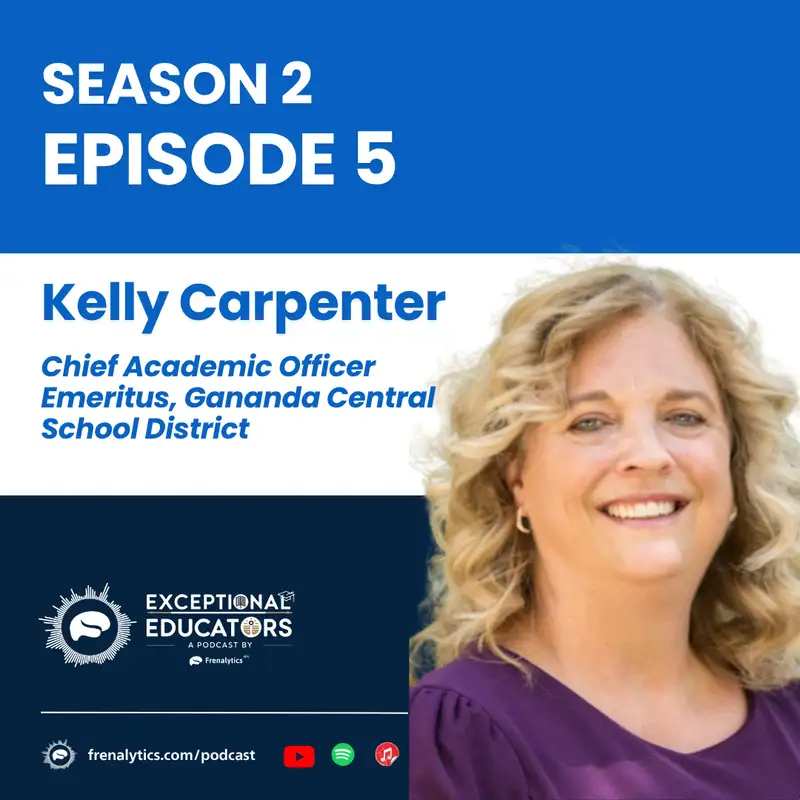
From Plan to Practice: Kelly Carpenter on Building a Personalized Learning District and Embedding MTSS
Welcome to the Exceptional Educators Podcast by Frenalytics edu, where innovation meets inclusion in education. I'm your cohost, Nisha Srinivasa.
Matt Giovanniello:And I'm Matt Giovanella, the CEO and cofounder of Frenalytics. At Frenalytics, we put special education and English language learners front and center. Our award winning Frenalytics EDU platform helps streamline progress monitoring, improve communication and compliance, and offers truly personalized learning to your students' availabilities.
Nisha Srinivasa:Each episode of our podcast features candid conversations with district and school leaders, classroom change makers, ed tech founders, and industry executives, all dedicated to transforming learning for each student, especially our learners with unique abilities. With the focus extraordinary educators and the exceptional students they serve, we explore the latest in special education, accessible technology, and inclusive leadership. In this episode, Exceptional Educators is exceptionally thrilled to welcome Kelly Carpenter. Kelly is a newly retired Chief Academic Officer for the Gananda Central School District, but by no means has stopped her work in education. She is an educator committed to diversity, equity, and inclusion initiatives and has had a tremendous and lasting impact on multiple districts, schools, and classrooms.
Nisha Srinivasa:So Kelly, we are so thrilled to welcome you onto the podcast today. Thank you so much for being here.
Kelly Carpenter:Thank you so much. Thrilled to be on with you guys today.
Nisha Srinivasa:We can't wait to dive in. I know Matt and I both have a lot of questions and curiosities for you. So just to get us started, this is a question you as an educator, I'm sure are very familiar with, but it's one we've been asking all of our guests that have come on the podcast and that is what is your why? So what brought you to the world of education and what continues to keep you here?
Kelly Carpenter:Hasn't changed really in retirement. I am passionate about every student getting what they need throughout their schooling and beyond, I guess. So I started operating on my teddy bears when I was like four and that didn't go well. So I knew right away that probably being a doctor wasn't gonna be my thing. So I started teaching them, and I found that I really was falling in love with helping kids get what they need and was really inspired by both my brother and my father.
Kelly Carpenter:My brother struggled tremendously through school. He didn't quite get what he needed, ended up, going into a trade college, and he's making more money than I did. Very successful. And my father, same thing. He ended up failing like the subject I ended up teaching, but again, turned out to be super successful.
Kelly Carpenter:He fixes everybody's everything everywhere he goes. So he's super successful. Schools just weren't designed for him, and nobody stopped and talked to him and asked him what he needed, and nobody met him where he was. And so that drives what I do and still to this day because education really hasn't changed to meet kids where they are. And we haven't changed what we do and provide appropriate instruction for kids to help them thrive and be the best person they can be and be successful in the world.
Matt Giovanniello:I'm really glad you're bringing those points up, Kelly. And for what it's worth, I can identify a little bit or maybe more than a little bit with your early days. I enrolled my brother into what I dubbed baby school at the right age of six years old. He was, I think a year and a half, maybe two years old. And I was printing out worksheets and teaching him as if I had any sort of qualification whatsoever as a six year old to be teaching my younger brother.
Matt Giovanniello:But into school he went before he even knew what the word school was. And I think that's where an early passion for education was instilled in me by my grandmother who was a teacher, my aunt who's a special ed teacher, and all those who just shaped my world around me. I too very quickly realized that medicine was not for me after also growing up in a family surrounded by medicine. I realized that I had pivot fast. That was just not working out.
Matt Giovanniello:But to your why, meeting students where they're at is so much easier said than done, as you know, and yet it's critically important. Through your time as Chief Academic Officer at Ganada, you led and spent considerable time building what you call yourselves a personalized learning district. So let's unpack that a little bit more. What does it actually mean? What does it look like day to day in the classroom, and then all the way up to the district level outcomes wise to be what you're dubbing a personalized learning district?
Matt Giovanniello:What was the tipping point for coming to this realization that it's necessary for you and your students?
Kelly Carpenter:So we did a strategic plan, I don't know, ten, eleven years ago maybe. And we were interviewing students and our best and brightest actually were telling us that they were just regurgitating information for our tests. And they were forgetting it like five minutes later. Right. So our teachers were like, wait, what do you, what do you mean?
Kelly Carpenter:Like, yeah, duh. Kids aren't remembering this and they, they aren't internalizing what we're teaching them. And we knew that the world they were heading into, it wasn't about facts, right? I mean, we all have these little things in our hands, right? So we can look up facts and we can find information.
Kelly Carpenter:And what we need to be able to do is help kids internalize the problem solving and critical thinking skills that they're gonna need to find actual facts and find the right information. So we knew we had to do business differently and help kids learn in a different way. So that came out of that strategic plan and we found this personalized learning method. And it really involved four different pieces. The first was targeted instruction, and that was really finding out what kids knew.
Kelly Carpenter:So using data, all sorts of formative, informal, formal, summative to find out what kids really know and what they don't know. And then targeting instruction, whether that is in small groups, it might be whole group. Your whole class might not know Pythagorean theorem, right? So you have to do a whole group instruction piece on Pythagorean theorem. Up here in Upstate New York, a lot of kids come to us knowing information about the Erie Canal because their parents have taken them on the Erie Canal walks and the tours on the little boats.
Kelly Carpenter:And so why would you start fresh with those kids on the about the Erie Canal when they already know the basic facts? Right? So you wanna do business a little bit differently and meet the kids where they're coming in. So that's what targeted instruction and data driven instruction are all about. But the other part of it is using flexible path and pacing along with student voice and choice.
Kelly Carpenter:So it doesn't mean that every kid just goes off on their own path. We still have benchmarks. We still have assessments. We still have testing. Right?
Kelly Carpenter:But how flexible can we be in getting them there? Can we let them do their own kind of instructional design to get them to that goal, to get them along that benchmark. And then can we give them some choice? It's kind of back to that old differentiated instruction piece. Can you give them a different mode?
Kelly Carpenter:Can you give them a different method? Can you allow them to do a different product? Right? Not every kid likes taking a test. Can you let them do a project?
Kelly Carpenter:Some kids like looking things up on the computer. Some kids like pulling out a book and reading a book. So can you give them different modes to research? So those are really the four main pieces of personalized instruction. You can't do it all the time.
Kelly Carpenter:It's not a 100%, but what we're finding is there's tech tools. I don't know, maybe like Frontalytics out there that would help teachers and save time to help you with the targeted instruction piece, to help design instruction for you so that you can provide more one on one instructional time with your kids and really get to know your kids. So that's what we like about being a personalized instruction school. As far as at the district level, our goal was to improve instruction, increase our scores, and ultimately help our kids be more successful in the world. Four years in, we hit COVID.
Kelly Carpenter:So it was really hard to measure our results. But what we knew is all of our staff was online with our kids because we had that down. We had that voice and choice. We knew online instruction. We were one to one devices because of personalized learning.
Kelly Carpenter:So we had the method and the format and everything down pat. So our kids and our teachers were ready to go. So, yeah, we slowed gaps and we still hit that roadblock, but our method of instruction matched what we had to do when we all went out for COVID. So that was a big help.
Nisha Srinivasa:I can imagine that implementing this very strategic, specific targeted plan to support students across the school district took a lot of momentum and effort. And I can imagine that one of the potential challenges was around mindset and cultivating the mindset that one needs to be on board with a plan that really involves a lot of really specific supports that I know many educators are finding really challenging to implement on a day to day basis because of so many things that they're experiencing in the classroom. What did you do to prime the folks that you were working with around the culture and mindset that might've been needed to put that plan into place?
Kelly Carpenter:We had a planning team that involved our building principals, some teachers from each of the buildings, and we really thought carefully about that exact issue. How do we create that culture and roll this out carefully? Because we knew it was gonna take a lot. So, our teachers helped us plan the rollout. We did four different cohorts of teachers.
Kelly Carpenter:The first two actually were volunteer cohorts and the second two were more not so voluntary. You know, we had a big signup party and they were the first ones to get their own Chromebooks. And we gave them little prizes and we had themes and it was a fun time. We tried to reduce the intimidation as much as possible. We added instructional coaches designed specifically for personalized learning.
Kelly Carpenter:They supported that instructional technique so that teachers would receive personalized support. We did learning walks so the instructional coaches and myself would walk in and provide positive feedback on what did we see, what did we like. And we allowed the teachers to visit other schools that were trying it along with us. And those schools came to visit us. So there was a lot of support in the region.
Kelly Carpenter:There was a lot of support in our buildings and we just tried to very carefully, slowly roll it out and provide a ton of support. And I did monthly newsletters. Here's what worked. Here's what's not working. Here's what you can do.
Kelly Carpenter:Here's your questions. Here's my answers to those questions. And if I don't know the answer, I went and got it from somebody. And so I would tell the teachers, you know what? I had to reach out to this company and get the answer for it.
Kelly Carpenter:Here's what they said. So I admitted failure, right? Like I admitted when I didn't know the answer because we knew they were taking risks and we had to fail forward. That was actually one of our themes, failing forward. And we called it adjusting our sails and the whole theme was sailboats.
Kelly Carpenter:So we knew we had to adjust our sails as we went. And we were trying not to be the Titanic. That was the goal is to not be the Titanic.
Matt Giovanniello:I think that even in and of itself, Kelly is pretty unique. I think we exist in an industry, education and even ed tech, taking risks isn't necessarily the default or the norm. I'm glad that's changing, but historically that's not the case. It's like, let's repeat what we've been doing. Thinking outcomes are going to get better.
Matt Giovanniello:That's kind of the definition of insanity. Like just repeat thinking that something different is going to happen and it's not going to. So I'm glad we're no longer in scene and that there are like noble leaders such as yourself, especially at Kanando who are willing to take the charge because as we know, not everybody is. I want to unpack some of the specifics to your implementation of personalized learning in this journey that you embarked on. So for the years leading up to COVID, let's go in our time machine to the mid 2010s and think about this need has identified itself.
Matt Giovanniello:You're starting to put together this game plan. What more specifically did that look like? How are you identifying professional development topics, schedules, tools that you're going to try and implement, changes in curriculum, bases within your buildings, etcetera, that you're like, let's try this and see if it works. Then we'll adapt if it doesn't. And for those naysayers who say, ah, Kelly was at a small school.
Matt Giovanniello:She was able to pull this off. I think there's going to be a lot of similarities in what needs to be planned and executed on in a small district versus a medium versus a larger one. And so I'd love to learn a little bit more about what you and Gananda did.
Kelly Carpenter:Yeah. I think it's similar to what we do with many initiatives in schools is we find that group of teachers that's willing to try it first, that, that we know will go out there and try it. And they're excited about it. And we did summer professional development. We had used a company.
Kelly Carpenter:It was kind of a train the trainer situation. So there was a consultant firm that worked with several smaller districts in our region that trained me and the instructional coaches. And then we turned it around and made it our own in district. And I think our teachers respected that too, because we were in it with them trying this and taking that professional development and really kind of making it Gananda ized. Wasn't a canned professional development from some company like you're talking about in a big district or had done San Diego's, you know, schools.
Kelly Carpenter:And so they felt like, okay, these guys know Gananda and they know what might work here and they're designing this for us. So our teachers felt very comfortable with what we were rolling out. And we tackled the mindset issues. We tackled devices. We tried to tackle all the questions that would pop up along the way.
Kelly Carpenter:We didn't get them all, but we tried to tackle them. One of the big things that we knew had to change was the way classrooms and school environments looked. So our classrooms don't look anything the way they did a decade ago. When you walk into our elementary school and middle school and most of the high school, you're going to find hydraulic desks. So kids can either stand up at their desks and work, or they can sit down.
Kelly Carpenter:The kids can sit in chairs and they're on wheels and underneath our baskets for kids to put their stuff on because our kids told us they don't like going to sit in groups and having another kid sitting with their backpack on their chair. It's a simple little thing, but when a kid can put his backpack under his chair and wheel to another group and work, they feel better because their stuff's with them and they didn't leave it at another desk with another kid sitting with their stuff. Silly. Right? But yeah, it was so meaningful for our kids to be able to have their stuff with them as they went around to collaborate with different groups.
Kelly Carpenter:We also have bean bags. We have little, common corners. We have all sorts of different flexible seatings. There, there was an author who came in and we had him do some PD with us around, does thinking about designing your spaces differently as an educator. And we train our kids.
Kelly Carpenter:Try this. Now reflect on it. Did you work better sitting in this seat or did you lose focus sitting in the seat? Don't instantly, as a teacher, yell at that kid for not being focused in that seat. Let them fail in that chair.
Kelly Carpenter:We're gonna find out the hard way sometimes. It's not the right environment for us to work in, or we find out it is, right? If we, as the adult, tell them that's not working, get up and move. The kid goes back to that same exact situation the next day and tries it again because they didn't learn and they didn't reflect. So a big piece of this is letting kids figure out what works for them and what doesn't work for them.
Kelly Carpenter:So there was so many pieces of this that we had to think about and we had to teach our teachers about. So whether you were in that initial cohort or not, everybody got professional development on designing educational spaces. Everybody got professional development on instructional technology, right? So we were laying those foundations on all those pieces. We started laying all that framework on MTSS because you also can't do this work without the multi tier systems of success, right?
Kelly Carpenter:You have to start identifying the kids. What tiers of support do they need? So really personalized learning looks at who needs the tier one instruction, who needs the tier two, and who needs the tier three. So we had to start using that language with all of our staff. So there was probably four or five different things we need to start rolling out on a tier one level with all of our staff, regardless of whether they were the ones receiving that personalized learning professional development.
Nisha Srinivasa:That is incredible. And to me, it actually sounds like the way that you've approached this professional development with teachers is similar to the way that you're encouraging teachers to design experiences for students in laying different foundations, addressing common issues, needs, and supporting the sort of foundational pieces that they might need to be able to take that risk in venturing forward with all these components of the strategic plan. And so is that something that you talked about when you were thinking about how to present this information to the staff? Is that the kind of framework that you approached and adapted to your own planning, the MTSS framework?
Kelly Carpenter:So this consultant firm really changed the way I saw professional development. They they taught us. I had so much fun sitting in there. I didn't even realize I was learning. Right.
Kelly Carpenter:And that's the way I wanted my kids to sit in a classroom forever from that point forward and my teachers, my instructional coaches and everyone who worked with me, we never did professional development the same again. So my teachers always had choice. Now that doesn't mean there weren't some mandated trainings and things they had to do, but the language we use as a district for both adults and students is must dos and can dos. So on every single staff development day, there were must dos that teachers had to attend. And then there were choice sessions, which were can dos.
Kelly Carpenter:Again, every teacher would have a must do of maybe designing educational spaces. And we kind of thought those strands through over the years, like what are those must dos that every teacher has to have to lay this foundational groundwork that they're going to need to have? So that was very intentional, very thoughtful. And we redesigned professional development forever in Gananda so that they're sitting in looking at a professional development day the way they should be designing instruction for their kids.
Matt Giovanniello:That's awesome to hear. And the fact that you are talking about PD with a smile is so rare as we all know. And the fact that you get this feedback from teachers, knowing that it's effective for them too, is such a huge win all around. Makes them actually want to show up and engage and in turn open engage with their students, which is just fantastic to hear.
Kelly Carpenter:Two years ago to actually add a genius hour because they're like, okay, enough of these can do's. You keep telling us to teach these kids genius hours. Can you create one for us so we can see what it's like? All right. Challenge accepted.
Matt Giovanniello:Literally somebody's asking for more PD. That's fascinating. Awesome. Awesome. Awesome.
Matt Giovanniello:Oh, I love it. I love it. Kelly, in relation to the feedback loop that we were just speaking about, what did you institute or put in place to measure the effectiveness of this new era of PDEKA Nada? How did you know it was so successful and so well received by your teachers?
Kelly Carpenter:We tried to do five to six learning walks a year. Some were choice and some were, I just scheduled them in. And the instructional coaches and myself would had a rubric and we would walk into the classrooms and we were looking for certain things. We were in there five to ten minutes maximum. And we were talking to the kids when we were in there.
Kelly Carpenter:We would then go out in the hall. We would convene. We would go through the rubric. And then every single teacher within twenty four hours would receive an individual feedback form. We really loved the way we saw these elements.
Kelly Carpenter:Then we would compile that feedback and we would have actual scores of, let's say, targeted instruction. We would know if it's improved over the years and we had charts and graphs and we could see where we saw improvement. The one area we continued to struggle with was actually student reflection. For some reason, we saw student reflection drop off after COVID. So that was a unique piece that we were continuing to work on as I was retiring.
Kelly Carpenter:And we don't know why that was happening. So we were trying to figure out how to beef up the amount of student reflection or change teacher mindset around it. But yes, we, we had a feedback loop that involved us physically going into classrooms and collecting data.
Matt Giovanniello:That's really interesting, including the fact that student reflection dropped off a little bit, but that could be a whole suite or a whole host of reasons. So I think digging into that will be really interesting. It doesn't seem like there's any obvious or immediate tell, and there could be these larger macro level changes and SEL related pieces that maybe are buttoning students up and not allowing them to go through that reflection exercise. But the fact that you even know that there's a drop off, you're more than halfway there versus not knowing that there's an attrition or a dip in rates somewhere else across the board. The fact that you're measuring those pieces, you're well on your way to being able to fix them.
Matt Giovanniello:Speaking of, and going back to a topic we were speaking about before, Kelly, of MTSS, you saw me light up. There's so many parallels between personalized learning and MTSS. Talk us through your thought process and the district's thought process a little bit of how personalized learning was getting embraced and implemented across the district at a time where you were also transitioning the philosophy, the shared language, and the implementation of tiered instructions through MTSS. Where did they commingle? Where do they intentionally separate?
Matt Giovanniello:And how did you think about implementing MTSS to support our unique learners who need that more targeted instruction?
Kelly Carpenter:The connection for us was that targeted instruction and data driven piece. When you find out what a kid needs, you should be providing them the appropriate intervention, right? So it was a matter of taking the work we're already doing with personalized learning and showing where it can fit in a more dynamic piece in MTSS. Every day you're providing interventions for kids. Not all of it fits in MTSS or goes into the model properly to be recorded.
Kelly Carpenter:We also started with PBIS. So again, that scaffolding, how do we make MTSS work in our school? We started with PBIS, and that positive behavioral intervention supports. So that something like the proud bucks, because we were gonna end up proud, they fit into looking at student reflection, right? When you reflect you're earning a proud buck or whatever.
Kelly Carpenter:So we kind of made that fit first. Some of the teachers got there right away and they were like, oh, this is a no brainer. It fits personalized learning. It fits what we're doing. Some of the teachers are still not there to be honest with you.
Kelly Carpenter:They see it MTSS as a whole different thing that personalized learning didn't work for everybody that way. I would say two thirds to three quarters of our teachers see how that fits nicely together and that you can't really do targeted instruction without providing appropriate interventions at the tier two to tier three level. So we've got some that still believe you can teach every kid the same way, and that every kid's going to go into college and they don't understand that the world they walked into is not the same world that these kids are going to walk into now. So it's really important that we try to expose our teachers to the world that exists now for kids. I don't know why they can't see it with AI and everything that's going on.
Nisha Srinivasa:Yeah. I know that that myself in my own role, that that is a challenge that I experience and face as well. Figuring out and how to sustain a sort of vision for supporting students with personalized learning initiatives, it can be really challenging because mindsets develop and for many different reasons and can be sort of fixed or cemented depending on, you know, folks, because every time. I also appreciate the fact that you're acknowledging the ways in which even an effort that is so strong and powerful and had such a positive impact has also not necessarily been ubiquitously adopted. And that's just the reality of a really big project such as the one that you've implemented.
Nisha Srinivasa:It seems like you are somebody who is so committed to the vision that you've set out, even though it takes, as you mentioned, it takes a really long time for a lot of these efforts to actually be implemented and come into place. What do you do to keep that vision sustained?
Kelly Carpenter:That's a good question. Some of it's almost accidental. When I was at ASU GSV, I went on a tour, one of the innovative school tours, and I walked in and I saw exactly what we were doing in our schools. And I went, okay, we're doing what ASU GSV says is innovative, right? And sending us on these tours to see.
Kelly Carpenter:So that was incredibly motivating. And I came back and I highlighted that with my entire staff. I said, I went to this really expensive, really amazing conference. And here's what I saw. And I showed them pictures of student reflection pieces that my, my school does.
Kelly Carpenter:And I, and I talked to them about exactly what we already do. And I said, this is great stuff we're doing. So let's continue to do it because it's highlighted as innovative practices in this country. So it was celebrating. It's taking the moments to celebrate what we're doing and we don't do that enough in education.
Kelly Carpenter:We're always pushing to go further and faster because there's still kids falling behind, which I, I get. But those moments where you see that the things you were doing are innovative and are really, really neat things. And then going into classrooms, those are the moments when I see the things actually happening. And I talk to kids and they're like, it was so cool when I did blah, blah, blah, blah, blah in the classroom. This is the great stuff.
Kelly Carpenter:This is the good work we're doing. Those are those are the moments where it fills my cup in this field and it keeps me motivated and I'm able to get on a podcast like this and hopefully excite others. Like I would walk into any school anywhere and help people roll out personalized learning. I'm so passionate about it because I saw the look in my kids' eyes and I saw the look in parents' eyes when they saw how excited their kids were. And I saw my teachers when, when a great lesson happened, I saw how excited they were.
Kelly Carpenter:So I know it works and I know it's innovative. It's been cited in, in practices all over the country. And that's what motivates me. It's not about test scores necessarily, right? It's the intersection of test scores, social, emotional learning, and flat out excitement about learning in school.
Kelly Carpenter:And that's hard to measure. So you have to get into schools. You have to talk to kids and you have to, you have to really understand. Every day I got to hear and see and just feel the excitement of what was going on when the announcements would go on and they won their proud buck goal. I could hear the cheers erupt across the building.
Kelly Carpenter:Those are the moments where, where you stay motivated in the work you're doing, even though a teacher complained to you the day before about a professional development you had given. So that's what sustained me the whole time.
Matt Giovanniello:It totally does. It really does. You've been speaking of a couple of wins that fill your cup and fuel not only you, but also all your staff when the going gets tough. Just over the past couple of years, Gananda raised their graduation rates nearly 20 percentage points. You're ranked number 19 best high school in the Rochester Metro Area, and you are a top STEM school for the state of New York.
Matt Giovanniello:So I imagine your investments into personalized learning and MDSS have in part helped the second order effects reach all time highs. Else has the district been able to achieve or reflect on as a result of these investments? And what else is to thank and to credit for your all time graduation rates, top rankings, and other accolades that we can continue to brag you about? What else are you doing right now?
Kelly Carpenter:The graduation rate actually goes back. I was hired as high school principal to raise the graduation rate. It was at seventy two percent when I was hired nineteen years ago. So my goal given from the board of education was to raise it to ninety five percent. And I, with the help of my staff, we did that in five years.
Kelly Carpenter:So we worked together, the high school staff. It was really about exposing the data as it was and really taking a look at data. So I'm very proud of the work the entire district does around looking at data. We just bought new curriculum and a new benchmark assessment tool because we looked at data. What did it tell us?
Kelly Carpenter:We needed to scaffold our curriculum differently. Our teachers look at it at the micro individual kid level. They look at it at their class level. The building principals look at their buildings. I look at it as a district.
Kelly Carpenter:So we're constantly looking at what does the data tell us. As a high school, we took a look at what were some of the blocks that were preventing kids from graduating. And then we also looked at what would be positives to help kids get over that hump and help them stay in school. So we added three project lead the way programs that are still kicking today. So that's part of what you're seeing now is some of the work we had put in place way back then to get that graduation rate up.
Kelly Carpenter:That's a wonderful success that we have. We constantly look at all sorts of subgroup data to make sure that we have equity in our district provided, geez, probably nine years ago, we started providing all kids school supplies. So no one had to buy any in our district. We gave every kid one to one device. So those TI-83s that are a 100 something bucks a pop, we provide every kid one of those to sign out for the year.
Kelly Carpenter:They don't have to buy them. We only have a 30% free and reduced lunch rate. It didn't matter to us. We knew most of our kids could afford them, but we have 30% that probably can't. And we need to make sure that that 30% doesn't feel like they can't afford it.
Kelly Carpenter:We now have a clothing closet for all kids. We have probably 120 different families that participate in our backpack program for lunch over holiday breaks. Our, our rotary provides two weeks worth of food for over the holiday breaks to a lot of families. So that was really important for us. So we're proud of the work we've done because data is a story.
Kelly Carpenter:It's not just numbers on a paper.
Matt Giovanniello:Those are such cool examples and incredibly impactful ones of how you can use the data you're already sitting on to analyze and to better meet the needs of your students, whatever their needs may be anticipated to be or not yet are, but you just want to make sure they feel included nonetheless. I have a little bit of a curveball question for you. Because we're both located in New York, you are very well attuned, especially because maybe on paper retired, sure, but not actually retired. I know you're very familiar with the ever changing requirements under New York state's Portrait of a Graduate and the changes in graduation requirements for students, not only in high school, but in their formative years leading up to it. What do you think the merits are?
Matt Giovanniello:What changes do you think might still need to be made? And how, going back to our earlier conversations, do you see these changes better supporting the diverse needs of your students from a more prescriptive graduation set of requirements under Regents to this more flexible environment where they can show their strengths as a means of graduating.
Kelly Carpenter:I'll tell you what the portrait of a graduate almost made me reconsider retirement almost. Is some really great stuff while it's now the New York inspires plan, but I really like what they're doing. If they follow through with everything on the plan, which it looks like so far they are, they will be eliminating Regent's requirements as far as the exam being required for graduation. Now the exams will still exist, so kids can use the exam if they feel like it. I would've like for math, I probably would've just taken the test.
Kelly Carpenter:I don't know what project I would've done for math, but for my social studies courses, I would not have taken the tests. I would've done something very differently. For personalized learning, it is the perfect fit. So they're going to be producing rubrics that will provide some definition for each of the character components in the actual portrait of a graduate wheel. So we'll get some more definition with each of the categories.
Kelly Carpenter:Then schools will need to figure out how they will provide options for kids to complete each part of the rubric to fulfill all that to graduate. So personalized learning, that is your flexible path and pace. Like for a change, they're not going to have to jump through those hoops of having a benchmark at the end of the year. Biggest concern for small schools is will we have the resources to make that happen? If a kid wants to take dance, for example, we don't have any dance courses.
Kelly Carpenter:So I don't know how they'll get through some of those pieces doing dance. The kids will be able to design the elements. Now that being said, we should have a heads up and be way ahead of the game because we have been teaching our kids how to reflect and how to know their strengths and weaknesses as educators along the way. They will know what they're good at and what they're not good at. So hopefully they'll choose the path that fits them the best.
Kelly Carpenter:That will involve a lot of work on all schools if they haven't been doing that work.
Matt Giovanniello:I think that's the key piece. There's so much promise coming out of the highlights of the new version of Portrait of New York Inspires that I think is really intriguing and attractive to districts who have already implemented this MTSS and personalized learning piece with Fidelity. Otherwise, I think it might hit you like a tidal wave if you're a district that is brand new to this, because first and foremost, your latitude for all of these graduation pathways has just unfolded. There used to be a very prescriptive path with alternative graduation requirements, as you very well know. Then now there's all these other options.
Matt Giovanniello:But if you haven't been working towards those, somewhat in anticipation and somewhat to give students choice over the course of a school year before that drop dead date of the readings exam, going from one extreme to the other might be very overwhelming. I do think and hope and agree that some of the specifics around these rubrics and the way to actually execute and implement these more flexible athletes does get the proper spotlight that it needs so districts know exactly what they are able to do, what's not permissible, what is still up in the air versus just a broad stroke of this is more moving towards without a way to actually implement it fidelity. So, I appreciate your perspective on that. Think it's really interesting one.
Kelly Carpenter:I don't want them to be so prescriptive that a school can't do what they want, but I also want them to be prescriptive enough that a school can't skip over it and continue to do what they're doing and still make it fit into what they're already doing.
Matt Giovanniello:Right. For all intents and purposes, this is brand new. We need to be not only eyes wide open and receptive to it, but actually be able to take it on ourselves in order to best serve our students in this new wave of, at least in New York state and hopefully in other states in years to come as they follow suit, embracing new graduation options that are reflective of our students in the twenty first century. As we wrap up, I have one more question for you that we ask all of our guests. If you want to take a moment to reflect on it, as you do require your students to do right now, please be my guest and do so.
Matt Giovanniello:My question to you, Kelly, is what does being an exceptional educator mean to you?
Kelly Carpenter:I think being an exceptional educator means meeting each kid where they are, helping them to become the best version of themselves.
Matt Giovanniello:Love that. I love that. It's so simple. It's so to the point. I like that you took pause in answering that.
Matt Giovanniello:Ironically, but also very unironically, that is everything that you just described in this interview of the administrators and the staff at Gananda in service of your students, and that's what you embody also, Kelly. For your decades of service, we thank you. You are an exceptional leader. You have been an exceptional educator. You now lead exceptional educators, and those students up north don't know how lucky they have it.
Matt Giovanniello:And they better be sending it down to the South End Of New York because we can appreciate it just as much if not more here down state.
Nisha Srinivasa:Kelly, thank you so much for being here today. I was so thrilled, to be able to have this conversation with you and Matt. It is incredible, the amount of work that you have done to support teachers, schools, and students. It's so clear to me that you're really centering their experiences and their lives in the design of all the work that you're doing, and I was really inspired listening to you today. Thank you so much.
Matt Giovanniello:Kelly, thank you for joining us today. It was such a pleasure having this conversation with you. I learned a ton, Misha. I know you did as well. To all of those listening to today's episode, thank you, and we will catch you on the next episode of Exceptional Educators.
Kelly Carpenter:I'm Kelly Carpenter, the Chief Academic emeritus of the Ganada Central School District, and I believe in the power of exceptional educators.