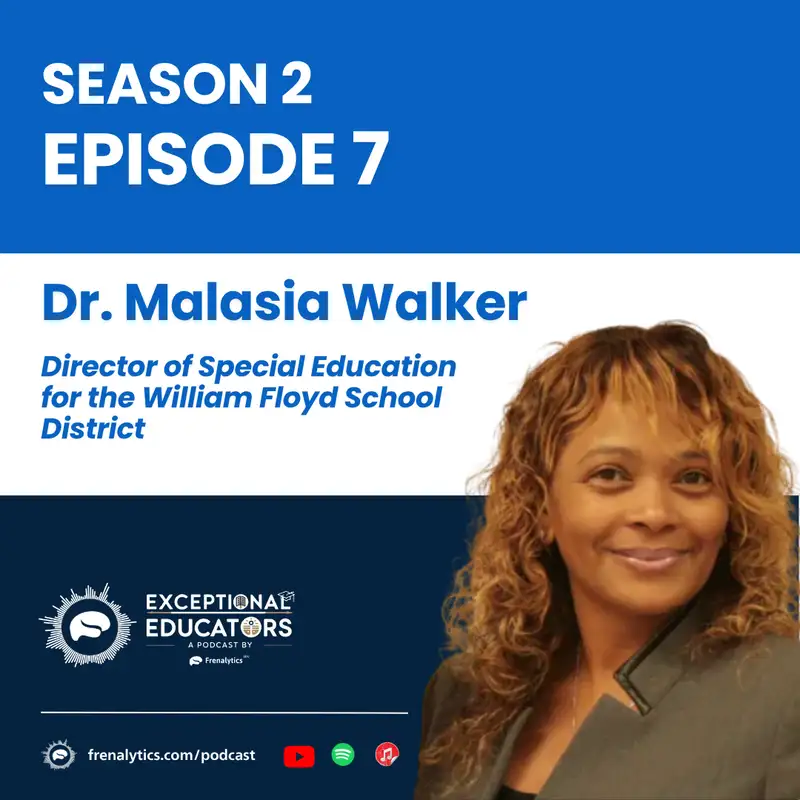
From Struggle to Strength: Dr. Malasia Walker on Transforming Student Outcomes Within and Beyond Special Education
Welcome to the Exceptional Educators podcast by Frentalytics edu, where innovation meets inclusion in education. I'm your co host Antonia.
Matt Giovanniello:And I am Matt Giovanello, the CEO and co founder of Frentalytics. At FRONalytics, we put special education and English language learners front and center. Our award winning FRONalytics EDU platform helps streamline progress monitoring, improve communication and compliance, and offers truly personalized learning to your students of all abilities.
Antonayah Ellis:Each episode of our podcast features candid conversations with district and school leaders, classroom changemakers, edtech founders, and industry executives, all dedicated to transforming learning for each student, especially our learners with unique abilities. With a focus on extraordinary educators and the exceptional students they serve, we explore the latest in special education, accessible technology, and inclusive leadership. In this episode, Exceptional Educators is exceptionally thrilled to welcome Doctor. Malaysia Walker.
Matt Giovanniello:Doctor. Walker, thank you for joining us this morning. Doctor Walker is the director of special education at the William Floyd School District, one of the largest school districts on Long Island, New York. With over fourteen years in the district, Malaysia has focused on building strong relationships with families and removing those barriers that have resulted in record high graduation rates. We're very excited to get to that today.
Matt Giovanniello:Thank you for joining us, doctor Walker.
Malasia Walker:Thank you for having me.
Matt Giovanniello:Awesome. Doctor Walker, we love to start every episode with a question that we ask all of our guests. That question for you is, what is your why? What brought you into this world of education? What's keeping you here, and what is motivating you to serve our students with unique learning needs?
Malasia Walker:My why is I had a horrible school experience. I wasn't connected to any adults in the building, and I was actually told to drop out of school and just go get my GED at the time. And I probably would have done it if I wasn't scared of my grandmother who was raising me. I just before I gave up, there was one guidance counselor. I wish I knew where she was right now who decided that if I worked hard, she would work hard with me and I would graduate.
Malasia Walker:So for some reason, I was able to graduate on time by going to night school, summer night school, and everything else. Based on that experience, I realized that, you know, we do have education. We have instruction. We have the classroom, but there's also connections because there's a lot of things going on at home. So my why is just making sure that all kids have the opportunity to belong to something.
Malasia Walker:My why is making sure that we provide instruction for everyone. And my why is just to make sure that all children are successful based on their ability and to never give up on them because that one lady never gave up on me. So that's important.
Matt Giovanniello:I love that. And I cannot believe that you got any advice at any point in your professional and academic career to just give up. Like, that that doesn't feel like an answer, and I'm glad that you're not accepting that as an answer for any of your students either, especially students in special education where that tends to be traditionally and historically an easy cop out or an easy answer. Yeah. Just before the start of recording this, we were talking about how William Floyd's graduation rate, especially among students in special education, is at an all time high.
Matt Giovanniello:This past twenty four, '20 five school year alone, over 80 of your students enrolled in special education graduated within four years. What's your secret? How is that happening? How are you getting your staff to also embody this culture of never give up and pushing their pushing your students to achieve the absolute best that they can?
Malasia Walker:So what I will say is it didn't start overnight. We started actually in 2012, 2013, dropping some of the Regis classes in the middle school. Everyone thought it was absolutely insane, especially when you talk about fifteen-one-fifteen-one-one classes. All we heard was the students can't do it. The students can't do it.
Malasia Walker:But I knew that if the kids could do it, they would do it anywhere where they were actually engaged with their teachers. So what we did is we started preparing them for the regions and give them the opportunity to get two credits within the middle school. So there's two credits that they didn't have to attack in the high school. If they were unsuccessful, we didn't hold it against them. What we did is put them in pure classes at the ninth in the ninth grade, where they're still with their peers who just needed more supports, not with repeaters.
Malasia Walker:Anything other than that, we also started looking at kids individually and to figure out what exactly was going on in eleventh grade. Why do kids have nine credits? Why did they have? Why were they constantly not showing up for the regions? And what we did is I gathered a group of teachers, which I call my dream team, and we just started attacking those students and we started making sure they got credit.
Malasia Walker:We started dragging them to credit recovery. We realized nothing at the school would work and nothing on the weekend would work. Why would it that it's not working during the day? So what we started doing is offering sometimes even home instruction. And pairing them with teachers that they had a relationship with.
Malasia Walker:And sometimes the teacher just worked on all subjects with them and then once they felt comfortable and confident, started working forward. I believe in bribing children. I come to work every day because I get paid every two weeks and I enjoy it right. So what we do is we mentor the children. I meet with kids that no one else can reach and I just tell them, listen, if you do this every two weeks we have lunch, your choice, this is what we do.
Malasia Walker:Sometimes they want gift cards. You do this, come to school, Just be engaged because it's little things that's keeping them from from coming to school and something that's so simple to us is so big to them. We just really, like I said, started looking at the in the curriculum instruction. We had to put reading programs in the high school. Our babies were not able to read and our high school teachers are not reading teachers, right?
Malasia Walker:So what we had to do is give everybody support. So we gave the children support. We gave the teacher support and now the kids are saying, Okay, I know I can't read at this level, but I have the support to let me take it and the teachers that do it really do love care and support for the children. So it's definitely a team effort and it's definitely years in the making, but I think when I first started it was around thirty four percent graduation rate, if not thirty seven. And I remember the state just every time they came, frowning at me.
Malasia Walker:And we all decided as a group, would get our kids across the finish line and we will drag them.
Antonayah Ellis:I'm really just clinging to the fact that you were pretty much raised by your grandma. And I was too at a point in my life, just regular issues I feel that parents go through, especially mine being young and growing up in Boston, Mass and all the challenges. But I really want to just see what do you feel like parent involvement, how does that affect the students that you've seen even while you were a teacher versus, you know, how you are in the district level now? What does parent involvement mean to you? How does that impact students?
Malasia Walker:So it can mean everything and it can mean nothing. And I think that goes back to what she said. It's like, so my grandmother raised me. She didn't know how to be engaged in a school, involved in a school. That didn't mean she didn't love and care for me.
Malasia Walker:So what I think that I meet parents where they are. I want them to be an integral part of their baby's education. But if they can't, for whatever reason, because they're working, because they don't have time, because sometimes they think they don't have the capacity, because school can sometimes be intimidating. I just take parents for what they what they bring. I do believe in my heart wholeheartedly.
Malasia Walker:Every parent wants their kid to be successful, and sometimes parents just trust us to just get the job done. So I take that as a blessing as well. If you trust me to be make sure your baby is successful, that's my job. So we do have parent training. We actually meet with parents as much as we can.
Malasia Walker:I think that if parents don't understand, especially in special education, it can hurt because sometimes they will reject services or they will say they don't need the services or because they don't understand the services. So I think that's where education and instruction comes in for parents and explaining it very basic terms. So this is what it is. This is how it helps, and this is how a baby could be successful.
Matt Giovanniello:That's a really refreshing take, Malisha, because I think for many, special education is often either misunderstood or a black box or too overwhelming for staff, let alone families to really get their get a solid grip on, and some just give up as a result. And so to know that you're leading the charge at William Floyd along with a mandate for all of your staff to make sure that families have well understood equitable access to IEPs and all the information within it is, like, a critical stepping stone for families to then be more involved and to be a partner in this work instead of coming to an annual IEP meeting and perhaps bringing a little bit of a fight to it or whatever that might look like for some districts who aren't as successful in those efforts to make sure that parents understand the nature and the gravity of the services that their child needs in order to be successful. From your position now as director of special education, what would you say is the most maybe misunderstood piece of special education as a program? Maybe a bit of a hot take.
Malasia Walker:I think the most misunderstood thing is parents think the the parents who are not happy with us think that we don't want to do things for their children, right? So they think we don't want to spend the money or we don't want to do that thing. And, I think that's not necessarily true. It's trying to explain to parents that sometimes your kid doesn't need 75 services to be successful. And actually 75 services might hinder progress because you're missing out on classroom instruction or things like that.
Malasia Walker:So we have some of our parents who are more well read or things like that. They come and they already have their list of things they want. And we're saying, okay, that's not the best action plan for this particular student. So sometimes that becomes combative because, you know, as a parent, you always think you know what's best for your child. And as a bunch of educators, we're saying, okay, let's try these steps first.
Malasia Walker:So sometimes it comes down to fights over, you know, what's the most appropriate route. Misunderstandings happen when we don't explain language and parents sometimes don't understand what we're saying because we haven't put it out black and white. Think just trying to explain sometimes the no's to families, like, you know, because they sometimes they don't believe you have their best interest in mind. So that's it.
Antonayah Ellis:I just kind of wanted to piggyback on that. I taught for five years, and now I'm not since I have become a military And it is such a different perspective just being parent. Before I was playing very much teacher and parent working in the school, and it is a challenge, I can attest, for those parents to just be a parent and trust the teachers. Even my neighbors, they know I used to be a teacher. They'll come and ask me, oh, my daughter's struggling in this.
Antonayah Ellis:I feel the teacher or the person who was supposed to be giving her accommodations or him accommodations is not best supporting. What, what is my perspective on it? And honestly, I'll give them a piece of my thinking, but I'll always tell them, trust what the teacher is doing. Trust what's going on in the classroom. I have to tell myself the same thing.
Antonayah Ellis:I have to trust the teacher. And whenever my kid comes home, all I can do is my best at home and trust that they will go to school and have these same practices, morals, principles that I'm instilling in them at home. And just to kind of piggyback off of that, earlier you mentioned the reading and how some students need extra supports for those readings. What are some supports that you feel are actually helpful for literacy development for special ed students?
Malasia Walker:So we're going back to the basics. So right now, I would say once you leave elementary school, we would, guess society says you're supposed to be reading fluently, right? And you're supposed to know all your letter sounds. You're supposed to know how to put it together. You're supposed to be understanding reading comprehension and making meaning of the world through reading.
Malasia Walker:We know that that's not necessarily the truth. So what we do do is and like I said in our middle schools, have specialized reading programs. We we still use. We use read 180. We use Wilson.
Malasia Walker:We have a consultant firm that comes in and does specialized reading. We have a consultant firm that has come in and has taught our teachers how to do specialized reading programs in their school. We do small group reading with our babies, which is a group size of bag, which we bring them in and work with them for forty two minutes at a time in the middle school and also in the high school. What we're doing is we're figuring out what skills that they did not receive in elementary school, and we're giving them the school skills in middle and high school. We're also seeing if at if at the time we they have enough skills to give them skills to compensate for, Because it becomes a time in life where, okay, if you cannot get these certain letter sounds, right?
Malasia Walker:If you cannot, these sight words are not working for you, what can we do? What can we do to make you understand this in context? So that's part of special ed as well, just scaffolding instruction and saying, okay, we've done this long enough and the baby may never learn this part, but we could get them to learn that part.
Matt Giovanniello:I love that you phrase it and frame it as going back to the basics, but yet also acknowledging that there's been a lot of advancements in curriculum and instruction, but also in PD and technology over the years too. Because I think what was working maybe twenty five, thirty years ago, there's elements of it that they'll still really have merit that you're continuing to use at the district, but also with a twenty first century approach that you're not stuck in a a merely paper based world, which is really refreshing to hear as well.
Malasia Walker:And our babies could use technology to do so many things. Like if you if you when you use Google Docs, once you start formulating a thought, that it it almost finishes the sentence for you. So why would I keep my children, right? So I'm not gonna keep them writing sentences forever. I'm gonna teach them how to use the technology.
Malasia Walker:And we actually put some new classes in high school, are technology based programs, but it's pure comprehension and just having them this year learning how to use the technology to finish the supports they need.
Matt Giovanniello:I love it. Let's get into that a little bit more. So changes in curriculum, changes in professional development, and now changes in technology. What have been some recent adoptions, pilots, other pieces of technology that the district's taken on within special education that you found to work particularly well?
Malasia Walker:Well, the virtual platform in and of itself has done light years with connecting our families to the office, bringing them inside. I think one, they feel more comfortable participating and two, they can participate at their leisure and when the time avails versus trying to take the whole day off of work. We're exposing our children to the same thing, so most of our kids in special education have access to Chromebooks, like, you know, the technology. We put them in a Canvas platform. We have them do Google Docs.
Malasia Walker:We have them doing Google Sheets. We have them doing everything that they can to respond. The kids like the interaction, plus it's good for engagement, right? So yes, pen and paper is necessary in some forms, but we have really crossed that platform. And a lot of the curriculum that we use is computer based curriculum as well.
Malasia Walker:So we do have a few textbooks around, but that's not really the world in which we live in anymore. So even when we go to science classes, we've made our our science based instruct curriculum primarily hand on. I will say it's up to the ability level of the teacher, but most of our special ed teachers have fully embraced that platform.
Matt Giovanniello:That's wonderful to hear. Incredibly important. And you're meeting your students where they are. The fact that they're playing Minecraft, the fact that the fact that they're on Xbox, like, nine hours a day more than even in school, that's their way of communicating. And if you can meet them where they are in school, they'll be that much more receptive to it.
Matt Giovanniello:On a related note about technology, let's shift gears a little bit and think about what your educators are now empowered to do. Students have have access to technology, including at William Floyd, in a way that we haven't seen in decades prior, but so do teachers. What access to technology do teachers have that you found to work particularly well in delivering special education services, but also just making teachers' lives maybe a little bit easier and reducing burnout just a maybe a smidge?
Malasia Walker:So I am an advocate for AI because I think it actually supports teachers with differentiating instruction, creating lessons. So as long as you have the idea, they'll have they'll it'll allow you to bring that to students in various ways. So what we have done is given teachers the the go ahead, do it, use it, use the system. The system only works as good as the information you give it. So we've been using that.
Malasia Walker:A lot of our teachers like to do the flip classrooms. So they like to pre teach, which is very important for our children. Pre teach is also helped a lot with students who are absent often because we have a lot of absent students with the materials that therefore such teachers are posting materials. It's on the platform. Some of our kids actually won't come to school, but they will do the work electronically.
Malasia Walker:Some of our teachers record their lessons when they're teaching or record a part of the lesson so that that is there or the most pertinent information is there for the children or the child to review at any time. Far as computers all about children, teachers want them in the classroom. Some of them are experts and some of them are learning, but all of them know that this is the way of the future, so they're really getting involved in that and involved in the delivery of instruction using that computer base when necessary. Because sometimes the kids do have to go back to the formal just to get a skill and idea down. Our teachers do have the ability to do that and they're knowledgeable of how to.
Malasia Walker:So we embrace it all because, you know, with special education, you can't just say I'm going to give you technology every day because that's not successful either. So we go from technology to paper to markers to crayons or whatever it is, whatever it is for them to be successful and the format of delivery that's most successful to that for that child.
Matt Giovanniello:You've got it all down. And the fact that your key point at the very end of differentiating to the needs of the student and being responsive to what works best for them, the fact that that component is there too is really important. We can't, as you know, doctor Walker, one eighty from doing pen and paper only to technology only because that won't meet the needs of every student, especially when we have really varied and unique learners. So it's great to hear that you're doing that there at your district as well. Antonia, you wanna jump in?
Antonayah Ellis:Yeah. I was just curious about like your more tenured teachers. What kind of feelings do they have about the new technology? Do you guys have like a mentor program for newer, more innovative teachers working with your more tenured teachers? What advice would you give to tenured teachers who are overwhelmed by technology?
Malasia Walker:So, you know what, it's funny because you think like the more tenured senior teachers wouldn't want to be engaged, Right? But what I realized is just no one wants to be left behind unless they are burned out. Right? So I think that when people see new things and they realize it's a benefit for you, they do get engaged. So some of my more tenured teachers who I wouldn't even think would benefit from or actually use it as a benefit has, they have.
Malasia Walker:And actually, I had a few classroom teachers who transferred into reading the reading positions because they wanted to use more of the technology, which I was completely shocked about. So I think it's just people's ability level. So when they get exposed, and I think it's also letting people know you don't have to be perfect the first time you engage in such a platform. It's okay to let the kids teach you. You know?
Malasia Walker:I I I don't ever consider myself the smartest person in the room, so I tell them that. It's fine. Because the kids will figure out how to work the board. They will figure out how to turn on the computer. They will figure out all of those things that you struggle through.
Malasia Walker:And as time go on, you'll be more comfortable.
Matt Giovanniello:Bet a lot of those students love being the teachers for fifteen minutes or a day or whatever it ends up being.
Malasia Walker:A 100%. And in the high school, they actually have a a switch with the teacher day. So like you said, those those teachers just sit down for once and just let those teachers let the students take over and and teach you something.
Matt Giovanniello:Well, that is so cute. I love that. Is that across all of the grades in the high school? How does that program work?
Malasia Walker:It's once a year, and it is across all the grades. They are allowed to pick whoever they want to be, and, they swap.
Matt Giovanniello:That is so, so, so cool. Sorry, Anthony, I think you were talking again. Are you on mute? Did you want to jump in?
Antonayah Ellis:No, I was just saying to myself that that's so cool. It reminds me of like the social media challenges whenever teachers and students will dress up as each other, they'll have those switch days to dress up as each other. I feel like this takes it to another level of literally switching roles, going beyond just those spirit week days and making it, you know, even more interactive. I love that.
Matt Giovanniello:Let's get back to a prior discussion point that we were just having around PD, around empowering teachers, especially those who feel burnt out. There are a million reasons why teacher burnout is at an all time high. Technology is in part showing up to try and be an answer to that, but for teachers who are too burnt out that they're shielded off for it, then there's a little bit of a lost cause there. But as you were describing, the fact that there's appetite and interest at William Floyd by your teachers to embrace new technology, even if it's a little bit uncertain, is really promising. You know, everything from our favorite topic in special education, progress monitoring, maybe our second favorite topic in in special education, IEP goal writing, and everything in between, technology and especially AI is showing up with a promise of trying to reduce and save time on those processes.
Matt Giovanniello:But the the sad irony, doctor Walker, as I'm sure you're putting together is, if teachers don't wanna embrace it, then we're back to our existing ways, and they're continuing to get burned out. So how do we how do we kinda cross that chasm? What do we do about that?
Malasia Walker:So for the last two years, we've been going to professional development as administrators, and we've been bringing back different programs as pilots. So what I do know is we cannot tell the teachers to do any another initiative without them throwing something at us, right? Because every year is something new, is something that even comes out from the state. It's supposed to happen this year. It doesn't happen for five years.
Malasia Walker:So what what we've been doing is bringing back, let's say, go writing pilots. This is a program that will do it for you. You feed it this information. It'll give you this information, but they still have to talk to the program, give them give it some stuff and come back. We've So been doing pilots in that respect so the teachers feel like they have an option to buy in and then.
Malasia Walker:Successful, we continue it. We've had some that are successful that we continued, some that was more work than they wanted, then we discontinue it. So with that, we try to give them a voice. We have two pilots also going on this year with some new, is that IEP writing programs, progress monitoring programs. And the beauty of it is we just do it within special education.
Malasia Walker:So we send out emails. We say, do you wanna try? We bring them to the sales pitch is what I call it. We bring them to the sales pitch. We ask them if they wanna try it.
Malasia Walker:Some say yes, some say no. And then we're hoping that the people who love it will then say, listen, you really should take advantage of this because it does save you time. And I think that's the best way we do it in district. In the past, we've tried to just say, okay, we're bringing this thing in and everybody starts Monday, and you'll be the only fool on it Monday. Everyone else is looking at you like, okay, yeah, right.
Malasia Walker:I got something else. So we we try to remain successful in life by giving people opportunities, giving our staff opportunities.
Matt Giovanniello:You say start on Monday, and joke's on you. You're the foolish looking one who's like, I'm not doing that.
Malasia Walker:You're like, they're like, okay. Alright. Yeah. Monday, I'll be taking attendance. So is about that buy in, and it's also about, you know, just test the waters, and and you give me feedback, and you see if you want to continue this particular program.
Malasia Walker:And that's what's happened to me.
Matt Giovanniello:And I think what I'm hearing through that, Malisha, also is, like, the partnership based philosophy of embracing new, not just technology, but initiatives across the district in general. You get that buy in from the teachers who that's the most critical component of it, then you're well on your way. And I think that's a really similar aspect and philosophy to what you're describing between your educators and your families, where here's access to all of the resources that you need as a family. We would love for you to take part. When it sounded like just tying back to our original points in this conversation, that's worked really well for you also.
Matt Giovanniello:So it's awesome to see that that's being implemented successfully and with Fidelity in all these various aspects. And I I do think that you're onto something with being able to bring on technology that much faster by getting teacher buy in. So I just I love to hear that the old model is kind of going away, and this this new, you know, twenty first century approach to adopting changes is going really well with your staff.
Malasia Walker:We're trying, bro.
Antonayah Ellis:It's because they're
Malasia Walker:in front of the children. They're the ones that's making the change, and they're the one that's getting the babysitting ultimately successful. It's just outburnt ideas they're implementing.
Matt Giovanniello:You got that right. We're near the end of our conversation. I do have one more topic for you, though. I'd love to explore this. Antonine and I were talking about this a little bit ahead of today's discussion.
Matt Giovanniello:It has to do with supporting our most vulnerable students, especially those who might traditionally fall through the cracks. Tell us a little bit about the changes that you've done in district over the past couple of years, decade or so that maybe is better having early awareness or early warning around students who might otherwise fall or slip through the cracks and what that program looks like nowadays, maybe as inspiration for a district who needs something like that.
Malasia Walker:So one thing we realize is that, you know all of our children are not going to college. Some of them are going to careers. Some of them are just going to work right in the community. So what we've done is we've we have a CTE program in William Polo School District that's far none the best, right? Our children sometimes can't get in it because of credits and behaviors and things of that nature.
Malasia Walker:So what we've done is created some CTE special ed classes. So like car care, we have a special ed version of car care. It's not half the day. It's a shorter version of time and it does two things for us. And we have others, that it does two things.
Malasia Walker:If one, it shows them why they need to do these things to be successful in this class to get into the bigger program. And two, it gets them entry into something that they may or may not like. What we've tried to do is to continue to offer different electives, because even though you're in special ed, that doesn't preclude you from participating in different things. We do culinary. We do things to support them.
Malasia Walker:We do that in our eight to 12 as well, too. We give them a variety of programs that they can participate in. We also give them the opportunity to take foreign languages, which sometimes they hate, sometimes they love, but we do that through the lens of special ed. So it's not a Gen Ed class. We have something someone there who's really supportive of them.
Malasia Walker:We give our students who have difficulties making connections with the school. We do pair them up with someone if they're willing and they want to, and then sometimes they're not even willing. Just They'll call them down to my office or the other assistant director's office and just say, and we meet with them and we try to build connections. And we'll see if we could adopt them or we know, like I said, my dream team, I'll call a member of the team, listen, this baby will be best suited for you. We also we don't use the child's experience as a crutch for them, but we own it.
Malasia Walker:Right? Our babies, given the community, are going through a lot. Right? So you have to understand that they don't always come ready in the way in which you want. So we accept that, but we also expect you to do these things.
Malasia Walker:It's a self free environment. But last year, the effort that they went through to keep them engaged through bringing snacks in class, bringing bottled water, things that you and I take for granted. Our teachers show the kids that they love and care for them through this way because sometimes that's what they need to just be engaged and to and just show up and support. I said curriculum and everything else falls in that, but it's just about how do we understand that when you leave the William Floyd school and you our poverty rate is very high, but when you walk in our classrooms, wouldn't tell. When you go home and things are different.
Malasia Walker:I can't expect you to still be the person who was here. You might have to do certain things. You might have to act a certain way, and I'll accept it when you walk in the room, but then we have to shake it off and let him give you the opportunity because. Through education you can impact your entire family, and that's what we tell them, you know, and a lot of our teachers have connections with the local community, so they do try to get jobs for our children. We try to pair them up with internships just so that when school is over, they have some place of connection.
Matt Giovanniello:I love that. They we're constantly reminding your students that there's so much promise and potential in just a couple years in the near future. You just gotta keep you gotta keep fighting and and working for it to earn it. I love that. Awesome.
Matt Giovanniello:Malisha, as we wrap up today's conversation, I have one more question for you. That question, if you need to take a moment to think about it and reflect, please be my guest and do so. That question for you is what does being an exceptional educator and being an exceptional leader mean to you?
Malasia Walker:An exceptional educator means that I show up every day with the intent to impart something in the children that in front of me. An exceptional teacher means that I have to embrace the whole child because there's a lot of things going on in the world in which we currently live in, and I must take ownership of that and let them know that they're safe in my particular environment. Also being mindful of the world I'm preparing them in. Like you were saying earlier, don't stay stuck in this box of this is what the lesson plan started. Like I started in 2001.
Malasia Walker:I'm gonna use this same English lesson plan from 2001. Yeah, I'll be teaching myself. So being exceptional educators, realizing that every year you have to do something different for every child because it's changing and having the wherewithal and the strength to do that. An exceptional leader is to understanding that you are as good as your team around you. So if you think the ideas are all yours and you're the only one that is going to make a difference, you are insane.
Malasia Walker:I believe in having people around me that help my weaknesses because that makes me a strong team. I believe in pouring into the people who are around me. I believe in identifying people who don't know that they are exceptional and pouring into them because those are the ones our children need the most. And I believe in clearing values so that my administrative team, the leaders, the teachers can can do the things that they have to do, give people what they need.
Matt Giovanniello:That certainly is. But all of the pieces that you summed up so eloquently makes not only you an exceptional educator back in your heyday and now, but an exceptional leader, and a great inspiration to the exceptional leaders at William Floyd and beyond. So for that and for all of the tidbits and lessons and inspiration that you shared today, Doctor. Walker, thank you. I really, really enjoyed this conversation.
Matt Giovanniello:Antoniah, thank you for leading the discussion with me. Malaysia, thank you for your time.
Malasia Walker:This was great.
Matt Giovanniello:You want to share a couple words about? Yeah.
Antonayah Ellis:Yeah, I definitely like making learning relevant, trying to get everybody to understand, like, we don't have to accept what you're bringing into the classroom. Like, we know that you have all these other things, but we still have expectations in here. We accept you for who you are, but there's still a standard here that we're trying to get you to become. Everybody's path isn't going to end up in the same route. So we're giving you all these different options.
Antonayah Ellis:I just, I think this is such an innovative way of thinking, of teaching others, leading others. I mean, great. Like seriously, this is awesome.
Malasia Walker:Such a great first podcast for me. Oh, thank you.
Matt Giovanniello:Yeah, we have a really strong start. Antoniah, thank you. Doctor. Walker, thank you again for joining. For all of us listening to today's episode of the Exceptional Educators Podcast, thank you for hopping on and we will see you
Malasia Walker:at the
Matt Giovanniello:next one.