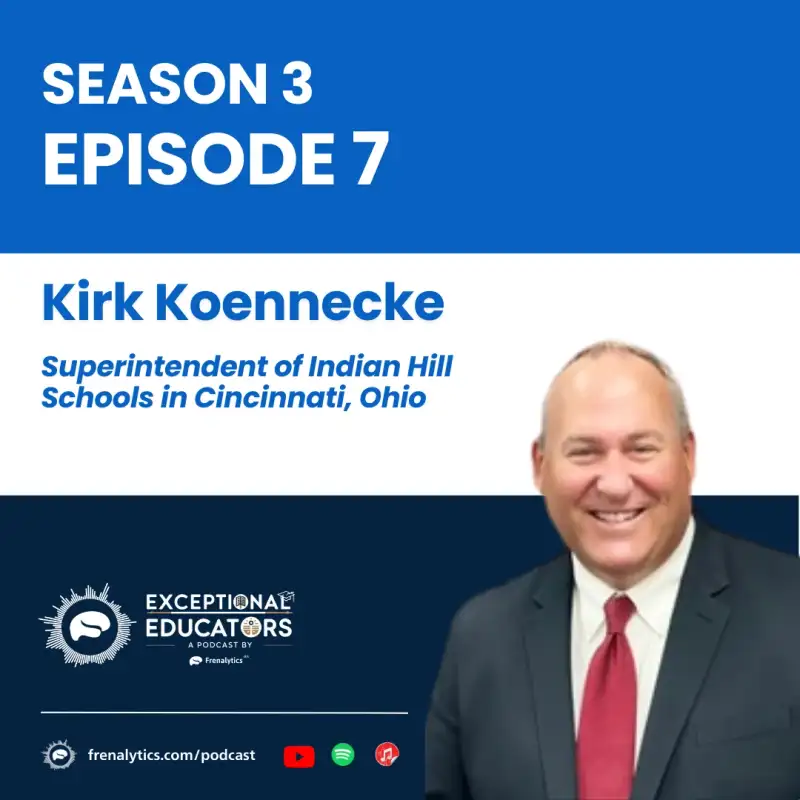
Growing Enrollment, Growing Excellence: How Kirk Koennecke Sustains a Top-Ranked District
Welcome to the Exceptional Educators Podcast by Friendlytics edu, where innovation meets inclusion in education. I'm your co host, Matt Giovanello, the CEO and co founder of Friendlytics. At Friendlytics, we put special education and English language learners front and center. Our award winning Friendlytics edu platform helps streamline progress monitoring, improve communication and compliance, and offers truly personalized learning to your students of all abilities. Each episode of our podcast features candid conversations with district and school leaders, classroom changemakers, ed tech founders, and industry executives, all dedicated to transforming learning for each and every one of our students, especially our learners with unique abilities.
Matt Giovanniello:With a focus on extraordinary educators and the exceptional students they serve, we explore the latest in special education, accessible technology, and inclusive leadership. In this episode, Exceptional Educators is exceptionally thrilled to welcome Kirk Kenecky, the superintendent of Indian Hill Schools in Cincinnati, Ohio. With over two decades in education and recognition at both the state and national levels, Kirk's leadership is grounded in student centered vision, community trust, and courageous change. Speaking of, in 2023, Kirk received the coveted Superintendent of the Year Award by the National Association of School Superintendents. And under Kirk's leadership, Ian Hill High School was proudly ranked number one, two years in a row, best public high school in Ohio by Nietzsche, and number six best school district overall across the state of Ohio.
Matt Giovanniello:He's here today to help us learn how an already exceptional district can evolve for the next generation. Kirk, thank you for joining us this morning. It's so great to meet you.
Kirk Koennecke:For having me, Matt. I appreciate it. And thanks for all those accolades. They don't happen without great families and great students working with world class faculty here at Indian Hill. We're very proud of our students and teachers.
Matt Giovanniello:You should be. And I'm so glad you're shouting it from the rooftops. It takes a village, and I'm so glad that you're a living, breathing example here to tell the tale today. Speaking of Kirk, let's start with an opening question, and it's one that we ask all of our educators and our leaders. It's what is your why?
Matt Giovanniello:What brought you into this world of education? We know you have a lot of reasons for staying here. Tell us what some of those are, and what are you seeing for the road ahead in education?
Kirk Koennecke:Well, my why hopefully is pretty apparent after thirty years of public education. I love helping children succeed. And I like working with people, of course, and adults who are like minded that want children to be able to realize their talents and have success in their life. And at this point in my career, my job as a leader is to develop other leaders, and I hope that we can pay it forward by developing other leaders who want to do the same. It's their future that matters to me.
Kirk Koennecke:That's my why.
Matt Giovanniello:It really does. That's so succinct and so well said, and I think speaks nicely to an opening topic that we can explore a little bit more, which is leadership within your school district. It is abundantly apparent that leaders in your school district care so much about your students, and that's what in part has resulted in all of these accolades. Let's talk a little bit about your leadership pipeline, what you've built over the years at Indian Hill that's worked so well that maybe can serve as inspiration for other districts who are trying to either recruit, train, or retain their teachers and their leaders so that they can be an exceptional district as well? What's your secret?
Kirk Koennecke:You know, the secret is the pipeline itself. You have to have a system, And I think you have to develop programming that is intentional, routine, and consistent that helps you attract and then develop and retain employees who want to be in the same culture. And so when we talk about leadership pipeline, we're really focused on the leadership development side. People talk in public schools and private schools a lot about leadership and look at those leaders and what they're doing. But teaching people how to be leaders and those skills that, first of all, children can learn and then all adults can learn, that has to be systemic.
Kirk Koennecke:And so we actually have a program in place K through 12 here at Indian Hill that we're really proud of. It's intentional, routine, consistent. There are opportunities for learning for adults and children about leadership skills themselves, and, that becomes a part of the culture over time. And then I think people want to stay and be a part of that culture.
Matt Giovanniello:Practically speaking, Kirk, how did you, during your tenure at Indian Hill, begin to implement that and how do you sustain it? Meaning, in other words, how often are teachers and aspirational leaders going through such programming? When does that happen over the course of the school year? What level of exposure do students have, if any? Tell us a little bit more about what that looks like.
Kirk Koennecke:That's a great question. By intentional, routine, and consistent, I mean daily, weekly, monthly, formal meeting. We have a cabinet level meeting with administrators. We have leadership team meeting monthly. We have our building leadership teachers meeting monthly.
Kirk Koennecke:We have our district leadership team of teachers meeting quarterly. We bring our student leadership teams together monthly. We have building level student leaders working with adults weekly and monthly. So there's a plethora of programs here for a school district that has 2,400 students. We really operate like a large comprehensive school system.
Kirk Koennecke:There are so many opportunities that are available, and those opportunities themselves have been built and created not just by adults, but by students who have ideas. And so what we try to do is not say no around here. We try to figure out how to get to yes, And that is because the teachers want to imbue this leadership development into the things that they're doing. And then of course, we let them run with it. Our faculty are world class.
Kirk Koennecke:They want to do the best they can with the content when they learn it and they want to transfer it to students. And that's where the magic happens.
Matt Giovanniello:I love that. I think it's innate for a lot of leaders within K-twelve education that staff need to have this feeling in order to be retained and to grow professionally and in their leadership roles. But maybe a little less often do I at least personally hear students playing a role in that. Related question to what we're talking about here, Kirk, what role does student voice play in shaping your district priorities? How do students get selected?
Matt Giovanniello:How can they raise their hand and say, I wanna be a part of those monthly meetings? What does that look, feel, and act like? And how much of a voice do students have?
Kirk Koennecke:Well, don't tell the adults here, but, you know, we joke about it. The students' voice matters the most. Right? And students, if we're truly going to have a personalized student centered culture, which is what our IH promise plan is all about, learners as doers, then learners' voice has to come first. But adults have to tease it out.
Kirk Koennecke:They have to ask for it. They have to give that space. And, you know, when we talk about leadership, people need to feel seen and heard, and that means you have to give them time. So you literally have to structure time and activities in that capture student voice. One of the ways that we do that here is literally through testimonials that are live, storytelling.
Kirk Koennecke:Our CCO Heather Higdon works with our student ambassadors k through 12 so that the students are capturing student voice and talking to each other and educating each other about the things that they love and those opportunities that are going on. And then we do a lot with focus groups and forums where we reach out to students and parents, and we put adults and students in rooms together. That way they have to listen to each other about aspirations and wants and needs. If we don't do that, then the adult voice always overwhelms the student voice. And again, we can't truly have a student centered culture.
Kirk Koennecke:I think our our staff and our community work really hard to elevate student voice.
Matt Giovanniello:I'm getting that sense as well, and I love the examples you've shared so far. I want to dig a little bit more into another kind of adjacent topic, and that is your increasing school enrollment. Here in New York City, we don't face We have declining school enrollment, and that is the case for public school districts, by and large, across the country. But you are facing an interesting bucking of the trend, where you have more students wanting to join the district than you might even be able to support at the moment. And so, what I'm putting together is this parallel between public school districts, such as the one that you operate, and private companies where competition is key.
Matt Giovanniello:So let's back up a little bit first before I get into the meat of this question. Tell us a little bit more about the status of your exempted school district, what that means within the state of Ohio, and how that affects the revenues you receive from students who enroll. And then that's going to be a conduit to my next set of questions.
Kirk Koennecke:I think when people hear of the Village School District, they might think about taxation and property, and it's really about how the size of the district evolved and grew from a small village to a modern school district. And throughout the second half of the twentieth century, this district evolved into an area where we have both individual properties that are owned by family owners, and then we also have a commercial and business area. This status that we have just as a way to define the school district and its size relative to others in a highly competitive region where we literally have competition in our backyard. Our private schools that are within our public school district boundaries that we compete against for enrollment at all times. People have been turning over generally generationally in the area.
Kirk Koennecke:We have a lot of new families that are moving in with multiple children, and there's been some new construction around our area, which has definitely driven another pop in enrollment. And I like to think the things we're working on are attractive to families, and that's why they want to come to The Hill.
Matt Giovanniello:It absolutely is, especially when there's such fierce competition as there is with general companies in the private sector. It forces you not only to innovate and do better, but also to be aware of what other options exist that if you're complacent, for lack of a better word, you'll miss out and that enrollment will go right back down. So I think that hopefully it's seen as a motivator, but also a really heartening and flattering compliment that your enrollment continues to improve. Using that as a segue to another question I have, just from personal intrigue, how does the enrollment of your students and the increase of enrollment affect the way that your school and your district receives funding compared to how that funding follows a student, they tend to go elsewhere? That's little bit unique in the state of Ohio.
Matt Giovanniello:Not everywhere follows that, as you know.
Kirk Koennecke:Great question. Couple of of answers. First, we receive very little funding from the state here in Indian Hill or the federal government. The large majority of our funds come from our local taxpayers and property owners and the commercial revenues. Over, I would say, 92% of our revenues are local.
Kirk Koennecke:And what we do use our funding from for the state, of course, the feds, is the things that you know. Title funds, helping with students with disabilities, making sure that IDEA is in place and that we are able to take care of students with every dollar that we get to have the most impact that we can have. So when I tell you that our local families are amazing and supportive, they understand that our budget is unique, and we also have the lowest tax basis in Hamilton County, Ohio, which a lot of people don't think of when they think of Indian Hill. So I really believe that our local families are able to maximize their own dollars and impact in a public education setting here at Indian Hill. And as we're growing, you might imagine the other part of this answer is we're dealing with a higher percentage of population of students with needs.
Kirk Koennecke:We have a growth in our ELL population that has skyrocketed over the last fifteen years, and so that requires more dollars, more services, more staffing if we want to maintain really high quality education with really small classroom ratios, which has always been a hallmark here at Indian Hill, the teacher to student ratio. And so as we're growing and looking at enrollment, it all matters. Every dollar matters for budgets, facilities, and staffing to be able to maintain a high level of delivery of services for all.
Matt Giovanniello:I think you're saying in part the quiet part out loud, Kirk, and the unfortunate but understandable reality that educating students with disabilities and students who fall under that English language learner category often costs significantly more than educating a student in a traditional general education or even ICT setting. Getting into that a little bit, you have an interesting dichotomy at Indian Hill of students who are incredibly high performing, might even be high performing on their own, but your staff is really turbocharging their success. It's helping you achieve the ninety eight percent graduation rate that you have across the district and all of the outcomes that Indian Hill is really well known for. Yet at the same time, your needs across students with disabilities and English language learners are growing. So let's get into that a little bit.
Matt Giovanniello:Tell me about what that landscape looks like, little bit more in color of how that's changed over the years, and what the district in more recent years has been investing in to better support the growing and increasingly diverse needs of your students.
Kirk Koennecke:Well, one of the things we've done is we've literally invested in people to add intervention specialists and to add paras and to train and develop them so that they can also have some movement within our organization. And, if they want to get an education, for example, and make more money, and stay with us, that's really important. Just when I look at the aides who work around our district, what our chief human resource officer Jim Nicholl has done with his planning and our director of people services, Erica Leppard, is they've created a tiered system where people can come in and those relationships they develop with the students are so valuable. We would like to keep those people. And and then how do we help develop them with their own professional goals, their own education, and all of that takes time and money, but being willing to be creative with it has allowed us to keep a stable of over 41 paras, and most of the people want to work here and they don't leave.
Kirk Koennecke:And so that's really important because that is an issue that so many public schools face year in and year out. And when you can't build those relationships with your students with needs, sometimes you have these losses right out of the gate. We're able to mitigate a lot of that with our staffing planning, and the intervention specialist, as you know, is an expert who helps us with individuals and classrooms, and that the collegiality that we've tried to build with our mentoring program has really, I think, helped us make great strides to serve families in ways that just many other schools I don't think can. And all of that costs money, but the impact is immeasurable for all students. If we say all, we have to mean all.
Matt Giovanniello:Very true. It makes my day, it makes my year, in fact, Kirk, that you're seeing the important ROI of that investment. Because I think when you come from a position of strength and you come in with that growth mindset, it's a little bit easier, albeit, you know, it still requires that leadership and long term mentality, to say this investment is worth it, not only from a moral standpoint, but because of the growing and changing landscape of our students. If you're not in as fortunate of a position as you are at Indian Hill, and you're coming from a position of a deficit a lot of the schools and districts throughout the country, that decision is that much harder. But it's still a decision for school districts to make nonetheless, and so I commend you for recognizing the importance and having that courage to say, This is how we're going to be doing things to support our students with disabilities.
Matt Giovanniello:This is how we're keeping our roster of aids and paras on staff, and we are going to retain them. Saying that is one thing, actually doing it, as you know, more than anybody else is a very different thing. There are a wide variety and endless list of reasons why staff, including paras and other licensed special educators bounce from district to district or out of the education system each and every year. There are issues within the school district that you can control, but then there are also a bunch, as you know, that you can't control. Changing regulatory landscape is one of them.
Matt Giovanniello:And so, this leads me to my next question. You are probably familiar, as is Erica, your director of PPS, that there are changes to the way that Ohio is implementing or rebooting, for lack of a better phrase, MTSS across districts and changes of guidance with their new iMTSS program. So, for what you know of that, the changes in regulatory landscape, how is that impacting the way that you're running PD for your staff, how you're thinking about supports for those students who need it both within and outside of special education?
Kirk Koennecke:I mean, we've spent a lot of time as a team taking some direction from Erica and our teachers to explore partnerships, right, in a different way. And partners can help us in lots of different ways. Some of them are just time, talent, some are energy, some are money, and some are, you know, companies. And we need to make sure when we talk about MTSS that first and foremost we can communicate to our public about what are we doing and how do we do it. And it's all about, of course, helping an individual and their family navigate the school system.
Kirk Koennecke:And so when we talk about a spectrum of services that we want to be able to provide to all students from intervention to enrichment, every child is different and learns different. The more personalized we can get with that data, the more granular we can get with the data in real time, the more we can make better decisions as a team to help that student thrive. And so we are looking at those kinds of things. AI interpretive data driven software that's adaptive, that has a great dashboard that can be used both by children and adults and their parents. And then how do you take all of that communicate it clearly and crisply?
Kirk Koennecke:And I think those are the things we're working on with partners and trying to move the needle so that our educators can do the best job they have with the time they have.
Matt Giovanniello:I love that you're prioritizing, embracing those partnerships, whatever those partnerships may look like, and I think you gave a couple of great examples of definitions for partners because it's not a one size fits all model. Let's switch gears a little bit and talk about the transition from being merely a test ready set of students and scholars to being future ready. I know Indian Hill over the years has taken on a variety of projects, whether it's project based learning, building thinking classrooms, and other AI focused mindsets that are preparing students for the twenty first century. So help us unpack that a little bit more. What do those programs look like?
Matt Giovanniello:What have been some success stories in their early years so far?
Kirk Koennecke:I love the way you started that. Mean, there's no such thing as a test ready learner who's a leader outside of a school classroom. So, I mean, at the end of the day, right, like, if you're good at passing a test, great. You might be able to to demonstrate some learning, and I'll I'll be proud of you. But what I wanna know is that you can perform and demonstrate skills on your own and with teams.
Kirk Koennecke:And I think what industry tells us is that in order for America to thrive or Ohio to thrive or New York to thrive, we need people who are interested in careers they are passionate about, where they find purpose, and where they wanna work either as an individual or a team to solve critical problems that require communication. So for us at Indian Hill, STEM is the public facing label of how we talk to parents about high demand career pathways and industry outcomes, but the work is k through 12, not just at high school. How do we introduce the concepts of leadership, the five c's? How do we introduce STEM culture? Problem based learning is what we call it internally with our teachers or building thinking classrooms, but the practical applications of all that are students leading to problem solve and students performing and presenting what they learn.
Kirk Koennecke:And that is so important to the IH promise strategic plan, and our public told us they wanted that. Over 2,400, bits of information and input from our community said, go do this kind of work because that's the most relevant, and don't wait until they get in high school. And so everything we're doing from an an entrepreneur center to a leader in me to making sure service learning is a as a a problem based learning module at the middle school, All of the programming you see at Indian Hill focuses in on these essential skills that people need to navigate multiple career paths of their choosing and do it successfully which is why leadership development is so important. We can all learn skills to apply, have really high ethics and morals and governance both for ourselves and with teams, and then apply it to whatever topic or industry or career path we want.
Matt Giovanniello:Absolutely. I love the examples that you just brought up. I'm gonna ask you to to dig a little bit deeper into some of them in a moment. But before we do that, let's back up. You defined your five c's.
Matt Giovanniello:Let's get into that. Share them us.
Kirk Koennecke:You know, again, critical thinking, creativity, all of those, those buzzwords that maybe you might hear out there in society, teaching our students the problem solving methodology. You know? Stanford's got their own language. Harvard has their own language. MIT has their language design thinking and whatever that is.
Kirk Koennecke:That's what gets boiled down to kind of those five c's of critical thinking skills and how you apply them in a decision making cycle, teaching children how to think and what to do with their thinking. That's what school is about. You know? And that's the bottom line. So we can talk about pedagogy internally, but I think what our teachers understand when they say learners as doers, learners as individuals in the IH Promise is we have this promise to make sure you learn how to think and what to do with it, and then you're gonna apply it to these areas where you find purpose.
Kirk Koennecke:And and to truly have a personalized student centered culture, students have to have voice and choice in that menu of learning. I don't care whether they're in kindergarten or twelfth grade. They need voice and choice about what and how they'll learn and what kinds of projects they're going to get to to be creative with to apply their learning.
Matt Giovanniello:Totally. And, you know, it's funny. I had a question for you about maintaining community trust while introducing change. That question actually is almost a moot point because your community was the one advocating for such a level of change. Let's flip that question around a little bit.
Matt Giovanniello:How have you over the years cultivated partnerships within and among your community members to allow them to feel comfortable enough and confident enough to say, we want this change while keeping it at a partnership level instead of it being, but some districts unfortunately have to experience a little bit of a pitchfork type environment where the board isn't, you know, advocating for one thing, the community wants a second, and the school is actually, you know, carrying out a third. How are we level setting that? How are we bringing everybody together in the middle so that they are saying, We want this, and you're like, I'm so glad you're asking for it. Let's do it.
Kirk Koennecke:Great question, man. First and foremost, as an administrator, no matter what your role is, to embrace your role, you have to be a listener, and you have to be willing to listen to input and feedback. And some of that's critical, but that helps you grow and and work on continuous improvement. And so I think we have a bunch of professionals in this organization who just get that. Our our head principals are amazing listeners, and they listen to faculty, staff, students, families.
Kirk Koennecke:And those are the key partners, right, that we start with is our own staff and families and to hear their needs and to try to meet them where they are. But the the bigger level, how you you you have these transformative partnerships with community, whether it's nonprofits, agencies, or businesses, you really have to reach out to them. In a public school setting, you have to reach out and kind of hold their hand to sustain the partnership so that they don't believe it's just a one off transactional thing like a field trip or something or, hey. We want a free meal, and we're gonna do a lunch and learn. A transformative partnership is identifying common goals and outcomes we want for both organizations and how to help.
Kirk Koennecke:We want every business in the Cincinnati region to be dying to hire Braves. And so the way we have to do that is we have to find common ground and continue to work together on the principles that matter, and that takes time and effort. It takes changing the culture, whether it's an event, an activity in the classroom, at the building level, at the system level. You you have to build those things over time with the partners and and really listen to their needs first and foremost and ask them how you can help them. Once they meet our kids, then then it's magic because they build trust with our students.
Kirk Koennecke:But you really have to work hard to do that in a school setting.
Matt Giovanniello:That's right. Let's go into a little bit more your example of the entrepreneurial center that you developed at Indian Hill. What grade levels do students have access to this environment? What kind of are the big lessons that you're hoping to instill in students? And how does that connect to this generation and the upcoming centuries worth of jobs?
Matt Giovanniello:I mean, I'm an entrepreneur, you know where I'm going with this, but how are we exposing students at those youngest levels to careers that maybe we don't even know about yet, but we need to start teaching them?
Kirk Koennecke:So exciting. Whether we're talking about leadership development or real world learning or entrepreneurism, I mean, you know, future ready mindset, this is all about the physical embodiment in our high school right now of an entrepreneur center where we renovated a space that was tired, that there was no traffic, students weren't going there. So the physical piece was, let's renovate and create the space that they need, and also that partners need to interact with them and make it look modern and contemporary. And then there's that notion of high school should be more like college, but really our whole campus should feel more adult. The Entrepreneur Center serves students K through 12, which is what's really great, and I think will probably outgrow the current space we're in because the demand for students for programming is phenomenal.
Kirk Koennecke:And so whether it's an internship or an externship or a speaker series or business at breakfast, we have students who want to interact with our community partners and their teachers to do great work together. I think what our teachers are learning is that as partners come to bear at the school, they benefit and find ways to connect on problem based learning and all the things that they want to work on in what you might call a more traditional classroom setting. And then what I think we're all learning is students want to find distinguishers as they build a resume, not only to decide what they want to do, but also to learn and filter out what they don't want to do after school. So from resume building to learning from an author to an artist coming in and or a leader coming to speak at a summit on the hill, our students are getting opportunities they never had before. I do think sometimes community members go, well, wait a minute.
Kirk Koennecke:What about all their classes and their schedule? Our students can handle this. Not only can they handle it, they want to choose it, and they want to demand it. And so what it's really led to is an evolving master schedule across campus at different buildings, which is really exciting because then teachers and students are working together to re envision what school should be like. And we all talk about that, but rarely do we ever change it.
Kirk Koennecke:And so here, our faculty are really working hard on that, and I can't wait to see what they come up with. And the EC is just one part of all that.
Matt Giovanniello:Well, you're delivering on your promise of voice and choice for students, and it turns out that both of those can be true. You can deliver on all of the state mandated and federal mandated academic requirements for students to graduate as they should be learning in a school setting, but also give them the flexibility and time of their day to explore all of these next generation career paths in a way that's really exciting and interesting and things that they want to actually sign up for instead of forcing them to do it. So that's a really cool example. I think more districts selfishly need to be doing that, and I just love that you have that going on at Indian Hill. Example.
Matt Giovanniello:I have maybe one or two more questions for you, and then we'll wrap up today's conversation, Kirk. This has flown. Let's get a little bit into how you are one, supporting student and staff well-being in these high pressure environments. And two, we've been talking about this a little bit more, but I'd like you to put an even finer point on it. How you're maintaining a culture of excellence instead of saying, we've got all these really good things going, let's just keep at them and having that be potentially construed as remaining complacent.
Matt Giovanniello:So, how are we supporting your staff and students right now and making sure that the highest of the high performers continue to be invested in while your students who might be struggling a little bit more get this where they need? And how do we maintain this culture of excellence, especially for schools that are trying to it?
Kirk Koennecke:I think one of the things we've really been working on internally the last few years is this notion of, you know, universal design for learning and how does that impact teachers and delivery. So when we talk about, again, all means all, how students work through problem based learning as an individual in a group, when you're in a group where there are multiple ability sets, you know, we need to make sure our teachers are equipped to deliver and differentiate and then support. And so we've been doing a lot internally with that professional learning model of what does UDL mean? How does it intertwine with all this other edge of jargon that we always have to use? Right?
Kirk Koennecke:And I think our teachers get it. Right? But but then to flip the coin on the outside, how do parents and students understand it? What does it look like? What does that support look like?
Kirk Koennecke:That support isn't just more staff. That support is using adaptive technology. That support is is unified activities. Just in the area of activities and athletics, we have dramatically increased unified opportunities for students of all abilities to be together, both on and off campus. Our middle school was honored as the only unified champion in Ohio, last year at that level.
Kirk Koennecke:We're we're so thrilled about that honor because those teachers work so hard with our students, and they deserve that. That's a great example of how we're moving the needle in terms of awareness and involvement of teachers with students, and then parents can learn and see that, and then we can try to meet everybody's needs. And it's about academics, athletics, and the arts here. Right? So it's not just what happens in the classroom.
Kirk Koennecke:And I think we're trying to make really important strides that way. So that keeps us moving forward. And then the second part of your your question is, you know, continuous improvement at Indian Hill is it doesn't matter what the rankings are. It doesn't matter what one community member thinks about the rankings. It matters what we all do to evaluate and assess.
Kirk Koennecke:And around here, we like to use words like assess and aspire and achieve as a process. Right? We're continually looking at gaps and what we need to do and continually trying to aspire with dreams about what's next at Indian Hill. One of our partner groups, the foundation, which very few public schools have a foundation. Our foundation has a theme, and part of that is what's next.
Kirk Koennecke:Well, we push them to think about what's next, and then then our educators talk about that. And I have to tell you my my cabinet level administrative team, they are amazing people who are willing to dream big. And then sometimes you start small and scale up, right, with what you're gonna do. That becomes part of the cycle of our work every year. It's it's almost November 1.
Kirk Koennecke:We're already working on 2627 now because that's the cycle of continuous improvement that we're in.
Matt Giovanniello:That's huge. I love those examples of how you not only practice but preach continuous improvement from everything at top level leadership at the district down through your classrooms and even into your foundation. It never dawned on me that the foundation could have a guiding theme or topic. I think even like as obvious seeming as an example as that, I'm hoping for those listening to this, trying to find ways to breed innovation and this forward thinking mentality in their own districts and communities are getting some really good recommendations on how they can very easily or hopefully very easily do that. Kirk, we are at the end of our time today.
Matt Giovanniello:This has gone so fast. Thank you again for joining us this morning and lending your voice and sharing your thoughts with us. I have one more question that we ask all of our guests. That question for you is, what does being an exceptional educator or being an exceptional leader mean to you?
Kirk Koennecke:It means I can help. I want to help children. You know? I want to help the adults that I'm around. I don't know that that makes anybody like me exceptional.
Kirk Koennecke:I just hope people note and take note that I'm here to do that, and I can be proud of those things for them, and that fuels me.
Matt Giovanniello:It does make you exceptional, news flash, but I think you're also incredibly humble. I think that having more leaders like you in our spaces to support the growth of our next generation of K-twelve students is necessary and really appreciated and I'm just glad that you're here to kind of tell the tale of what's working so well so that we can try and breed this in districts all over. We desperately need it in New York all the way out to the coast on the other side in California. I know we'll really appreciate it and all of our listeners in between. So Kirk, thank you again for joining us this morning.
Matt Giovanniello:It was just such an inspiration listening to you and I can't wait to follow the successes of Indian Hill in these next few school years to come. Thank you, everyone.
Kirk Koennecke:Matt, I appreciate you too. Thanks for having me.
Matt Giovanniello:Absolutely. For everybody listening to today's episode of the Exceptional Educators Podcast, thank you for joining Kirk and me today. We will see you on our next episode.