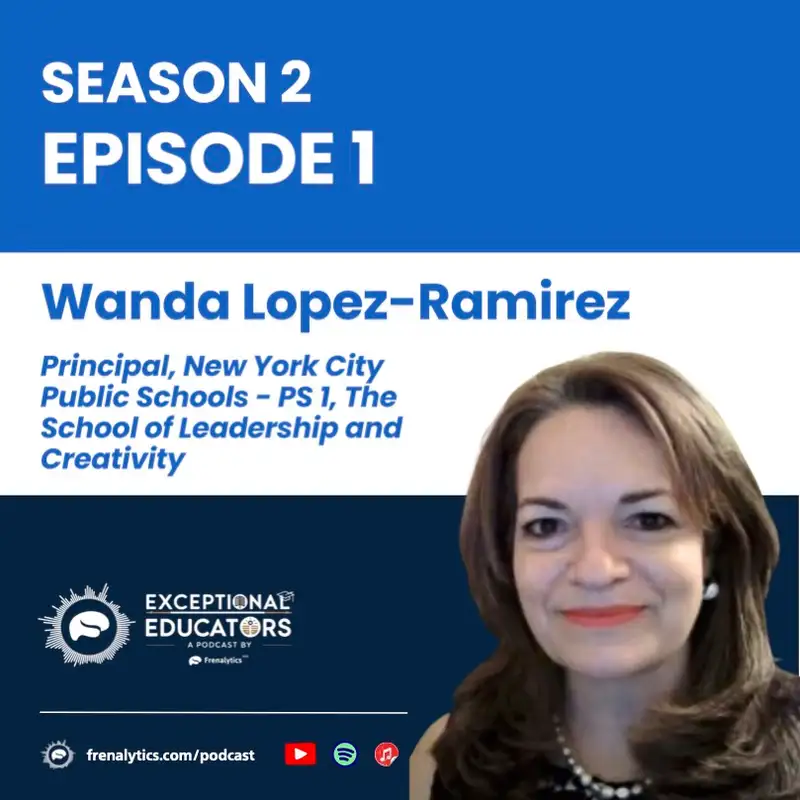
Leading Urban Schools with Purpose: Wanda Lopez-Ramirez on Culture, Community, and Equity in Education
Welcome to the exceptional educators podcast by Friendlytics edu, where innovation meets inclusion in education. I'm your cohost, Nisha Srinivasa.
Speaker 2:I'm Macho Vannello, the CEO and cofounder of Friendlytics. At Friendlytics, we put special education and English language learners front and center. Our award winning Friendlytics EDU platform helps streamline progress monitoring, improve communication and compliance, and helps offer truly personalized learning to your students of all abilities.
Speaker 1:Each episode of our podcast features candid conversations with district and school leaders, classroom change makers, EdTech founders, and industry executives, all dedicated to transforming learning for each student, especially our learners with unique abilities. With the focus on extraordinary educators and the students they serve. We explore the latest in special education, accessible technology, and inclusive leadership. In this episode, Exceptional Educators is exceptionally thrilled to welcome Wanda Lopez Ramirez, the principal of PS1 pool of leadership and creativity in Brooklyn, New York. Wanda is committed to maintaining an inclusive, positive learning environment for students and staff alike, advocating for inclusive practices and technologies that support the momentum of all.
Speaker 1:Welcome, Wanda. We are so grateful to talk to you today.
Speaker 3:Thank you so very much for the invite. It's such a pleasure to be here, and thank you, Matt, for definitely letting me collaborate with your team.
Speaker 2:My pleasure. Thanks for joining us.
Speaker 1:Just to get us started today, Wanda, a grounding question that we've been asking all of our guests, which is a question I'm sure you as an educator are very familiar with, is what is your why? So how did your journey to the world of education start and how is it continuing?
Speaker 3:So believe it or not, education is my second career. I started my world as a social worker for children in foster care for a good six years. You know when you just haven't found where you belong kind of thing? After six years, I said it was an emotional draining job when you are noting families that are disconnected, families that are at a disadvantage. It was definitely like an awakening for me.
Speaker 3:And my dad as an educator all of his life, of course, you know, you never listen to mom and dad, right? But I had been listening all my life. You'd be an amazing teacher. You'd be an amazing teacher and you'd be an amazing teacher. And never gave them that opportunity to even think about that.
Speaker 3:I needed to take a break from being a social worker and my break was going back to school to get a master's in bilingual education. So here I am. I started as a teacher at my community school, literally three blocks away from where I live. Actually started as a pre K teacher and then moved on as a teacher teaching bilingual children in PS1 Sunset Park District fifteen. Went back for a second master's in administration and then moved to another neighborhood in Brooklyn called Bushwick where, the population of my multilingual learners was at a nine at an all time high, let's just say.
Speaker 3:As a bilingual teacher, that was where my heart was and, became an administrator there for nine years and now came back full circle because the school that I started as a teacher, I am now the administrator. And I call myself the COVID administrator because during COVID when everybody was running for the hills, said, why not? This works. And when I think about my why, there's this young lady that I was her kindergarten teacher, Laura. And I remember Laura many years later coming back and saying, I am a social worker because how you always talk to us.
Speaker 3:As kindergarten and first grade students, because I had looped that year with my students, said how important it was to know children, not only how they learn how to read and write, but knowing children here and children who their families were, everything that had to do with the whole child, right? It's my heart to be a bilingual teacher and you always, that's always who I will be. And then coming back to think about that Laura is now a social worker with a master's because I motivated her to think about how important it is to know a whole child, not only how they read and write.
Speaker 2:Love that. I feel like we go way back on it, and I just keep learning new things to you. So thank you for sharing your original career trajectory as a social worker and Laura and your multilingual and bilingual experiences. It makes so much sense now how all the dots are getting connected and how you're running PS1 and your emphasis on multilingualism and just needing to say, Okay. Question for you on all of this.
Speaker 2:Thinking back to your days as a social worker, what skills did you take from that previous career into not only teaching and education, but now into administration of running PSOne in Brooklyn? There are a a couple of, like, kind of overarching things on whole child and SEL. Let's dig into that a little bit more. What do you think that being a social worker has done in times past that is contributing to the success of your job in present day?
Speaker 3:Piggybacking off what I said about knowing the whole child, right? In my school community or in any school community, we are mandated reporters. That's just one example. It kind of brings me back to the days of having to go into homes where children are not safe and removing children. We think that that's as a mandated reporter, we're making sure that children are safe.
Speaker 3:The reality is that children, even if they're not safe, where they want to be is with their family, right? That's children in crisis, right? If children are in crisis, they're not learning because their family dynamics are not where they need to be. They don't understand that, but we understand that. So as a leader, take that very much to heart when we're providing support to a group of children or students in our situation right now in temporary housing, students in foster care, students in our school community that are not in that box, that literally are outside of that box, that we as a school community are prepared to support that social emotional learning for children.
Speaker 3:When I think about as a mandated reporter, not everybody really knows that family and we're the first ones to contact, right, as a mandated reporter. I wanna say that I prefer, and not that I'm an investigator because as a principal, I got one job already. But it behooves me to follow-up and contact families to say, is there something that I can do that we as a school community can do before I need to contact another agency that may, that's going to support you because I also want to respect that process. But then maybe you don't need that. Maybe what you need is an opportunity to get connected with, we have our CBO that has counseling that can connect families to economical services, right?
Speaker 3:That if anything, it'd be a resource for families, right? So once again, I don't want to believe that it's everybody, right? Because there are situations that, we need to follow-up with ACS or the police department or whatever other agency. But I want to be able to provide resources and tools for families before I go there. And I believe that that has been my mission for our school community.
Speaker 3:And of course, I could never stop a teacher from saying, oh, well, I believe that I, you know, this child is not safe and I wanna respect their thinking as a mandated reporter. But I also want to make sure that my staff understands that there are other opportunities for us to make connections with families. So I don't know if I've answered pretty much, but I want to say that I named about three things that pretty much could connect myself as a leader and how I view what my skills were in making connections with family as now I do as a principal.
Speaker 2:Thousand percent. And, Wanda, this is really enlightening for me because it's not a discussion or or topic of conversation that on our side we explore every day, but it's in a critically necessary prerequisite to make sure that students feel safe. Nisha, I'm sure you feel this way, and I'm curious what life out in urban California for students that you work with at the elementary school is like. But here in New York City, if students don't feel safe, they're not going to learn. And if students don't feel safe, they may not even showing up to school.
Speaker 2:Or the times that they are, they're not at their best state to be able to reach them effectively, and instruction is kind of a secondary priority even though you're a school. So I'm glad you're raising these things, Wanda, and I think that there's a lot more overlap than people may initially realize on this SEL front, regardless of a student's disability, regardless of their English proficiency, regardless of their even their housing status at times. It it comes down to safety. And those other pieces can exacerbate it, but we we need to make sure that we're taking care of our kids first as people before we treat them as students and work with them as students. Nisha, what's that like for you out in California?
Speaker 1:I was going to say from coast to coast, there's a lot of similarities even though we're across the country from each other. I was going to say that psychological safety is of the utmost priority for our students because exactly as you shared, Wanda, and as you shared, Matt, if students don't feel safe, they're not in a space to be able to learn. I completely agree with that and see a multitude of examples every single day. And Wanda, something that was coming up for me that I was really curious about as you were sharing was it seems as if your background as a social worker, your experience as both a bilingual student and a bilingual educator has made you very attuned to the multitude of needs that a family coming to your school or a student at your school might have. How do you, as a school leader, cultivate a similar mindset and carve out an opportunity for teachers who maybe have a different background or set of experiences coming to the school?
Speaker 1:How do you support them in developing a mindset to think about the whole child as you share?
Speaker 3:It's just not enough to know that you graduated, that your GPA is this, or that you have these credentials or that you've been, you know, or that you have X and Y, Z experience. In knowing where I want my school community to represent, I have made a conscious effort to hire staff that has that level of compassion and that level of empathy, it's enough for me to say, what did you do to support that family? My staff already knows where I'm coming from with that, right? Having two guidance counselors within our school community that have been in this building for the last, just like me in the last fifteen, eighteen years, that known how our school community has developed, right? And it's ironic that for the last two weeks, we've been getting ready for September because June, you get ready for September and realizing that the amount of staff that has been in this building for the last, I have staff that has been here for thirty two years, right?
Speaker 3:And then I have last year's staff, I had 12 new hires and I wanted to ensure that the new hires were going to be exactly teachers that had that sense of community and be able to have that TLC and nurturing that our children need. Because in our community, that's the need that we have. And don't get me wrong, our scores may not be the proficient scores that they have in the other side of Brooklyn within my district, but I believe that we take a lot of pride to know that our teachers go beyond the call of duty to either ensure that children have the right sneakers or and this is a perfect example my fifth graders are getting ready for graduation on Friday. I had my parent coordinator reach out to a salon and to reach out to a barbershop to give out vouchers to children that I know for a fact is a hardship for a family. Like I get my child a haircut or I pay a bill, right?
Speaker 3:That's the economic disadvantage that we have in our school community. So then what do we as a school community do about that? Right? Well, you get proactive people that say, not a problem, Wanda. I got you.
Speaker 3:I have 25 vouchers for boys that can literally go into a barbershop and we've taken care of the cost. Right? That's that's only like a little layer of what a school community does.
Speaker 1:I think that was one incredible answer. And two, I think it speaks a lot not only to how you're thinking about the structure and community of your school, like from the beginning, not even just necessarily what you're doing on a day to day basis, but like even before somebody comes.
Speaker 2:You summarized it well, Nisha. Wanda, my follow-up question for you on that is if somebody's listening to this episode and they're saying, whether it's in New York City, San Francisco, or literally anywhere in between, says, my school demographic sounds really similar to Wanda's. We are not as far along in providing community support to these students, and we know we need to. Whether it's sneakers, whether it's a haircut, whether it's access to social services, whatever it might be that you've been able to cultivate for your school community, what advice do you have for getting started? Like, what's a little bit of the playbook of that you did in your five years, let's say, that provided more services and access to them at PSOne than you did prior?
Speaker 2:Like, what did you do that someone might be able to replicate or copy so they can get that access to their kids too?
Speaker 3:One of the important parts that I believe where leaders can be successful is knowing the community that they work in and, knowing the resources, walking the community, getting to know who are who's your local bodega? Who's your local coffee guy? Right? Who exactly are the resources that you're gonna gather in the tomorrow for your students, for your families? You can't make those connections if you don't know or walk the area from FDNY to NYPD to being part of the school board.
Speaker 3:Right? All of that definitely puts us in a different place when we think about making connections as leaders.
Speaker 2:I'm really glad you brought all those things up, Wanda. I think participation and partnering with these local organizations is critical to all of the points that you brought up, and then some from building school leadership to affecting positive school culture, improving student safety. It runs the whole gamut. And it's funny, you're very involved. In addition to the ways that you just listed, I know and have had the incredible fortune of meeting you at the Asian American Association of CSA's event a few years back.
Speaker 2:You're part of the Latino Latina Caucuses. You're a part of Nassalas. So tell us how access to those organizations and the resources and the people within maybe help augment even more the gains that your school and you have received in your leadership position on behalf of your students than even community partnerships could perpetuate alone.
Speaker 3:So I've been very fortunate that as an assistant principal, like, very early on was connected to the assistant principals association within my union. Just the amount of networking within itself definitely puts us in a place where you can make those connections. And networking is power. Right? And yes, I do belong to a handful of associations, but I can't imagine not.
Speaker 3:Right? And I know Matt has, you know, whether it's with the chancellor or whether it's any kind of forum that they put out, knowledge is obviously power. And, you know, we we continue to nurture that. We are going this year to the ASSA convention with our union in Vegas so that there's, you know, we have to put ourselves out there in order to continue to grow. And of course, us know what are the nuances, what exactly, what is our union saying?
Speaker 3:What are, How are we ensuring that our families are benefiting from in my tomorrow? Right? So I will continue to do that as long as I'm in this position. I don't know if I named everything that you mentioned, but it definitely is important for us as leaders that it's not only in the school, it's outside of the school also.
Speaker 1:That's amazing. It's really clear to me, and I'm sure to you too, Matt, that you embody and embrace community at every single step of the way throughout your leadership. It's so clear to me, even just from talking to you for a short amount of time, that not only do you share with your staff that community is really important, but you live that through and through. And that is absolutely incredible and I think a really important way of providing an element of inclusion and safety into your leadership. Sort of to pivot on that and think about another element of inclusive practices that you as a leader have taken to.
Speaker 1:I was wondering if you could share with us a little bit about your embrace of technology as a school leader. I know that Matt mentioned that you use the Frontalytics platform at your site. And so as you were talking, I was just curious how that piece of the puzzle, how that technology piece is another element of that community based inclusive practice that you seem to really embody.
Speaker 3:I remember fifteen years ago coming into this school building and honestly feeling like we were so backwards, right? Because I came from another school community that was very much accepting of technology, and that was not the norm here. Everything was pen and paper. And I was like, oh my gosh, I can't believe this. Right?
Speaker 3:We would have been fortunate enough to have three different grants from our presidents and literally having, I mean, of course, a push during COVID for everyone to be on some kind of device. We started a trajectory of ensuring that technology was a bigger place in our school community. There's always two or three that you still have to push for, but nonetheless, I think that we're in a better place. I actually have teachers who literally come in with laptops now. And don't get me wrong, I'm always a pen and paper, you know, person, and I love it just because there's that sense.
Speaker 3:But yes, it definitely is a push for school communities to and it's important, right? We connect children like right now, our children are, believe it or not, it's our first year that we did computer based testing, which was huge for children, grades three, four, and five. But it's just like anything, right? Like that's where we need to be. At first we were like, oh, it's only gonna be one grade.
Speaker 3:I was like, no, it has to be three to five. And it's okay. They may not be 110% comfortable with it, but it's okay. But it also behooves our teachers to definitely get online, have a computer for every child or have an iPad for every child. Like if a teacher herself doesn't feel 100% comfortable, then of course that's always gonna be the challenge.
Speaker 3:When even our curriculum is, you know, online, and even though my teachers are like, Well, I want the manual. Well, guess what? You can easily access it. And it's just a mindset, right? And we need to continue encouraging the mindset, really.
Speaker 3:That's what it is.
Speaker 2:Absolutely. Speaking of mindset shift and speaking of exposing students to technology, including at an early age of your pre K through five environment, I think that personally, having the chance to experience a number of your extracurricular programs and the ways that you support students with career exploration and career development at early age is a really important hand in hand type experience where, as an example, stepping into your STEAM classroom and joining fifth grade career day and exposing students to the world of, in my case, entrepreneurship, but the world of technology, the world of AI, the world of software development, showing them all the possibilities of embracing a STEAM based curriculum and what they can do post elementary, but also post middle high school and college if it's right for them. Hitting them at that early age is really important. So tell us a little bit more about how your now thirteen year long fifth grade career day and other types of arts based programs came to be. How do you cultivate your staff to not only starting them, but keeping them?
Speaker 2:And what do you see the benefits being to your students and your families of putting on these above and beyond type programs at your school?
Speaker 3:When we come to the school community, we wanna ensure that our students walk away. And I'm talking about fifth grade. Right? But I'm talking about 10 year olds. But the same way I think about that Laura became my little protege.
Speaker 3:Right? Like, I think about each and every one of us as educators become those protege for children, right? Whether it's, you know, teacher of the year or a New York City Apple teacher, that definitely encourages children and our student leaders that there's nothing that they can't do, whether they have an educational, an individual educational plan, there is nothing you can't do, whether you're part of the youth equity group, whether you're part of the student council, or maybe you're not part of any of that, but that there's in the tomorrow, you're going to be someone, right? Because someone encouraged you because someone told you you could. I think that as a school community, that's what brings in the, once again, the word community.
Speaker 3:And I know it sounds almost like a cliche, right? But our children, whether they participate in the champs or whether they participate in origami, because one of my students last year said, I believe that I'm like the best origami maker in the world. And I said, well, I'm going to do this for you. I'm going to have you come in and teach to children. And there's going be a teacher that's going to supervise you for the last one hundred and twenty five days.
Speaker 3:He has come in religiously, Tuesday, Wednesday, and Thursday to teach other children origami. And then one of the parents comes to me and says, you know, I wouldn't be sure. Is it true that so and so teaches, he's a fifth grade student now, but proposed to me as a third grader? And can I tell you that the amount of origami that he has displayed on the 2nd Floor with the students that as far as he's concerned, he's taught? It's been amazing.
Speaker 3:I'd given this student an opportunity based on his proposal. He came, he sat here very professional to say to me that he just needed an opportunity and that he was going to with a plan, and I'm not gonna lie to you, better than most of my teachers to have a plan in mind of how he was going to teach origami as a fifth grader. And I gave him that opportunity. I had a teacher, my librarian, and her paraprofessional, who would be the supervisor, and they said, Ramirez, he comes planned and prepared every day. So we just let him be.
Speaker 3:But those are the opportunities that we give our children. Right? There's no doubt in my brain that he will always walk away. I'm like, where were his footprints in this school? As he probably, as a sixth grader, will share in his middle school, how he was the teacher that supported children making origami.
Speaker 3:I mean, come on. Something as simple as that.
Speaker 2:That is so unbelievably adorable. And served as a great story and a great example of literally no cost things that you can tweak and change to shape the school culture that not only is inclusive of all students, but also now this student is serving as a role model and hopefully one that other students will want to emulate and maybe copy, maybe clone whatever word you want to use. But now we're raising the bar of what's expected of students if they too want to walk in his footsteps. Love that story.
Speaker 1:Yeah, me too. It's so heartwarming. And I think that student is going to remember that for the rest of his life. And it was such a as you shared, Matt, such a heartwarming way of offering connection. And it really speaks to the importance of you seeing all of the students in your school community.
Speaker 1:What advice do you have in that regard? In considering school leadership, what advice do you have to share with other school leaders who are maybe looking to infuse some more of those opportunities to create and build an inclusive culture as you have in your school? What are ways that folks who might be listening to this can kind of like take from this and continue to learn from?
Speaker 3:You know, we talked about community first, right? And this school and this area and this neighborhood is very special and dear to me, right? Because I could see myself in each and every one of those students that when I sit down with my student council, I give them the opportunity to reach out to the rest of their classmates to ensure that they have the pulse on any changes that they want to make. And one thing that has always been important to me is knowing children. And what do I mean by that?
Speaker 3:Something as simple as children's name, right? I make it my business. We have little pictures of children in the beginning of the year as, you know, for lunch and stuff like that. Going through the pictures and getting to know the names of children. So when they see me or when they see me in the hallway, whether I knew them from pre K or whether now they're fifth graders, there's a difference between, hi, how are you?
Speaker 3:Or hi, Nisha, how are you this morning? Right? Or even parents that come in and for me to be very conscientious to know their name. Some families feel different about that. Right?
Speaker 3:As opposed to sometimes I'm not feeling wonderful when my own teachers call the parents, hi, mommy, or hi, dad. No, that's Ms. Hernandez. Enough to say like, I have 20 students in my class. I want to be sure that I get to know who are those families.
Speaker 3:Right? And I know that my teachers make a conscious effort for that because I think it's important. As future leaders, you know, that are lit may be listening to that, that's when you know that you have established those relationships, right? Because it's not only relationships with children, but it's relationships with families, right? And I think that that's the culture that you establish within a school community.
Speaker 3:Matt has been in this school before and not for anything, but the people that do visit our school have definitely walked away with saying there's a certain warmth about this school. And I kind of wanna continue to nurture that. So that school culture and that warmth that I'm talking about has to be established as a school community. Right? And you wanna be able to be able to name that, but not that you can name that, that someone else can walk in and name it for you.
Speaker 3:And I wanna continue to ensure that that happens in my own school community.
Speaker 2:Lana, you're spot on. Your school has such a warmth to it. You're not exaggerating in the slightest. It's one of the reasons I love visiting your school the most. I think just to put a fine point on something you mentioned just before, not only are you using community as a word and a phrase for action, as opposed to being a buzzword or a cliche, you're giving all sorts of examples of how you've actually done that.
Speaker 2:Same thing with school culture. Knowing students' names is no small feat in a school like yours. Some districts are smaller than your school. You have over 600 students across pre K through five. And to know those students and try and relate to them to the extent that you do is not just impressive.
Speaker 2:It feels almost impossible. So the fact that you and your administration are even making the efforts and going the extra mile in that investment, I think speaks volumes. So I really appreciate for you sharing that story. I know we're short on time. For our final question with you, Wanda, today, we can keep going on and on and on.
Speaker 2:I'll save it for my next visit. We like to ask a question to all of our guests. And if it takes you a moment to come up with an answer, that's more than fine. Our final question to you, Wanda, is what does being an exceptional educator mean to you?
Speaker 3:So I don't find myself to be exceptional. I just want to put that out there. I don't know if I could name that for myself. And yes, I probably would have to think about that. You know when certain jobs is like a calling, right?
Speaker 3:Like in my brain, like I always think about what my dad said, that I would be a great teacher and I continue to be that teacher. Right? So whether it's that I'm sitting at this desk and leading a school, I don't do that by myself. I do that with a team. Right?
Speaker 3:My heart is always going to be families and students. And that's where my heart sits and sitting down with children and really listening to what they have to say, being in classrooms, really listening sometimes. Well, all the time as a leader that you always listen before you say anything. I want to kind of take my equation out of that about exceptional. I definitely want to be the best that I can always for our children and in the tomorrow that when they come looking for a job, which they have, that I can say, I remember you as my first grade student or my second grade student.
Speaker 3:And knowing that their own why was established based on whether it was little seeds that I placed or little footprints. That would be my takeaway, but definitely not exceptional.
Speaker 2:Oh my gosh. Yes, you are. You are exceptional by means of the definition of dedicating your professional life across both of your careers to bettering the lives of students and their families and your staff members. That in and of itself, in my mind, hits the criteria for exceptional. But you've dropped countless examples of just how exceptional you are, Wanda, and how you've empowered your staff to be even more exceptional to serve all the kids at PS1.
Speaker 2:So for that, we thank you and for your time today and sharing all of that knowledge and insights with us. Thank you so much for choosing to spend your afternoon with us on a very busy day at the end of your school year. We're recording this June 17 here in New York. School is on for two more weeks, and the fact that you carved out nearly an hour with us, we're just so grateful. So thank you for choosing to spend your afternoon with us, Wanda, and for all of your time today.
Speaker 2:Nisha, you want to wrap us up?
Speaker 1:Yes. Thank you so much, Wanda. It was absolutely incredible to talk to you, and the way that you center and hold community in your heart as a leader is so inspiring to me. As somebody who's also a fellow educator from across the country, I feel really, like I felt really deeply connected to so much of what you just shared. So thank you so much.
Speaker 3:Thank you so very much. So very kind. Thank you for those words.
Speaker 2:We will talk to you soon. For everybody listening today on our episode of Exceptional Educators, thank you for joining us, and we will catch you on the next one.