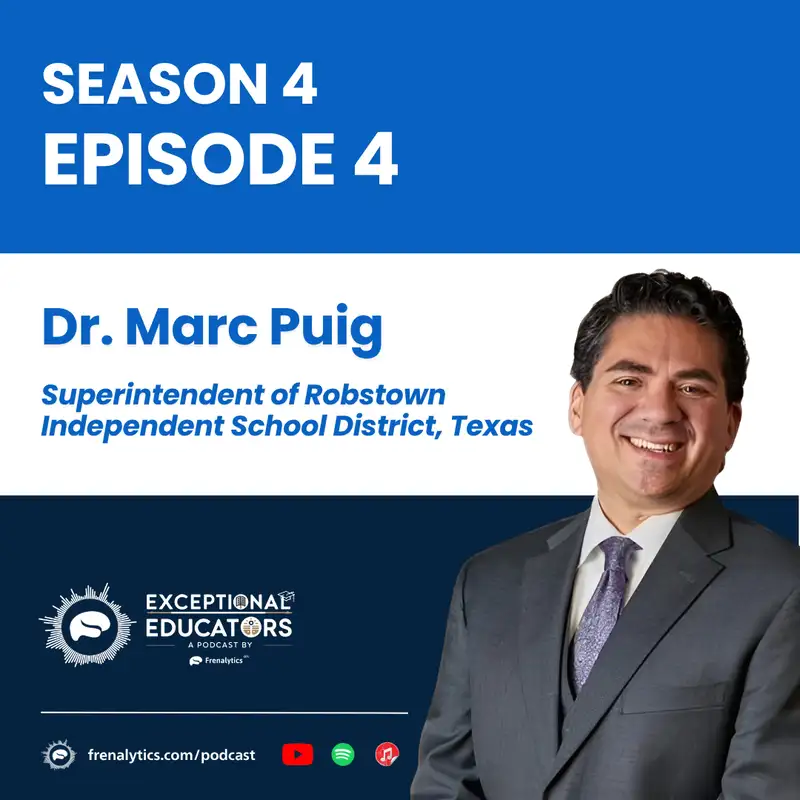
Limitless Futures: Dr. Marc Puig on Igniting Brilliance in Education for All Students
Welcome to the Exceptional Educators Podcast by FrenalyticsEDU, where innovation meets inclusion in education. I'm your co host, Matt Giovanello, the CEO and co founder of Frenalytics. At Frenalytics, we put special education and English language learners front and center. Our award winning FrenalyticsEDU platform helps streamline progress monitoring, improve communication and compliance, and offers truly personalized learning to your students' availabilities. Each episode of our podcast features candid conversations with district and school leaders, classroom changemakers, ed tech founders, and industry executives, all dedicated to transforming learning for each student, especially our learners with unique abilities.
Speaker 1:With a focus on extraordinary educators and the exceptional students they serve, we explore the latest in special education, accessible technology, and inclusive leadership. In this episode, Exceptional Educators is exceptionally thrilled to welcome dark Doctor. Mark Peuge, a dynamic superintendent whose leadership philosophy centers on visibility, connection, and big picture thinking. In Robstown IS, deep outside Corpus Christi, Texas, Mark has become known for inspiring staff, supporting students, and staying active across district platforms to strengthen communication and community trust. Today, we'll explore the leadership, innovation, and the heart that drives his work.
Speaker 1:Mark, thank you for joining us this afternoon. Welcome, welcome.
Speaker 2:Hey, Matt. It's good to be with you. Thank you. I'm excited.
Speaker 1:Likewise. See, let's do this thing. I'm gonna kick it off with a question that we love to ask each of our guests. You may have heard this question once or twice before. Mark, what's your why?
Speaker 1:What got you an education? What's keeping you here? What's getting you excited for the road ahead?
Speaker 2:My why is straightforward. It is to exist to add brilliance and impact to the lives we touch every day. Doesn't that sound ambitious, like adding brilliance and impact to lives we touch every day?
Speaker 1:It's so simple, but it's not. You make it seem so simple. How are you doing? What's your
Speaker 2:Okay, well, Brilliance Impact begins with yourself, right? You gotta lead yourself first, so how do you make yourself brilliant in terms of being brilliantly humble and taking the approach of Socrates and the wisest man in the world? All I know is I know nothing. That may just mess up my podcast now, right? All I know is I know nothing.
Speaker 2:But we have to take this humble approach to pursuing brilliance. And that means really managing yourself, leading yourself in all aspects, professional life, your spiritual life, your emotional life, your physical life, all of those aspects of who you are, you have to make brilliant. And then once you begin to impact yourself in those areas, then you can actually have an impact on others personally, whether it's your spouse, your friends, your family, or your work life, where we are here. It's really difficult to divorce your personal ethos from your professional ethos, in my opinion. And so my why is to, in all areas of my life that I just described, to add brilliance and impact.
Speaker 1:I love it. Again, seems so simple, yet so inspirational. A similar inspirational phrase that you and Robstown like to use, I know, is this concept of limitless future. So, you have to believe in yourself before you can pour into others, as we very well know. What does this limitless future tagline, more than just a tagline, more than just a motto, mean to you in the professional work that you're doing, but also as you inspire your staff and your students across the district?
Speaker 2:Yeah, it really means you have to own the experience where you're at. As they say, wherever you are planted, you shall grow. Here, we live in a very impoverished community, low economic tax basis, low, but that our challenge can never be our excuse, can never be our excuse. So we have to exist to create this learning opportunities in these communities that as we know the data are incontrovertible likely doesn't happen for this population, right? So for example, you know, last year we had a, one of our gifted and talented teachers approach us and say, Hey, we have some kids that want to be part of participating in this academic bee, was focused in science in San Antonio, Texas, two hours north of here.
Speaker 2:And these kids from all over the state come together and converge to San Antonio for this academic bee, this science bee, right? I mean, is great. You want kids to be sweating mentally if they're gonna become you someday, Matt, right? Go to VC, that's what you gotta do. So when they approached us, said, Well, what is our vision?
Speaker 2:Well, it's to ignite brilliance and transform lives and empower generations. Does this opportunity do that? Every decision you make, measure it against your vision, your mission, your values. Well, does, and so we sent these kids to this transformative learning opportunity in San Antonio, I think probably 40 to 50 qualified for nationals, so what do we do? These kids have never barely been, they haven't even been out of Robstown, they've never certainly been out the state, right?
Speaker 2:So this was a transformative experience. We ended up, the school board approved their trip to Florida last year and they got to participate against some of the greatest young minds across the nation to be exposed to this culture of scholarship and academia and thinking and creative, just creativity. That's what we mean by transformative learning experiences. But how do we expose kids? That's what equity is, is exposing kids to things they might not have otherwise had the opportunity to do.
Speaker 1:That is so cool. And the fact that a lot of your students haven't left your local community, let alone have left the state, and now next thing you know, they're being shipped down to Florida to show off the amazing work that they're doing within the district. What a cool opportunity. It may be a once in student lifetime thing, and for others, once in a real lifetime thing. That's amazing that you're making those opportunities happen for yourself.
Speaker 1:Yeah, and
Speaker 2:it's the exposure. You know, Matt, they get to be exposed to a whole new world, a brave new world, different food, different kiddos from different backgrounds and languages and just where that leads, we will never know this side of heaven. Right? We don't know the impact, but that's what we mean about trying to ignite brilliance in kids and have an impact, exposing them to these things that, wow, you just don't know. Mean, of the time, let me ask you, think of a time that was impactful for you.
Speaker 2:What was it you experienced and go, wow, still shapes you to who you are today?
Speaker 1:Well, that's a good one. One that immediately comes to mind is when I was in high school, I did not enroll in a science research class, but my chemistry teacher at the time was also the science research teacher. He was like, you're coming with me. And so he would pull me from band. He would pull me from gym.
Speaker 1:He'd pull me from whatever class and was like, you are going to be in my science research class. Don't have anybody else question why you're here all of sudden, because you're not enrolled. Put a research paper together. You're going to submit to different science competitions and you will win. And sure enough, some of the work I did for what's today known as our company Frenalytics for special education was the research work I submitted.
Speaker 1:I was a national semifinalist through one of the competitions and off to all these places I went. It was fascinating. It was super, super cool. You changed me, Mr. Weiss.
Speaker 2:I mean, that's incredible. Right? I mean, see those exposed, that experiences as youth, I mean, what we do. We mold minds. It molds you to who you are today.
Speaker 2:I mean, that's a beautiful story. Yeah. Similar for me, but it's more music. I'm a musician. As a boy, having a teacher push me to be in choir when I didn't want to, but heard my voice and said, Hey, will you be in choir?
Speaker 2:No, that's not cool. I'm an athlete. Of course I ended up participating in choir and guess what I enjoy doing, but that's just a small part of who I am, but it shapes the way I view the world, the way I interact with the world, the way I interact with people. The things that I champion, we have to champion fine arts. We've lost so much of it nationally because of this thing called budget.
Speaker 2:We have to hold fast to those things like the arts that really help bring out another side of completing who we become. So yeah, great story. Thanks for sharing that.
Speaker 1:And likewise, thank you for sharing yours. I really do wholeheartedly believe in that left brain, right brain piece, because I played three instruments in public school growing up, I'm so grateful that I did. I'm a little bummed that I stopped when I went to college, but it taught me the importance of being able to participate in fine arts while participating in sports and STEM and computer science and all of these things that I had passions for, or maybe I didn't realize I had passions for, but other people in the school building picked up on the fact that, Hey, you can do all of these things and you'll be better off than a more well rounded person for it. Shout out to you as well for not only recognizing how those formative years where you held those interests shaped who you are present day, but now passing it forward to the next generation of students. I think maybe there's a question coming into all of this, Mark.
Speaker 1:So there's a leadership philosophy you have that's quite unique. I think that setting a vision at the top level and having that go all the way down to each and every person in your district will make or break the success of your students because they're sponges. They're absorbing what's being fed to them, not only by their teachers, but also the feeling in your buildings and the feeling across the district. So tell me a little bit about how you approach setting a vision for the district, what you've done over these past couple of years at Robstown, and then also the importance of leadership, not just of you, but everybody in that building.
Speaker 2:Let's see. Let's talk about what's fundamental question you ask, in my humble opinion, when you are with a group of influencers in your community, in your district, that all have a stake in shaping your public schools. It is simple. You say, what do we want to do with these kids who are entrusted in our leadership? What do we envision for them?
Speaker 2:How do we lift them to accomplish that vision? And so that takes a lot of thinking, vulnerability, humility, imagination, and creativity. A lot of times you want to get moving to the action. And I know my weakest leadership muscle is patience. And I've been working on that constantly getting much better than it was even five months ago.
Speaker 2:But you know, you have to give vision the time and attention it deserves. Often leaders don't do that. So we have to think really deeply about these kids that are in our community. What do we want them to experience and how do we give them a school system that the city deserves that lifts? And that's a process.
Speaker 2:I mean, you have to get a cross section of the community together, get all the folks in the room and go through that, what we call a visioning process, and everyone does it a little different, but at the end, you have to have a vision that stretches your community, and then you have to develop the values that really anchor you. And then once you set that, I think the hardest part is really tending to it. But then the next level of that is trying to infect others with that vision. So you have to find a way to inspire those around you to own the vision, mission, and values. And you know, we have a diverse population to serve, whether it's our special education kids who also happen to be GT kids too, our emergent bilingual kids who also are special ed and GT, they fall in multiple buckets, right?
Speaker 2:So everyone in the organization has a role to play in that and you have to bring and take everyone with you, and that's quite a lift, it really is.
Speaker 1:And you're starting to acknowledge it now, Mark, that it's a heavy lift, but you make it seem so effortless, easier said than done, but it has happened considering you have a very diverse background, including a high percentage of underserved community members that then trickle down into your student body of underserved student populations. How are we reaching everybody across socioeconomic barriers, across language barriers, across understanding and belief in a school system, barriers, advanced degrees. What have you done over the past couple of years that has led to the success that you're in right now?
Speaker 2:Let's talk first about external. Engaging your community places of worship. Because in our community, faith based families, that's what we have. So you have to touch your places of worship. And so early on in my tenure, I was very, very involved in visiting with a couple of the local pastors to see how we could connect to deepen the love and the importance of our school system, namely attendance.
Speaker 2:So starting externally, you know, we, we, you have to have a great team. You can't do it alone. I can't do it alone. You have to hire really vision aligned people. And think about Jack Welch.
Speaker 2:I'm going hire you on three things. Okay. Initiative, intelligence, and integrity. And if you don't have the last one, sorry, want anything to do with you. Right?
Speaker 2:So we have to really hire people that are vision aligned, that are going to help drive the external work and then also the internal work. And so you got to have a good PR person, a public relations person. We hired a young lady named Katrina Alejandro who's from Robstown. So for ten plus years she was, you know, she's been in another district and she went through the interview process and I'm going to explain something here to you, Matt. You know, it is people.
Speaker 2:And when you hire people, I don't care if it is for your company, my school district, corporation, small company, boy scouts, whatever, whoever you hire, you got to be ridiculously selective with who you hire. Right? So, I mean, cause it's, it all comes down to people. And so we, we, we hired Katrina back, went through a rigorous process, a ridiculously rigorous process. And so we hired her, bringing her on board really helped ignite that external piece.
Speaker 2:I'm talking about that component. So she, we're the cotton pickers. And a lot of people think that name has some sort of negative connotation. That's who this community is, the cotton pickers. I mean, but we use the word pickers to make some partners.
Speaker 2:So we develop picker partners. So in our communities, we have these picker partners and they invest in our community. They help with things from attendance to like, you know, for example, our local Sonic is a picker partner. So if Mark and Matt have perks of attendance, get what? I go get a free ice cream cone or whatever it is, get it, Sonic, free tater tots, whatever they serve there.
Speaker 2:I don't need it, Sonic. Love it though. Are small little social nudges collectively where our picker partners understand our vision and how they play a role in lifting our community too. That's a small snippet of the external aspect. Internally is much harder and it still starts with who you hire, right?
Speaker 2:But we all know there's a certain inertia to every organization and getting folks to move off of that, it really takes understanding who they are, why they are the way they are and tapping into the way that you inspire people to be part of a cause bigger than themselves. Most people in public education, because it moves at a glacial pace, you know this, an old quote Woodrow Wilson, said, it's easier to move a cemetery than it is to change a curriculum in school. Okay. I mean, and that still stands today. I mean, it's just hard.
Speaker 2:You know, education has been set in its ways and it's, we have to find a way to, you know, really resurrect it completely. Cause I worry about it just like I do about higher end, but that work cannot happen and will not happen unless you can cast a big vision that rallies everyone. You have to rally, you have to reason, you gotta rise, and get everyone to understand why they're here. I wrote a short article about it a few years ago. Vision isn't the only thing.
Speaker 2:It is everything if you're going to move people, but you gotta understand then once you have the vision, you have your mission. Now you gotta get folks inside to execute it. You got to get folks to say, okay, what am I going to do differently?
Speaker 1:You put a lot of that Mark, so eloquently, and it's making me think back to the framework of the six types of working genius that I did over the summer at an education conference in Pittsburgh, Pennsylvania, led by a former superintendent in Princeton City Schools in Ohio. He spoke about how we need the visionaries who superintendents often are, as are you. We also need the people who are able to execute them, as he spoke about. We also need people who are able to take the 30,000 foot view and bring it down to 10 and then bring it down to zero. Hiring, putting together a strategic plan and saying, okay, is how we're going to execute on it.
Speaker 1:It requires all pieces. Right? And that's what then leads to these outcomes, secondary outcomes that we're really longing for in schools, but you can't start without those beginning pieces that you're speaking about. So it reminds me a lot of that framework. And I think that you're a living, breathing example of it.
Speaker 1:And that's what leads to a lot of these programs and these outcomes that you've been speaking of for your district, but also in the roles that you've held prior, and is going to continue your forty plus year tenure of doing that successfully. There's a little bit of an equation here. It is as much a science as it is an art. I think that you're really helping us get that complete picture there. Question for you coming out of that.
Speaker 1:You're known for some of your progressive programs. You named a couple of them before, something as clever, but simple and just motivating as I have perfect attendance. Now I go to Sonic and I get free fries or free ice cream or whatever it What other initiatives are you thinking about? Have you enacted? Are you excited by the outcomes of at Robstown that you think that this should be a good example of other districts too, whether they're in rural communities, whether they have high diverse socioeconomic backgrounds.
Speaker 1:What are you excited about that you're doing in the district that we just need to hear more about?
Speaker 2:Our career technical education workforce readiness programs are second to none in the coastal band. We are a flagship. Schools from the area come to our high school to watch the way that we deliver what we call CTE programming. In the area of welding, we're also really big in the healthcare sectors. All of these areas of CTE, what we're excited about, and we're really doubling down on is aligned with industry needs right now.
Speaker 2:I mean, the healthcare sectors, you know, it's recession proof, right? Kids are coming here and leaving with industry based certifications in veterinarian tech, PCT, CNA. We also have a teacher pathway. So teachers of the future have an opportunity to, through our high school, get a certification as a paraprofessional. And what's really cool about our CTE program is, you know, these kids in that particular strand get the opportunity to come and tutor our kids, look over classes.
Speaker 2:And I tell you that that's an important strand because there is a teacher shortage. It's real. Another one we started last year was the law enforcement. We started that last year and the program has quadrupled. So we really keep our ear to the ground.
Speaker 2:We coordinate with our workforce commissions in the area here in the Coastal Bend to look at what they need. One of the other items on the horizon is process technology. We get into oil and gas understanding how process technology and preparing kids for that field is the next sort of piece we want to add in our CTE belt. Well, what we started last year is called, and we went back to the picker, right? This was called picker paths.
Speaker 2:So we started it down at the junior high, which is essentially becoming an early college junior high. So kids are getting exposed to different industries, different career paths, hands on through these modules. They go through, I don't know, 15 to 20 modules, whether it's drafting, engineering, STEM, culinary, media, multimedia, they're being exposed to all these things in a hands on way that they typically aren't till they get to high school. So we started this last year, it's called Picker Path, so it's really deepened and enriched our CTE program even more than I thought we could. It's amazing.
Speaker 2:That's incredible. I'm serious. The second piece, one of the big components we need in this community is literacy. Early childhood literacy has to be the seminal thrust of everything we do in Robstown America. We are struggling mightily with kids not reading on grade level.
Speaker 2:And we see this statewide, we see it nationally. What are we doing about it? So I engaged them with some very interesting ideas of how they could help with that. Related to that is this idea of really preparing our kids for a new world in public education. One that involves artificial intelligence.
Speaker 2:How do we become one of the first public schools to really leverage and utilize artificial intelligence to help us in all aspects of operations, but also instruction. So I put that out there to them and I said, she goes, what does that even look like? And I said, look, you know, we aren't the first to do this. There are private schools that are doing this across the nation. So I kind of gave her an overview of what our vision was and how it might look.
Speaker 2:Kids were sort of self directed. I would hire Matt. Matt's not a certified teacher, right? Matt, you're not? No.
Speaker 2:But you could be a certified people person, a guide, an influencer, someone to help provoke some deep thinking, right? And allow kids to experience those subjects in the practice of agency, student agency, learning on their own, which is essentially what happens in college, right? And then spending the other portion of the day or a portion of the day, giving them skills that they really need to be the next match in parallel. How do you do that? How do you do that?
Speaker 2:Well, you gotta teach them how to speak publicly. You gotta give them some financial literacy. You gotta give them some entrepreneurial ship. You gotta think, how do I get them to create? So this school that I'm pitching to her would have some of those components.
Speaker 1:I'm glad that it is inspiring you, not just right now, but it inspired you years ago to say, okay, we need to become we need to look within, and then we need to look externally and say, how are we going to become more innovative? How are we better going to support our learners now and the next generation? And how did we do that yesterday? Like we can't wait for, you know, something to come hit us in the head and say, this is what you have to do. You have to take it upon yourself.
Speaker 1:So I agree with
Speaker 2:you in all of those aspects. So we have to have things that are sticky. It can't be about the leadership. It's gotta be about those that stay with it, and typically the school board that stays there. They've got to continue these innovative ways lest the systems revert back to you, say, like you said, the status quo, which wants to hold on with bloody tenacity.
Speaker 2:Mean, you know? So we have so much work to do in this realm, but those are the two areas, I think. That was one sort of a current initiative, you will, under the umbrella of CT that we're really excited about. And then one future one that we are super excited about right now.
Speaker 1:I'm excited for you. I'm excited you're excited, but I'm excited independent of that just because I think it's a direction that we need to be heading. I do, to play devil's advocate a little bit, Mark, to take a moment to reflect on the equity piece to this. CTE for our Gen Ed students who are already high performers, amazing because we can introduce them to what their career and life is going to look like outside of graduation when they graduate. For special education, sometimes that's an if.
Speaker 1:So tell me a little bit more about how some of these programs are being applied across the board to support our students in those special education environments. What do those access pieces look like? What's different? What's the same? How are you thinking about innovating in special ed in the wake of needs growing and finances getting even tighter than they were just a couple of years ago?
Speaker 2:So let's talk about first the biggest inequity we have in public education, the biggest inequity. And that's tier one instruction. Tier one instruction is good instruction, high quality instruction for who? All kids. All kids.
Speaker 2:Okay. All kids. High quality instruction. Your first teach has to be your best teach. What is evidence that it's not happening?
Speaker 2:When you have kids less than 80% not reading on grade level. That is a sign that your tier one instructors are. When you, and what happens is a doom loop. This occurs, I've walked into every school and everyone I walked into Matt is a fire, it's on fire. And the fire is usually in tier one instruction.
Speaker 2:I look at the data, how many kids are on grade level? Thirty five percent, okay, your district's on fire. And so you're in this doom loop, you have a broken tier one system and then you have what? I'm gonna continue to do what I've always done, intervene intervention, tier two, tier three, I'm going to continue with struggling learners, following my doom loop, and guess what? I got burned out teachers.
Speaker 2:See what I'm saying? There's your Broken
Speaker 1:tier Everybody in tier three, you're over identifying special ed, everybody's burned out as a result, and no one's getting the services they need.
Speaker 2:And and I wanna set this problem up right, because this is where we have to improve as not only in Robstown, but as public ed and as education on the main really is this. We have doubled down on tier one instruction to ensure that all kids, every child is receiving a high level, high dose of not just high quality instruction, but high quality instructional materials regardless. And my special ed director inherited a system where her special education teachers were not connected to the content core teachers. How is that even possible? How do we make the teachers understand that role?
Speaker 2:And it's a mindset now. So you talk about how do we overcome it and expose everyone? And it's a mindset. We have to get everyone. We have to really change mindsets to understand that is making sure that our tier one instruction impacts whether it's our merging bilinguals, our sped, all of our populations.
Speaker 2:Right. But also making sure we have a life changer who understands their role as a teacher and connecting to what their calling is here in the district. Does that make sense?
Speaker 1:It makes perfect sense. I love that you're starting with the root cause of the problem. And if we start with our strong tier one instruction, you'll see that things in the second, third, fourth tier, not in MTSS, just second, third, fourth order effects are a lot stronger and changing along the way, tier one, tier two, tier three referrals of special ed. And the feedback loop will become that much more resilient as a result, of trying to tier three your way out of a tier two problem and tier two your way out tier one problem, because we've seen that play out and that ain't the solution. That ain't the way to do it.
Speaker 2:Yeah. So we have a lot of work in area, but we have to really also empower our educators to do this work in the right kind of way. Cause once you get in a strategic plan, you know, and our strategic plan is simple, Matt, it's just four parts. One, we are focusing on tier one and all things related to that. That's one pillar of the strategic plan.
Speaker 2:The second one is understanding we are a professional learning community. Hear that word PLC, PLC. We are. The third part of the strategic plan that we're getting everyone to move towards is what we call a learning walk protocol. So when you walk out of a learning walk with your colleagues, you ask yourself three questions.
Speaker 2:What did I see? What did you hear? What did you wonder? This is the protocol we use. It's what gets teachers to be part of the solution.
Speaker 2:It causes them to feel truly empowered. In other words, you've empowered, I mean, you've given them the skills to do this and the permission. And so the last piece is the coaching model. I said the tier one is the first front, the PLC, the learning walk, and then the fourth part is the coaching model, where we have created this culture of feedback, where the teachers crave feedback. How did I do?
Speaker 2:What did I do? And that's what you want. Feedback is a gift. Which is
Speaker 1:amazing to hear because I feel like most teachers are scared of feedback, and they see Doctor. Puig coming into my class and like, Oh crap, what am I gonna do wrong? What am gonna to get negative feedback on? So the fact that you flipped that is huge.
Speaker 2:So we have got to really emphasize like, if we're going to get better, then we have to become reflective practitioners. You know, I never call myself an expert, but I am an effective practitioner, a reflective practitioner. Like how do I keep getting better at, you know, we can get better student outcomes, don't change until adult behavior or adult practices change. And so in Robstown America, that's what we are focusing on changing our practice, honing our craft so we can fulfill our vision of igniting brilliance, transforming lives, and empowering generations.
Speaker 1:I'm so glad you walked us through that, Mark. Thank you. And I think the examples are an excellent illustration of how you're not only having this on paper and here are our four pillars of our strategic plan, but this is how specifically we're doing it. Because I feel like that execution part sometimes gets lost and it's like, these words sound great, but how are you actually doing it and what is the effect of doing said aspect of the strategic plan? I just called those examples.
Speaker 1:Thank you.
Speaker 2:Yeah. Thank you for pointing that out. Mean, do have an execution issue and I don't care what industry you're in. If you talk to any CEO, she or he's going to tell you, you know, what's, what's the biggest challenge we have. It's execution.
Speaker 2:You know, it's just getting everyone to commit to the mission and executing the strategies at an exceptional level. It's, it's a lot, but we're getting there.
Speaker 1:Yes, you are.
Speaker 2:I'll give you evidence we're getting there. You know, we have a couple of, there's some campuses that are struggling mightily on our A through F accountability rating. And this past year we moved one campus to a D, to a B as in boy. We have another campus, our high school, which is our flagship, moved from a C to a B. And then we've got three other campuses that are still struggling that we are in the process of moving.
Speaker 2:We've changed some leadership there and so forth. Yeah, all evidence, data we are collecting is showing we are moving in the right direction.
Speaker 1:Good. I'm glad you're bringing up that data word. I have one more big topic I want to It's explore with you, your favorite. It's the D word, data. I want to frame the question like this.
Speaker 1:This is a little bit of a hot take. Yes, sir. On our side, running a software that collects data for special education, for MTSS, for English language learners and other underserved populations, data is everything in our world. Right? However, our staunch belief is there's so much work that educators are pouring into students and outcomes are increasing.
Speaker 1:But if you're not measuring those outcomes, then sometimes it's for naught. Sometimes you don't know the efficacy of your intervention. Sometimes you don't know the frequency of whether those interventions are given and whether they're well received by students. And when it comes to parents, it comes to the state of Texas, whether it comes to whatever else you need to deliver to, the data's not there. It's like, well, we don't even know what we did.
Speaker 1:Right? That at the same time can easily be misconstrued as collecting data for the sake of collecting data. So let's tease that out a little bit more. I'd love to know your perspective, your take on data versus data that you're actually drawing insights on and acting on and executing on. So where does the line draw?
Speaker 1:Where does the line stand? Where are you drawing your own line of like, this is data that's distracting versus this is the data we need to make a change?
Speaker 2:Yeah. Well, so philosophically, I think, and I shared with you the top of our conversation here. We have more data than we can shake a stick at. We have been doing data dumps for decades. And I love data in another space.
Speaker 2:I was an analyst and basically in that world, I collected a bunch of data for a client, distilled it down to some key takeaways and said, okay, this is what we recommend your company do. If you want to improve X, Y, Z, right? We have now in public ed and continue to have this notion that collecting data actually changes outcomes or changes actions. It doesn't. So how do you do that?
Speaker 2:Leadership. You have to equip leadership to use data to drive insights. Once the data dump is done, how do you force inspire, conjoil, persuade, whatever you want to say. Folks, to be an analyst, every teacher across every content is an analyst. You're an analyst.
Speaker 2:And I'm not saying that every child is just a data point, they're not, but that data has to inform my, back to the reflection, inform my practice as a teacher. And the principal's primary job is ensuring that the data collection, one, we're collecting the right data and two, it is part of that, which it is for us, that professional learning community. We're bringing the data to look at the cross section of our kids, whatever bucket they belong in or buckets they fall in. We're using that data to inform our practice. So what does that look like for us?
Speaker 2:I'll give you one example. Know, have an elementary principal, she has a data drive. She's collecting data on, and we go back to early childhood literacy, in our curriculum we have two components, I'm gonna make it real simple, two components in our curriculum, skills and our ELAR, English language arts curriculum, skills and knowledge. So knowledge is like the fun lessons and we're learning about deciduous trees. You're learning about all kinds of things related to botany and these are young kids, right?
Speaker 2:Third grade, but that's knowledge. Skills is the phonics components, becoming a reader, fluency, becoming fluent, understanding what I'm reading, emphasizing comprehension, making inferences, but getting those skills down is where our data showed last year we weren't doing. We had knowledge down. Teaching skills is a little harder. And the teachers admitted it and principals themselves.
Speaker 2:So what do we do as leaders? We're collecting these data, so now this year, she's one example, our principal has this data drive that has, we have data on all of our kids regardless of their background. We know how they're doing on knowledge and we know how they're doing on skills now. So really honing in and using that data from the skills to reinforce the early childhood literacies in K-three, where we really, really need to win the war. If we're going to win the war on literacy, we have to win in the early grades.
Speaker 2:That's one example of using data in an insightful way, in an actionable way. And the principal takes that data drive, looks at those numbers and then coaches Mr. Big or Mr. G coaches those teachers on the execution of a lesson that's going to help those kids get better in that particular skill.
Speaker 1:I think the big takeaway I'm getting there of your definition between the two types of data, data that's a little bit of a distraction, or you feel like you're making some sort of gains when you're really not, versus data used as a means to an end of helping either measure the efficacy of something that's already happened, or as a means to drive a decision that's rooted in future changes in instruction or whatever it might be. I think one of the big takeaways there is it doesn't make the collection of the data any easier, but it gives purpose to make it worth it. You understand as a teacher now why you're going through this laborious task prior of like, I'm collecting all this data. What is the purpose of it? It's like, okay, now I see the clear path of collecting all of this and now I'm able to do something about it.
Speaker 1:And that's that insight, that's that action piece. That's that, how do we affect change going forward based on current state? And then the other is, okay, now that we made all those changes, now we've got to measure again and see what gains or what regressions did we achieve as a result of that. So I think that was a really clear example. Again, doesn't make it easier for teachers, but at least it makes it worth it.
Speaker 1:It gives them that purpose. It gives them that understanding of this is why we're doing it and here's why it's important.
Speaker 2:Yeah, for sure. I think that we are way better now collecting the right data, but equally important, we are better at using the data to actually inform our practice where beforehand, like I said, was just the data that we talked about it and collected it and okay, I'm going to go back and still do what I'm doing because I really liked the knowledge lessons. Even though I've got some skills lessons, I got some skills data that show that I need to focus my efforts there. But again, it's that leadership that really has to get the teachers, that's where the rubber meets the road, the teachers to really use that data to inform their practice and it changes lives. I am so impressed and amazed with the way our principals are using the data in a meaningful way.
Speaker 2:I can tell you right now, you want to improve student outcomes in math in the elementary, you focus on fractions, percents, decimals, ratios, and place value. I've had the same data in every district on those areas. If you focus on those areas, I promise you will increase scores exponentially, but do they do it? No. They focus on everything else around that or just a little.
Speaker 2:Go deep there. If you don't go deep there, and the data says you should go deep there, you're not gonna get the results. So who's really the slow learner, the kid or the adult?
Speaker 1:Kids are easier to mend than change. The adults are the complicated ones. Us adults are the problems. But the equivalent example in ELA, Mark, is the same that you're making for math. That early literacy, that early intervention in phonics, in reading, like those are the pieces there that we need to focus on more than, you know, maybe the fun lessons or the similar points that you're making there.
Speaker 1:If we go deep in early literacy that will solve our literacy crisis happening at the late elementary school, middle school, high school, and adult age, where we still only know how to write a sentence. We don't know how to read these deeper pieces because fortunately at the elementary school, things fell through the cracks and we didn't build that foundational knowledge. So I think you make a very salient point. One that might be obvious now listening to this, but I think it's clearer than ever that that's where the investment needs to be made. And it's so worth it.
Speaker 1:It's so, so worth it. Mark, we are near the end of our time. I'm going to ask you one more final question that we love to post to each of our guests. The question for you, Mark, is what does being an exceptional educator or being an exceptional leader mean to you?
Speaker 2:An exceptional leader to me means seven words. Do what you say you will do.
Speaker 1:When you'll do it. When you say you'll do it. That's the end of that sentence.
Speaker 2:Yeah. I mean, I just think that leadership has to follow through. Leadership means if you have a vision, great. But you know, vision without action is a daydream and action without vision is a nightmare. So you have to make sure that you've got a vision that you are going to execute for all kids.
Speaker 2:To me, that's public education leadership right there.
Speaker 1:You got that right. Mark, you are exceptional. You are entertaining. You are so salient with your points. You are an inspiration to the staff, but also the students that you work with.
Speaker 1:Robstown is lucky to have you. We're lucky to have you. Your districts prior are just as lucky, and wherever life takes you in these next years ahead, they'll be lucky to have you too. Thank you for inspiring me today with your stories and with your leadership lessons. Thank you for lending your voice to this podcast, and thank you for being the superintendent star that you are.
Speaker 1:We are just so lucky to learn and grow with you. So thank you for joining us tonight on our podcast.
Speaker 2:Thank you for having me, Matt. It was a pleasure. I love your energy and passion for serving really engaging deeply today. Means a lot to me. I appreciate you, sir.
Speaker 2:Well, I got
Speaker 1:you a thousand percent. To everybody listening to today's episode of the Exceptional Educators Podcast, thank you again for joining us, and we look forward to catching you at the next