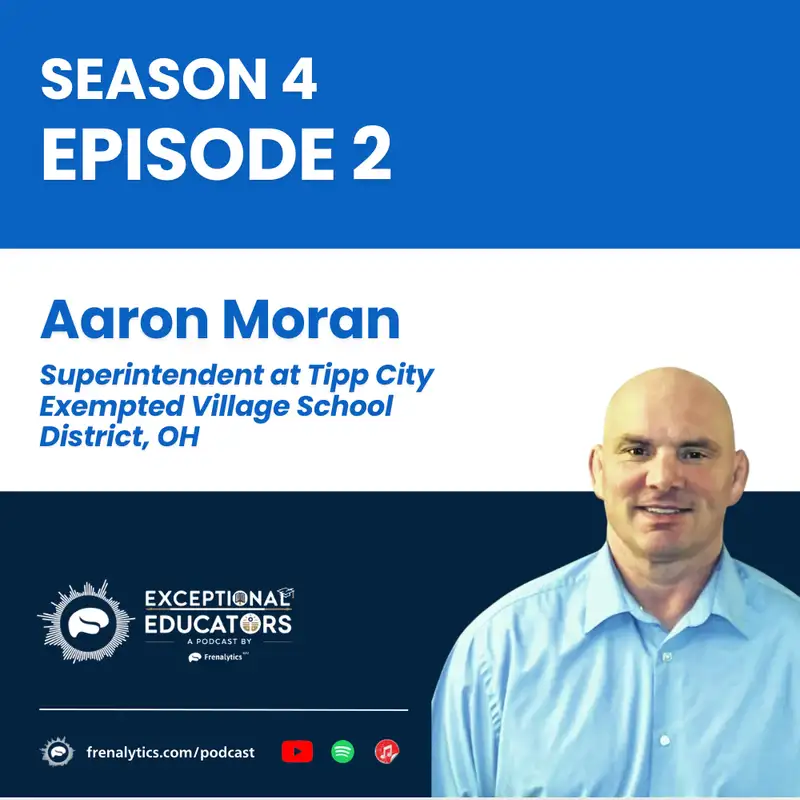
Pioneering Progress: Aaron Moran on Collaborative Culture and Designing Spaces for Inclusive Education
Welcome to the Exceptional Educators Podcast by FrenalyticsEDU, where innovation meets inclusion and education. I'm your co host, Antonia Ellis.
Speaker 2:And I'm Matt Giovanello, the CEO and co founder of Frenalytics. At Frenalytics, we put special education and English language learners front and center. Our award winning FrenalyticsEDU platform helps streamline progress monitoring, improve communication and compliance, and offers truly personalized learning to your students of all abilities.
Speaker 1:Each episode of our podcast features candid conversations with district and school leaders, classroom changemakers, EdTech founders, and industry executives, all dedicated to transforming learning for each student, especially our learners with unique abilities. With a focus on extraordinary educators and the exceptional students they serve, we explore the latest in special education, accessible technology, and inclusive leadership. In this episode, Exceptional Educators is exceptionally thrilled to welcome Aaron Moran, a superintendent leading a major transformation in TIP City Exempt Village Schools with eleven years of superintendent experience, a background in special education, and a district that just earned a five star rating from the Ohio Department of Education. Aaron is guiding Tipp City through new building projects, inclusive learning initiatives, and a renewed focus on student success. Welcome to the podcast, Aaron.
Speaker 1:We're so happy to have you.
Speaker 3:Great to be here. Thank you.
Speaker 1:So we usually like to start off our podcast asking a question that I'm sure you've heard a 100 times in your education journey. What is your why? What brought you to education and what keeps you in this space?
Speaker 3:I've kind of stumbled into education. It wasn't something that was, planned, so to speak, but I've been in education administration now twenty six years and everything to me has been doing what's best for kids. And how do we engage kids? How do we get kids to do more of the thinking, more of the connecting on their own and to be active learners? And that's really the why for me.
Speaker 2:Aaron, I love that. And I know that you come from a background in special education as well. So tell us about your early days. How did you go from special education in the classroom to superintendent?
Speaker 3:Well, this is where I think the special education part is just something I've grown up in administration and not something that I was part of, but it's always been something that we want to challenge all kids. And that includes students with disabilities and other kids with challenges. They all have the ability to be successful. I truly believe that piece. We're here to unleash that creativity and that finding that special place for them and letting them know that there is more than what they believe they can do a lot of times.
Speaker 2:You're a thousand percent right. That's a conversation we talk about a lot here, Aaron, how we support our underserved learners to reach their fullest potential. From the outside, it might seem that their disability may preclude them from achieving the Gen Ed curriculum or being successful, we all know, especially on the education side, that's not necessarily the case. But it requires a very disciplined, thoughtful approach to inclusion. And I know that Tip City is no stranger to inclusion.
Speaker 2:Tell us a little bit about what the district and you have been leading on the forefront as it relates to bringing more inclusive practices for special ed, your gifted and talented programs, and your small but sizable English language learner population. We know they sometimes are perceived as different, but all under one roof. How are you supporting those groups?
Speaker 3:Really being intentional and challenging each of them, each of those groups at different ways. Students in special education. The resource room has a small part of things, in my opinion. I want students in the classroom with their peers. I want them to be challenged at that level and differentiation may have to occur.
Speaker 3:And I think that's something you're hearing a lot in probably the last five to ten years, differentiating lessons to meet the needs of everybody. All kids need to grow at that high rate. And I think when you put kids only in a resource room area, you're not giving them exposure to typical peers and stretching them like they need to be stretched and giving them a text that is at great level or challenging text that puts them to a different level of thinking. I know we think, well, the kids are doing well, but they're never closing the gap. And that's something that I think is very important.
Speaker 3:The idea is to get them out of special education because they've built the skills, they've overcome the adversity or managed new skills to help them be successful. So that's what we're really trying to do in our special education realm. ELL, it's a smaller population than our special needs, but again, it's the same thing. Get them engaged in the classroom. We have a couple of really good ELL staff members that work K-five and six-twelve to help with student needs and engaging them in stuff.
Speaker 3:And then the gifted section, same thing. How do we challenge these kids to go deeper where needed, but also accelerate where needed as well? Because their job is not to necessarily teach other kids what, Oh, I got it, so I'm just going be the teacher helper. No, we need to provide them engaging, challenging things because no different special education students to me. Gifted students, when they run into something tough, then all of a sudden they think they're not smart and then they shrink.
Speaker 3:That's what happens lot with kids in general and adults for that matter. We need to build that resiliency up in all our kids to challenge and to see where that ceiling is because I don't think we challenge enough of them.
Speaker 2:I agree. What I'm hearing, Aaron, you call out is confidence, competency, and that resiliency across different populations. It's way easier said than done, you certainly know that for sure. I'm curious as we think about changes throughout Ohio this school year and beyond regarding MTSS and the newly relaunched iMTSS program, how you see supports for students in the subpopulations we're talking about fitting within the framework of MTSS and what your district makes of those scaffolded supports and tiered supports you could offer kids. And on a related note, your PBIS program, because we know that MTSS doesn't necessarily call for it, but Tip City is a big proponent of PBIS.
Speaker 2:So tell us about how all of these things intermingle and how you're best supporting your kids.
Speaker 3:I started my third year in the district here at Tip City, and that's one area that we really need to get a clear path and clear expectations for MTSS. And that really comes down to making sure, to me, tier one instruction is meeting that need of 85% of the kids. That is really for instruction for all kids. We have to make sure our practices are engaging all kids at that level. And that's really to me the focus.
Speaker 3:And then once we're engaging them and we're looking at data, really finding out, okay, we taught a lesson. Did they learn what I wanted them to learn? Did I not? How do I provide another scoop at our elementary level? This year, really trying to get them to push in and support all kids.
Speaker 3:So, Title I is not a magic where they go somewhere else and all of sudden they learn how to read, it needs to match what's happening in the classroom. Same thing with the special education piece. And so it's a systemic plan that addresses those things. And the PBIS, I am more about the actual achievement. When the kids know that they can learn, they're going to have to work at it.
Speaker 3:There's no doubt about it. Some kids may have to work harder, but they have to be willing to work. And once we get them working, the results may not come immediately, but we keep at it, we keep supporting them, the results will come. And then they will believe. They're not going to believe because we told them that.
Speaker 3:They're going to believe it from the results of getting an improved score on their standard based report card that we started at the elementary level. But actually seeing that they did better because they are putting the work in and we are learning they are learning the skills needed to be successful.
Speaker 1:I I've used PBIS at, one of my previous schools. It was a pretty interesting system. At least it was our first year using it. And it seemed like a just super rewards based system, something that really helped us bring community. We're able to scan the students' IDs in the hallways that we felt like were showing model behavior and just things of that nature, trying to organically implement the system into our daily routine.
Speaker 1:What are some ways that you encourage your teachers to implement PBIS in their daily routines to where students know that it's happening, they understand the system, and they're working towards certain goals?
Speaker 3:Well, to me, what you're talking about is culture. You set expectations. You hold people accountable for those expectations. Accountable is what are the supports you need in order to get to where we want you to be or where you can be at. So I really think that it's recognizing kids when they go above and beyond.
Speaker 3:They may not know how to do certain things, or that's a different expectation than they've had. So you have to work with them on that. But it's all about them becoming better. Again, it's work. So we recognize kids at board meetings every month, kids that go above and beyond.
Speaker 3:They do stuff at all the different levels for recognizing students who are super citizen breakfast and growing leaders at the various elementary schools that we have, the two elementary schools that we have. So, there's some of that going on, but it's everybody having the same expectation. Extrinsic motivation only goes so far to me. It's the intrinsic when the kids know that they can do it, they believe that in themselves, that's what we're looking for.
Speaker 2:Aaron, that sounds to me like you're highlighting a key maybe misunderstanding of PBIS in that it is exclusively extrinsically motivating for students. I think if properly implemented to your point, maybe it starts extrinsically motivating for students who need that piece, but then it moves this more intrinsic motivation to not only show up to school to participate, but to deepen your understanding of like what comes ahead and what life looks like after school, how this is all kind of building blocks for one piece to another and how your actions affect others and how other people's actions affect yours. So a much broader piece than just academics or just behaviors or just insert piece here. It's a lot deeper than that. I'm really glad that you're calling out a couple of those examples.
Speaker 2:Let's get into culture a little bit more. I know Tip City has been recognized not only by the state of Ohio, but is known across for its unique approach to culture. What are a couple of the pieces since you took over as superintendent a few years ago that you've prioritized culture wise to really reshape what things looked like in the district from when you first started. It looks a lot different now. What are the key pieces you've been focusing on culture wise?
Speaker 3:I think the biggest thing that's making a difference in this district and my previous districts was the collaboration. I think everybody says, yeah, we're a family. We know each other, but they don't know what's necessarily going in their classroom. They don't know what the teaching goes on. So some of the things that we implemented with learning walks and providing feedback, teachers providing feedback to each other.
Speaker 3:Not only do they provide feedback to help the other person, but they're learning at the same time and they're getting resources. So that collaboration of people working together, aligned to what's in the best interest of students. How do we make this more engaging for students? How do we make sure that all kids are engaged in the activity? What type of activities could we do that elevate the thinking for all kids?
Speaker 3:That's really starting to, I think, positively make an impact of bringing everybody together. We're on the same page. So alignment is very important. Setting the vision of this is what we need to do. I don't want 80%.
Speaker 3:I want a 100% of our kids to be proficient. That's the standard. And we're going to do that through collaboration, creativity, and working together to make that happen. So we have that going on. At the same time, our professional development is different.
Speaker 3:It's not a top down approach. We have invested in our teachers to be professional development leaders and department chairs that are helping guide their professional development. So for example, we have one day a month that we're meeting at 06:45. The other three times are working with departments. So what are our needs?
Speaker 3:What do we need to get better? How do I you know, it could be, for example, high school is working more like intentional lesson planning and student engagement or evidence of student learning. Middle school was working on similar things. Elementary gave time to work on standards based grading, there's commonality understanding of what those issues are. Now, what do we need to do?
Speaker 3:How do we fix these things? It's more, again, engaging the adults into the actions of how it's going to benefit them in the classroom.
Speaker 2:I think that's a really unique take on professional development that not only trickles down to the outcomes that your students are achieving, but also speaks to teacher retention. Because as you know, Aaron, a lot of districts struggle with teacher retention and it can be a little bit of downward spiral. If you don't have the best of your educators, you can say you want a 100% proficiency all you want, but if those teachers have a higher than expected turnover or higher than average turnover, then there's no continuity there. There's no culture, and you're not going to be recruiting and retaining the best of your teachers. So I think that's a really important piece to underscore as well.
Speaker 2:It's no surprise that you've seen really huge success in Tip City for that. Just to give a little bit of context for those listening of the type of district you're running. You're just North Of Dayton on the Western Side Of Ohio. You have about 2,400 students. I think that might be growing a little bit.
Speaker 2:Is that right? It's been stable. Okay. So about 2,400. You're the number one school district in Miami County.
Speaker 2:And we were just referring Not yet. According to niche, they say so at least. According to the niche. We'll take it from I'm
Speaker 3:looking at performance index scores. I'm looking at our achievement. I don't want to make We can do it. We're going to get there.
Speaker 2:Good. Good, good, good. And as Antone was introducing you, you just recently earned a five star rating from the Ohio Department of Education, which can be sticklers as we know. So I think that just for that background of the size of your district, its location, and what you've been able to achieve in your couple of years is night and day compared to what things looked like just a couple of years back as you started your tenure there.
Speaker 3:Well, again, I think the state report card earning five stars, they add some new, some different variables. We have four and a half this past school year. The academics ticked up in a in a positive manner the last couple years as well. But the we want to compare ourselves against the best. Right?
Speaker 3:I want to be not just good for Miami County. I wanna be recognized because our staff has the ability to be the best in the state. Our kids have the ability to be the best in the state, and I want them to feel that and know that they have that potential to make that happen. So we're working every day to make that happen. Going back to the professional development, a lot of things that we're doing that make a difference is sustained professional development.
Speaker 3:So every two weeks we have a late start on Fridays, which allows teachers to collaborate. We have to create time for teachers to be able to collaborate. To expect them to do that as they're passing through the hallway can't happen. We have to create time. Just like any other business, any other model out there.
Speaker 3:You have to have time for people to work together to make sustained change and growth. And our teachers have done a really nice job when we moved to this model to utilize that time for the best interest of kids.
Speaker 1:I love the idea of making the time for teachers. I taught for a few years and I feel like they just wanted us to come up with our own imaginary time and collaborate during, again, these imaginative hours that were with beyond our contract hours. And I'm sure making the time for the teachers during their already contract hours makes them more willing to collaborate, more willing to be creative, more willing to be great. Have you seen better results than making these times for for your teachers? Have you seen any teachers wanting to become teacher leaders?
Speaker 1:Have you just seen any huge differences since
Speaker 3:I I think that going back, that collaboration has worked. We've had teachers that said, I taught with this person next door for X amount of years. I never knew what they were doing in their classroom. And then I go on a learning walk. And that's a little vulnerable, right?
Speaker 3:They had to take a step out of their comfort zone, but they learned. And we just had a teacher, Mrs. Stooky, seventh, grade English teacher. She put on a literacy night at the end of first quarter, in first quarter, where we're using wit and wisdom for our ELA. And she said, Hey, I'm going do this for my kids.
Speaker 3:Does anybody else want to jump on board? Before you know it, we had the sixth grade and other social studies and other staff get involved. The kids were displays all throughout the media center, in the cafeteria, in another classroom where kids were displaying. But what was the best part about it was the kids were there and they brought their families there in the evening to show off. And the number of people that came in to check it out and the kids were explaining, making the connections, showing why they did this, it wasn't just slapped together.
Speaker 3:There were some pretty elaborate things that kids did and that the teacher provided. She's been doing it maybe 30. She did something different and very proud of the work that she did to make a difference. That's again, it was kids of all levels that had stuff displayed, multiple pieces, poetry, their own stuff. So that was really good.
Speaker 3:And we're seeing more of that collaboration occurring, and that's exciting.
Speaker 2:That's awesome. And it's a relatively small intentional change that you can make, Aaron, that fosters that collaboration compared to, you know, giant multi year district endeavors to try and achieve the same outcome. That's an awesome example. Just so, so heartening here. So cute.
Speaker 2:Speaking of multi year endeavors though, taking kind of the flip side of this. There are intentional things you can do there. And I know capital projects is one of the big pieces that Tip City has been investing in. So tell us a little bit more about the new spaces that you're building and what the next couple of years look like, that road ahead, as you build out those spaces.
Speaker 3:So we're waiting tomorrow. We get our first draft of the guaranteed maximum price for the building. So we want to make sure we're in budget. All the bids have been out, so I think we're doing okay. But we're really excited about this endeavor because two years ago when I came here, we had five buildings.
Speaker 3:We had a K-one building, a two-three building, a four-five building, a six-eight building, and a nine-twelve high school. Three buildings, three of them were on the same campus, but still separate. We shut one down because roofing, asbestos, all these issues that we were running in with it, we consolidated to a K2, three, five, six, eight, nine, twelve. In two years, we're going to move in, hopefully knock on wood, December 2027, we're going to move into a unified PK-eight building. And we've been very intentional working with the architects, working with school design consultants, that we are essentially making floors.
Speaker 3:So it's going to be a K-twelve floor, three-four-five-four, six-seven-eight-four. But in that, everything you need is there in that floor. So your counseling, your OT, PT, your office will be there in with the kids. So the way we have it designed, there are kind of pods. So eight or 10 classrooms around the outside, which includes special education, which includes all your related arts.
Speaker 3:So, your art classes, your music class, everything you need is going to be on that floor. The only thing that you won't have is you got to go down for lunch and you got to go down for gym if you're on the 2nd Or 3rd Floor. Everything else is right there where you need it. And we have extended learning areas in the pods. And that's something that's been very neat.
Speaker 3:Especially at the middle school, we have a couple of new staff members in the sixth grade English class who use this extended learning area to combine classes, to make connections, to do these things. And that's what we're envisioning. We have garage doors that will open up in four of the, I think four of the 10 classrooms or whatever. So they can use that to extend the area, to bring people together, to have space for multiple classrooms, to work together on things, maybe even some cross curricular. But we're really working on this, again, space to collaborate.
Speaker 3:We don't have that right now, except for at the middle school level because we consolidated some things. That's something we're trying to really be intentional about inclusion, including all kids and all the needs. They don't have to go somewhere else to get what they need. Everything's on that floor for those kids.
Speaker 2:It feels like collaboration is central and at its core with all of these large and small changes you've been making and continue to make. It's awesome to hear these examples. I have to know, Aaron, what did you draw inspiration from for the designs as you're putting these blueprints together for this new PK 8 Building? Did you look to other districts? Did you bring in consultants?
Speaker 2:What inspired you to design this future building in the way that you did?
Speaker 3:We we we had some constraints because we were operating we're building this PK 8 Building in between the 35 Building and the middle school.
Speaker 2:So, it's physically There
Speaker 3:were some space issues that we had to navigate. And as we're looking through, one of the things I just don't like are these long hallways. Even safety security, having these long hallways is problematic in the K-two Building. They got one really, really long hallway, and bottom. The teachers, they're spaced out.
Speaker 3:So how do they communicate and collaborate when there's so this physical space is there? So what we've done in those, in this each pod is we have a teacher work room. We have a storage area for them, a place for them to kind of force collaboration in some way, but this is a place for them to go. They find somewhere don't have else to go. They can work on stuff.
Speaker 3:There's a workspace for them to do it. Everything they need is there in their pod. Their copiers, their printers, their mailboxes are there in the pod that they have. Restrooms will be there in the pod, some for kids, some for adults, and then we'll have larger ones, but it's not some separate area in the building that they have to go to. So we're hoping by the space that we utilize is going to just become really a K-eight community of learners where everybody can help each other out with just even background knowledge on kids.
Speaker 3:When the kids go to another building, sometimes these other teachers lose, know, they, Hey, what happened to so and so? I wish I knew. Well, you know what? They can reach out to them and find out what's going on and follow their progress. And I think that's going to bring again a community, not just of students, but of staff and actually the whole area, school community together.
Speaker 1:I went to a K through eight school in Boston. I loved it. Oh, so much. I still have some of my teachers on Facebook. It definitely does feel like a community, forever.
Speaker 1:It's so nice. Well, it was nice to be able to look down the hallway and be like, oh my gosh. It's my first grade teacher, miss Pessenden. It's like 100 dream home from HGTV, how you're like planning all these different areas to convenience your teachers and your students. I just think that that And really, kudos to you for thinking about all these things because sometimes when it comes to space, restrooms, copiers, printers, schools can be, I don't wanna use the word stingy with things, but they can just not plan to where it's convenient for everyone.
Speaker 1:So it's like, oh, I have to find coverage for my kids to go and make a copy because, I don't know, I'm too paper short for whatever reason. And it just becomes this huge mess.
Speaker 3:Well, we had a lot of help with our architects, Garn Miller, Shook Construction. Nick Salmon was a consultant for us, OFCC, really trying to, you know, we talked about this and we, I just didn't like the long hallways. I didn't, I just, I came from a K-twelve. My previous district was about half the size, not quite half the size, but a little bit bigger than that. But it was a K-twelve building, had wings and there was never a workspace for everybody to get together to collaborate.
Speaker 3:We had to be creative and make some of those things happen. So that was, again, part of how do we design the space. And again, using the gym. Well, the gym's being used every day for classrooms, right? So where's a space for all my kids to come together?
Speaker 3:Well, they can't unless I kick the gym out or something. So this extended learning space essentially just folds the, you know, folding the hallway back on each other, creates this opportunity. Now, if I wanted to have a class meeting for all kids, I could have a class meeting in that pod for every kid. And that's, that's again, being flexible and thinking hopefully a little different and better as things go.
Speaker 2:Aaron, my guess also, as I'm thinking about one more topic, I hope we get a chance to talk about today, which is career exploration. I imagine this new space having pre K all in one building, in one roof will help you better meet your promise of exposing career options to students like really early on. I know you're doing that well, I think in the elementary school and also the middle school, well before students reach high school. But with this one building now, I imagine just that ability to expose students and share resources will be that much grander than it is right now. How was that considered in some of the designs?
Speaker 2:And then we can also transition a little bit into how you prioritize career exploration because I'd love to hear how you're doing that differently.
Speaker 3:I think it goes back to alignment. Everybody needs to be able to have understanding alignment of practices. K2 is not doing something completely different than three, five in the middle school. And that's something that the MTS process is really trying to get is alignment. And how do you get alignment?
Speaker 3:You don't do it by just sending out an email saying, this is what's going to happen. You got to have these conversations. You got to have communication and sometimes some tough conversations like this is what's best for kids. This is how we see it. And this is why it's focused on kids' needs.
Speaker 3:So we're doing that here and we're working more together, but we're all in alignment. I think that's a big piece of creating cultures is that alignment piece. And in Tip City, we have a lot of kids, you know, that go to college and that's great. But we've also know that college is not the only path of success. There's a lot more paths to success and we need to expose our kids in learning about stuff.
Speaker 3:So we just started a pre apprentice program. So we have kids that have gone to, fire EMS during the day as part of their classes. We're trying to expand that more, exposing kids to different things. Even at the elementary level, they do a lot of, career days and parents are coming in and sharing what they're doing, but we need to keep pushing that envelope. If you're going to college, we want to have all the options, college credit plus, AP courses.
Speaker 3:We want to have all that. We also need to know that that's not needed for everything and not wanted by everybody either. There's plenty of great jobs making more than educators make doing other things without the four year degree or getting debt. There's a lot of great things out there.
Speaker 2:That's right. Education is a very promising occupation, but not the only one. And I also appreciate your district's priority on exposing students to these opportunities really early. And Tanaya, this reminds me of an episode we just recently recorded with a district down south where the majority of their students do not go into college. And the community doesn't necessarily have a shared or verbose understanding of what career options are.
Speaker 2:So it becomes the mandate of the district to expose students to that really early. And they made it a central tenet of everything they have to offer because they couldn't just sit back, you know, hands under their legs and, you know, just be like, figure it out after you graduate because that wasn't working for their population. It's certainly not going to work for years either. And I'm glad that you're prioritizing that.
Speaker 3:And I don't think, and this not going to college doesn't mean kids don't need to think. The rigor still needs to be there. Totally. This is not a lesser education. This is just a different education.
Speaker 3:And we need to make sure we're clear with that. Anybody that you hire in your position or you work, you want them to be great thinkers. You want them to be dependable and problem solvers. Well, that's the same thing for everybody. Every career wants those people.
Speaker 3:So we want to make sure that kids are successful when they leave us. And that means that they have all these opportunities. It could be college, and college could be right now, right when they graduate, or college could be in two years like, hey, you know what? I've been this electrician, but you know what? I really like the designing of electricians.
Speaker 3:I want to be an electrical engineer now, so I want to be able to go to college. We want to make sure we gave them the skills needed so whenever they want to take that opportunity, they're prepared for it.
Speaker 2:Absolutely. Vocational college, career, and anything in between. It's awesome to be preparing students and letting them know there are a variety of tracks. It's not a one size fits all mindset as we know. Aaron, we are reaching the end of our time together, which is so sad for me to think this was an awesome conversation.
Speaker 2:Thank you again for joining us, making it your first ever podcast appearance. Our last question for you, is what does being an exceptional educator or being an exceptional leader mean to you?
Speaker 3:To me, the exceptional educator sets a vision of growth for everybody, no matter where you're at and then works to hold them accountable. Accountable to me is supporting, but making sure that they're in line. That's such an important piece. They have to know and you have to provide that feedback. If things are going well, you provide that feedback.
Speaker 3:If it's not going well, you provide that feedback and you provide supports to make that happen. But exceptional leaders, and if your district is struggling, just take one step forward. Take one step, one step up for growth. Set the expectation and get it better. It's not going to go from most of the time it can.
Speaker 3:It may not go from maybe 50% proficiency to 90% in one year. But you know what? Get it to 55. And then when you get to 55, get it to 60. Get it to 60 cent.
Speaker 3:We're highly ranked in regards to performance index in the top 100 of the schools, top 80 some. I don't want to be here Because if the kids are performing, that means they're achieving and that they're opening up more and more doors for themselves. So I think Exceptional Lead is always looking to push wherever they're at to make it better for kids the education field.
Speaker 2:In other words, you don't settle. And I think that that is the exact right mindset to have. It speaks to the successes of your district, but all of the students within it. I think conveniently and very unsurprisingly, Aaron, I think the exceptional leaders you described are all of the staff and the building leaders across your district, but you as well, because you've inspired them to do exactly that. And my prediction is your next generation of students will morph and grow into that exact philosophy that you just described.
Speaker 2:So you are exceptional, Aaron. Your district is exceptional. Your students and your staff are. Thank you for joining us today and for lending your insight into how you grew Tip City into the district it is right now, but also what's on the horizon. It's always cool to hear about what's ahead, and we'll need to check-in with you at the end of that capital project, I think two years from now.
Speaker 2:Well, first, we'll check-in tomorrow, and then we'll check-in two years from now to see what that looks like and how you squeezed a KA building in between two others and the amazing new offerings that you have to your students and your staff as a result. Aaron, thank you. Antonia, any
Speaker 1:Just final words we wrap want to kind of applaud you on your leadership, your focus on alignment. I do feel like that is something that's going to continue to set you apart because it starts with alignment, starts with everybody being on the same page, working towards the same goal and getting your teachers to collaborate, finding that time, making it to, you know, just convenience everyone. I know they appreciate you. I know your students look up to you. Just thank you for sharing those things with us today.
Speaker 2:Antonia, well put, well said. Aaron, thanks again for joining us. To everybody listening to today's episode of the Exceptional Educators Podcast, thank you for joining us, and we look forward to seeing you on our next one.