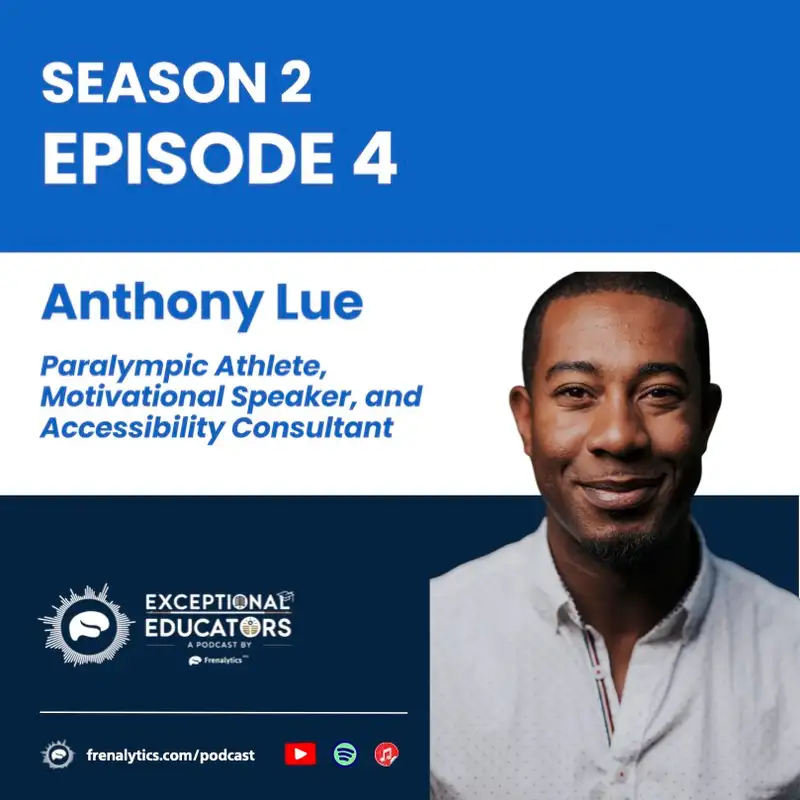
Redefining Disability Narratives: Anthony Lue on Inclusion, Advocacy, and Empowering Youth
Welcome to the Exceptional Educators podcast by Frenalytics edu, where innovation meets inclusion in education. I'm your cohost, Michna Srinivasa.
Matt Giovanniello:And I'm Matt Giovannello, the CEO and cofounder of Frenalytics. At Frenalytics, we put special education and English language learners front and center. Our award winning Frenalytics platform helps streamline progress monitoring, improve communication and compliance, and helps offer truly personalized learning to your students' avowabilities.
Nisha Srinivasa:Each episode of our podcast features candid conversations with district and school leaders, classroom changemakers, ed tech founders, and industry executives, all dedicated to transforming learning for each student, especially our learners with unique abilities. With a focus on extraordinary educators and the exceptional students they serve, we explore the latest in special education, accessible technology, and inclusive leadership. In this episode, exceptional educators is exceptionally thrilled to welcome Anthony Liu, a motivational speaker, consultant, and disability rights educator. Anthony uses his inspiring story to advocate for the inclusion of folks with all abilities. Anthony, we are so thrilled to have you on the podcast today.
Nisha Srinivasa:Thank you so much for joining us.
Anthony Lue:Thanks for having me.
Nisha Srinivasa:As I just previously mentioned, your story is so inspiring just having read it and learned a little bit about you, but I can't wait for all of our listeners to get to know you even more. That being said, we're gonna launch into our first question that we have been asking all of our guests that come on the podcast. And the question is as follows. What is your why? You can answer that however the spirit moves you.
Anthony Lue:What is my why? My why is life, quite frankly. Just being alive. After going through what I went through, being this close to death and living through it, just waking up in the morning, taking a breath, opening my eyes, you know, being able to see, taking the little things in. It really and truly is my why.
Matt Giovanniello:Anthony, let's get into your story of your teenage and your early adult years. You and I had met originally at a special education conference up in Toronto, Canada, and my jaw hit the ground when you went up on stage and started telling your story. And so let's get into your roots, your wild child years. Let's get into your story and what's driving you into the motivational speaker, consultant, advocate, entrepreneur that you are nowadays. Where do you want to start with that?
Matt Giovanniello:We need details.
Anthony Lue:It's funny you mentioned those early on wild days because I think that kinda has shaped me into who I am, as you said. Being that person that always just wants to go for it and shoot for the moon has put me in this position really and truly today. Even though I broke my back and I am now disabled and I may need help for some things like getting up a curb or stairs or whatever it may be, I'm still shooting for the moon. There's so many goals and aspirations and dreams that I have, and just because I'm disabled, I'm not gonna let it hold me back. And that's just kinda how I live my entire life.
Anthony Lue:Growing up, it was always like, I wanna go fast for one, was the first thing. And for two, I want to experience the best of everything. I wanna travel. I want to have fun first and foremost. I don't like taking things too seriously.
Anthony Lue:So I guess that's probably how I got into a lot of the trouble that I got into growing up. I just honestly didn't think anything was gonna happen to me. I thought I was invincible. I was 21 years old when I got injured. Growing up, I was just a natural athlete and did very well in all my sports, very charismatic.
Anthony Lue:So I charmed a lot of my teachers, didn't get in too much trouble in school, and I got a pass for a lot of things. And that kind of set me up for failure because I didn't think anything could happen. There was no repercussions for my actions, and life slapped me in the face very quickly, very fast, a few times, whether it was getting kicked out of high school, whether it was a run-in with the law, whether it was crashing a car or two. There was so many things and I just really and truly thank God that I'm still alive today. I didn't hurt anybody or myself.
Anthony Lue:And now I go and I share my story, just try and inspire people, mainly the younger generation, and be like, listen, you have the world at your fingertips. Don't throw it away. Because I essentially did. Not everybody gets a second chance. Not everybody wakes up from a coma or a life altering accident.
Anthony Lue:That's why I share my story, and I speak to everybody.
Matt Giovanniello:Anthony, you might be the literal definition of flying too close to the sun and getting burned. But thankfully, you are here to tell your tale because one, it will hopefully inspire others to not fly as close to the sun if they are in a similar personality or predicament as you. But also, there's so much to learn, to grow, and to gain out of such a profound experience. Maybe not as much for you personally or professionally, but certainly for all of the audience members that you share your story with. Tell us a little bit more about the one eighty that you ended up ultimately experiencing, where you thought you were on top of the world.
Matt Giovanniello:You thought, to use your words, invincible, and all of a sudden, you very much were not. Tell us a little about how that transition happened and how you're kind of rising back up from the ashes, not to be so dramatic, but what that kind of transition period has looked like for you.
Anthony Lue:It was rough. It was rough. Like I said, I didn't just think I was invincible. I knew I was invincible until something happened. And that's what I say to a lot of people.
Anthony Lue:It's it's one of those situations where you're like, oh, that's not gonna happen to me until it does. And it was a beautiful day, 09/30/2009, went to work. One thing led to another to make a really long story short. We brought some scrap cars down the street to the scrap yard. And as I was exiting the the weigh in scale, steering this car, someone wasn't paying attention, brought over the big magnet with the claws, dropped on the car, crushed me inside, picked me up with the claws to about 15 feet in the air.
Anthony Lue:Someone said, he's inside still. And the guy panicked and dropped me from 15 feet, and I came crashing back down to the ground. I won't get into all the particulars through the hospital and everything like that, but that's when the transition really started. Like I mentioned, getting help from my mom on the early on days, whether it's my mom, my dad, nurses, doctors, whoever, somebody, a friend or a family member that was in the room, it was extremely humbling. I was pretty well six foot, I say on a good day, a hundred and eighty pounds, completely shredded, and I could do anything.
Anthony Lue:Going from that to learning how to go to the bathroom again and eat and shave really and truly the the biggest humbling experience of my life. And I was just so fortunate that I had friends around me, family, and that I was still alive. It was looking back at all the things that I took for granted on a daily basis, all the silly or stupid things that I had done, whether it was speeding or jumping off ramps or diving into shallow pools. So many things that we just don't think about on a daily basis that could just, you know, end it all in the blink of an eye. So at that point, it was, alright.
Anthony Lue:Thank God that I'm still alive. Thank God that I'm still here. And let's reframe the way that you look at things and the way that you approach life. Because you're not as mobile, you can get hurt a lot easier, but you still wanna live like today's your last. I know that's horrible to say because that really hasn't rubbed off on me too much, but I'm just true to who I am for the most part.
Anthony Lue:But, again, still remembering that I have loved ones. I have a wife now, and things happen. Like I said, in the blink of an eye, just to remember to be responsible and take that extra ten to thirty seconds before you make decision, whatever you're doing. You know? You could be playing sports.
Anthony Lue:You could be at the racetrack. You could be at the cottage. You know? Things happen.
Nisha Srinivasa:Thank you so much for sharing that piece of your story. I am so breathed by the optimism with which you carry yourself and the positivity that you have throughout your journey. And it's so nice to be able to hear and share somebody that has your story living a full life. I think that's really important for a lot of folks to hear and see. Folks of all abilities can live both the happy, successful, fulfilling lives, and you are the embodiment of that.
Nisha Srinivasa:So I just wanted to first say thank you before I launch into my next question. I'm curious for you. What was that pushing factor, that motivating factor that made you really want to share your story after you kind of went through this journey that you both described here?
Anthony Lue:It just happened, really and truly. The first time that I shared my story was with the party program and is preventing alcohol and risk related trauma in youth. The program coordinator heard about my story. I was in the trauma ward at Sunnybrook at this point, still within the first month of my injury. Her name was Sandy, and she came into my room and said, hi.
Anthony Lue:I heard about your story. I have a group of students coming through. I'd love for you to speak to them and tell them what happened and just kind of how they can avoid this. And I was like, sure. Bring them in.
Anthony Lue:I literally was naked underneath the sheet, catheter still in, the leg bag hanging off the side of the bed. And I think it was about 15 kids came around my bed, and I told them what happened. And that was kind of the beginning, the catalyst of me sharing my story. From there, I went to Lyndhurst rehabilitation facility just down the street from the hospital. And that same group of kids, through the party program, would come to Lyndhurst in the afternoons, and we'd take them on a tour of the rehab center and show them what happens after a life changing accident at the hospital.
Anthony Lue:So it was just kind of a natural progression and transition. I really and truly wanted to let the youth know that, one, you're not invincible, and two, life can change in the blink of an eye. And three, if you ever feel that you're in an unsafe situation, to say no. It doesn't matter if it's with your friends, your family, if you're at work. When you get that gut instinct feeling letting you know something that is gonna go wrong or isn't right, listen to it because it will not steer you wrong.
Matt Giovanniello:Glad that you found the courage to share that story as quickly as you did. I don't know if I was in your shoes that I would feel the same way, and I'm really glad that you did because I suspect that it's really easy to be down the dumps and woe is me, and I'm just gonna kinda go insular and shelter off from the rest of the world and be like, either I am going to handle this on my own, leave me alone, or I need so much support because I'm just being either hard on myself or thinking that the world is against me or whatnot that you're not gonna turn this really, really unfortunate situation and make lemonade out of lemons kind of a deal, Anthony. And so I'm really glad that you did. And I think that sharing that story so succinctly with students in a way that teenagers, especially, who tend to get themselves into a lot of trouble and do so prematurely, will actually listen. Like, that's a message that resonates.
Matt Giovanniello:A question that pops into my mind as you shared this portion of now delivering your message directly to students is going back to a point you made earlier when you were first introducing yourself. You said that you were a high flyer, especially through school. You got good grades. You were well behaved. And because you got a lot of passes, to use your phrase, from teachers, that was to your detriment and not in the way that they thought they were perhaps enabling you to do better or be an even higher achiever.
Matt Giovanniello:That it was actually a bad thing. Tell me a little bit more about maybe any potential change in perspective, either before or after your series of injuries, that makes you think that there could be more that maybe teachers could do, or in the moment, something that you wish your teachers did more for you that maybe would've altered a change course? I'm curious if a teacher hears this story. Is there a way that they could do better to make sure that their students achieve nothing but the best and stay out of unnecessary trouble?
Anthony Lue:Absolutely. And so I had amazing teachers. You know, the best influences of my life were my coaches and teachers. For some teachers, it's difficult when they're dealing with students like myself because, you know, it's not like you can be mad at me because I didn't do my work or whatever the case is, especially when I'm like, oh, look at this gold medal I just brought back or these three or four gold medals I just brought back. And I'm in the newspaper.
Anthony Lue:So, like, they're happy for you, they want you to do well. And a lot of them understood that I was traveling and training, and so my school marks may suffer. But at the same time, a lot of us didn't go where we needed to go because we weren't as disciplined as we needed to be on the school side of things. So I think, like, if I were to have a message for teachers and principals, it's like, make sure these kids are getting their work done, getting the good grades. My grades weren't great, but I didn't do my So that's what it was.
Anthony Lue:I thought I was a dumb jock just going through school, whether it was some of the things that I experienced, some the things that I was told, not getting good grades on some things because I didn't put in the effort that some of the other kids did. And when I broke my back, I've kinda got forced to learn because I'm like, I gotta figure things out at this point. I can't just live off my athletics anymore. I realized that I was very intelligent. I was very smart.
Anthony Lue:I could communicate well. It was just reframing my mind and being like, alright. Just because I was told this or thought this doesn't mean that I am this. You know? It's up to you to really dig deep and figure out who you are as a person and what you want out of life.
Anthony Lue:When I figured that out is when I really and truly started making strides forward to becoming who I am today. I haven't really changed for the most part, but I think the way I'm able to impact lives and change perspectives is all encompassing of of everything that I've been through and the way that I carry myself.
Nisha Srinivasa:In your time sharing some of those things with students, with all the in the different settings that you have been able to speak in, what has kind of, like, the feedback been been into? What have been some of those responses maybe from some of those students, from folks who have been lucky enough to witness you share your story? What have you heard has been, like, some kind of a takeaway?
Anthony Lue:The responses are amazing. They're heartbreaking at times because there's so many people that are going through similar situations, and they don't know where to turn to. They don't know how to get through it. Or it's not even them. It may be a family member that's going through it, they don't know how to help.
Anthony Lue:It's good and bad. I love it because you wanna be able to do the most and help out as many people as you can, and I'm working towards that with the foundation. But it's heartbreaking because at the same time, you're like, society, we shouldn't have to be going through these things. I see people and the issues and the hurt, and I need to do more. I need to reach out and continue sharing my story.
Anthony Lue:And that's why I do this. Right? So that I can help to open some people's minds and perspectives and hopefully help them along in their journey. And then there's the flip side, like, when you have elementary school kids that make you feel like a rock star. They swarm you and to the point where I'm almost falling onto my chair.
Anthony Lue:Can you sign my shirt? Can you sign my book? Can you sign my face? You know? And then that's wild.
Anthony Lue:Like, I love that. The teenage kids are kind of, like, too cool, but then you have the group that's like, can we get pictures? Can we get your Instagram? Can we post to you? And then they're sharing.
Anthony Lue:You get the DMs that the kids are too shy to come up and talk. And then the ones that say, you know, you've really changed my life because I've been going through some things. And those are my favorite ones. Those are the best ones. I always say if it's just one person's life that I change in the audience, then I think I've kinda done my job.
Anthony Lue:You you're not always gonna be able to do the most for everyone, but just trying to help where I can is one of those things.
Matt Giovanniello:That just it makes my day hearing these reactions because on the one hand, if you try to put yourself in the shoes of these students who can't necessarily relate with what you personally have gone through, they might be like, screw this guy. Don't know what he's talking about. And yet on the other hand, it's the complete opposite, where they very much resonate with what you have to say. They look up to you. You're a role model.
Matt Giovanniello:And they find that they're able to learn so much through you, even at early stages, so much that they wanna be autographing your face. And even the ones who are older who are too cool for school, maybe how you thought back in the day, they're still relating just through a different way. And it sounds like that's some of the advocacy work that you've done through your consulting company, but now more recently, as you very quickly referenced, the Anthony Blue Foundation. So let's transition into that a little bit. Tell us more about the foundation.
Matt Giovanniello:How did it get off the ground? What goes into launching a foundation in Canada? And more importantly, expand on your mission for us and what the foundation's goals and aspirations are specifically.
Anthony Lue:Alright. So we're still very young. Just had my soft launch about two weeks ago. The mission to try and help people with disabilities lead an active, healthy lifestyle through rec, tech, and mobility aids. So like recreation, technology, and mobility devices.
Anthony Lue:Those have been the three major things that have changed my life for the better living with a disability. Getting out and meeting people in my community through recreation has been phenomenal. Technology, whether it's audiobooks, the computer, live captions, all these things are helping to advance our society and help people with disabilities. Gaming, stuff like that. So tech, it's something that I absolutely love.
Anthony Lue:And then mobility aids. Getting around my wheelchair, the one that I'm currently sitting in this setup is about $15,000, and it doesn't have a motor. I gotta push it myself. It's full carbon fiber. It's amazing.
Anthony Lue:I love it. But accessibility equipment, adaptive equipment is not cheap. My hand cycle is another 15 and a half thousand. That's US, so that's closer to 20,000 Canadian. And I'm fortunate because I've been able to get sponsors and funding to get these things.
Anthony Lue:But when it comes to someone that doesn't have those resources, I'm hoping to be that resource, you know, through fundraising, sponsorship, community events. I'd love to raise some funds, grow the foundation to the point that we're able to give away adaptive equipment, whether it's a wheelchair to handcycle, a basketball chair, a mountain bike, all sorts of things, things that people need just to be able to make it through their days happily.
Nisha Srinivasa:It's enlightening for me if somebody is a non wheelchair user to think about the class element of different types of adaptive equipment and necessary mobility aids. I think that's also something that I hope our listeners are able to take away too is the sort of hidden behind the scenes things of navigating different types of white cells. So thank you so much for sharing that too. I'm wondering if you were to pitch your wildest dreams for the success of your foundation beyond being able to provide mobility aids for folks in needs. What does that look like to you to have the Anthony Loom Foundation kind of, like, go global?
Anthony Lue:Global is the word. Hey. I'm in touch with people with disabilities all over the world through social media. Technology is amazing. I met him at the University of Arizona when I was there.
Anthony Lue:We stayed in contact through WhatsApp, and he's running, like, a blind adaptive program out of his school. He's a teacher. And he has done so well in the past couple of years since I met him that he's been able to bring the national championships. I'm not sure if it's just blind national championships or, like, adaptive athletic championships to his school and done phenomenal. So in the grand scheme of things, I would love to be able to just be, like, wheelchair equipment.
Anthony Lue:Because he literally sent me a message, like, two or three days ago, he's like, I can't get equipment for one of my students. That's one of the barriers to just living a fulfilling life, just being free. You know? I can't really and truly express or explain what it's like to be held down or held back by a piece of equipment. For you guys, would say, dicks, go get a bike for, like, a $100 and go ride your bike.
Anthony Lue:For me to get a bike and go ride with my best friend, it cost me $3,500. And I had to get that from The States because those weren't available here in Canada. And so it was things like that that I saw, I'm like, this is wrong. I realize, you know, it's not just adaptive equipment, it's resources, like medical supplies, it's access to funding, access to medical care. There's so many things that if you don't know, you don't know.
Anthony Lue:And just being so fortunate in networking, meeting people such as yourselves, I'm able to now open up the network and be recommending things to people and be like, here, go here, do this, whatever it may be. Actually, Matt, I don't know if you remember the Trexo machine. It's about to roll out on Instagram, and it was phenomenal. Right? But even that, I said to them, you guys have this geared towards children.
Anthony Lue:I'm five eleven, about a hundred and fifty pound or whatever, and this thing got me up in a walk. So there's a lot of people that this could work for, but they were not marketing it to adults or people that could fit in this. And I'm like, guys, you're missing out on a huge segment of the population that this can completely change your lives for. There's so many other things that I learned and met people at that conference that I was able to share information with, and it's gonna change people's lives. So it's it's all part of the journey and just trying to give back, help out where I can, and make this world a little bit better than when it was when I came in, as corny as it sounds.
Matt Giovanniello:It's not maybe a little corny, but it's very true, and I know you're gonna get there. And what we will need to do, Anthony, is have you back in a couple of years and replay these little clips and be like, here's my goal, and where are you now? It's making me take pause and think and reflect on, one, your goals, while at the same time as you're thinking about your goals yourselves, realizing just where you're coming from and why those goals are extra ambitious. And part of it is a general acceptance of people with disabilities, especially for people like you who are not born with one, but later acquired one. Although, as I'm sure you know through well regarded research, people with disabilities represent the world's largest minority.
Matt Giovanniello:There are one point two billion people around the world with a disability. And the maybe traditional definition of a disability of somebody in a wheelchair like yourself is a portion of that. But people with disabilities look, feel, act, and present themselves in a multitude of ways. I think something that I took out of your comments just now is we have some work to do in order to better educate people who don't have disabilities in how we can interact with, think about, speak of, and communicate directly with those that do have disabilities. What particular areas of growth are you longing for in order to move forward with that status quo so that you can better achieve the goals both of your foundation and through your advocacy and consulting
Anthony Lue:So having conversations like these is where the groundwork starts, and then having real raw conversations. Because a lot of times people shy away from disability and accessibility because they don't want to hurt someone's feelings, or it's not sexy or attractive, but at the end of the day, like you said, the base minority in the world. At any point in time, if you're not part of this population, you can become a part of this population. Seeing the coin from both sides is what really has pushed me to move forward and really voice my opinions and speak up about these things because you don't know, you don't know. When you travel around and you see accessible placards and push buttons and automated doors, you're like, oh, we're good.
Anthony Lue:Disabled people don't need no help. We've got a mate in the shade, but we couldn't be further away from the truth. Right? It really comes back down to education, educating the masses. We have to have these conversations so people have an understanding.
Anthony Lue:One thing that I would absolutely love to do is put people in a wheelchair for a day. You know? Give them a shot in the spine, numb their legs, let them wheel around, and see what it's really like. At that point, things and light bulbs are gonna start to go off. You know?
Anthony Lue:It's something to walk a mile in somebody's shoes. And when you do, you will have a greater understanding at that point, you will try and make some change. You know? Your your consciousness will be open. Your mind will be a little bit more forgiving and caring and empathetic.
Anthony Lue:Because if I punch you in the face or if you've been punched in the face, are you gonna punch somebody else in the face? Probably not. Because you know it hurts. And why would you want someone else to hurt? There's a very small percentage of people that want people to hurt.
Anthony Lue:We really just need to do better in breaking down those barriers, the stigma and the bias that surround disability and accessibility so we can have an open conversation where people are walking on eggshells and being like, we can't say this because we're gonna hurt your feelings. And with our current climate, it's becoming that much more difficult because everybody's got a feeling about something. We gotta be realistic about things and just call it what it is. You know? I'm It's not a bad thing.
Anthony Lue:You can say I'm disabled. I don't like handicap, but disability, disabled, it is what it is. But some people will lose their mind over it. Again, education, talking to people, communicating, and then just being respectful. Yeah.
Anthony Lue:I got it tattooed on my right bicep. As long as you approach somebody with respect and love and you mean well, I think we can further our knowledge of these conversations and people's positions, and we'll all be fine.
Matt Giovanniello:I'm glad that you're bringing these topics up, even if they are hard topics to broach. One, you're not offending us. Two, if somebody who's listening to this is offended, you are a person with disability, And your opinion as a person with a disability, in my own opinion, matters more than somebody who does not have a disability in the language that you prefer, where you think is right or is wrong. So first things first. Second, I can relate to a lot of what you're sharing.
Matt Giovanniello:I have a history of family members with disabilities that continues to inspire me to run the company in the way that we do. And I think that their own experiences and the way that I lived through those via my family members is bringing me closer to the disability community in a way that maybe wouldn't have otherwise happened. And so for that, I am grateful. But it's unfortunate that for a lot of people, myself included, that's the main pathway in. If you experience one yourself or you know somebody who has or experiences a disability, like that's what aligns you closer with the work, I agree with your opinion that we need to do better.
Matt Giovanniello:But to your point, there should be no shame in that game, and for some reason, there is. I'm curious if culturally, politically, or otherwise up in Canada, you're seeing a shift to a little bit more, not only of an awareness of disability, but an acceptance of it. Here in The States, in New York at least, I have picked up on that in the past couple of years, which is a great thing.
Anthony Lue:I've seen the progress. It's slow, but I've also been down to The States, and I've seen your progress. And over the past couple of years, what I've been noticing, unfortunately, is a regression. We're going backwards. It's very, very, very, very, very, very sad.
Anthony Lue:People like us need to keep having these conversations and advocating for the little person. People with disabilities, minority figures, persons with the BIPOC population or disabled. There's so many people that are under fire right now, and we really need to hunker down and get to work. Let's respect everyone and give people an equal opportunity to live and get like universal healthcare. We're so fragmented that you're not really gonna make any progress forward.
Anthony Lue:And the things that really and truly matter are getting swept under the rug. People are suffering. We just need to keep doing what we're doing. And as long as we keep doing what we're doing, people will jump on the ship, and then we're gonna have momentum and steam, and there's power in numbers, and we're gonna be good. But we we definitely need to ramp up the advocacy.
Anthony Lue:Right now, I think they're trying to repeal rights where you guys are at, like the five zero four disabled rights. It's sad to see, like, where we're at in 2025 and the hoops we still have to go through because all these things are gonna be affected, like IEPs. We're setting ourselves up for failure. With COVID that already happened, we're behind the ball right now. And within the next year or two, we'll start to see those real repercussions, and hopefully, not super bad.
Nisha Srinivasa:I absolutely agree with you and resonate with so much of what you just shared. And what I'm gathering from what you shared is that, one, community is what inspires progress and social momentum. And the opportunity to convene across causes and communities together might be the push that we need to continue progress across multiple domains, really. Thinking about what you just shared, knowing the sort of social and political landscape that folks with disabilities might be navigating, not just in The United States, but across the world, what do you see as some potential ways to move forward, some potential solutions in the face of institutional stress that might be impacting the work and experience and lives of folks with disabilities?
Anthony Lue:So social media has been phenomenal. Thank God for influencers. Some of the stuff that I see, I'm like, yes, yes, yes. Thank God that somebody's out here talking about it. Those typical channels where we would get our information, it's it's not the same anymore.
Anthony Lue:Right? And they won't share it. Sometimes even on social media because disability isn't sexy, they will take it down. Like, I've seen posts of disabled women in swimsuits being taken down. Right?
Anthony Lue:But it brings up that conversation again of, like, why is it okay for Taylor Swift to be naked on Instagram and not okay for me to be half clothed? You know? So, again, it's bringing up those conversations and allowing us to to speak about it. Politically, I'm trying to figure it all out. I don't know where things are going.
Anthony Lue:All I know is it's going backwards because at the end of the day, it's expensive to renovate and make things accessible. To build universally, it's not more expensive. It just takes a little bit more thought and process and time possibly. But for some reason, they're so resistant to it that but socially, I think we're knocking it out of the park. The influencers are doing a great job.
Anthony Lue:Podcasters, people that are sharing the messages. It's what we need to do to have these conversations to be real. Sometimes there's just not enough time to keep having these conversations. I hope you guys will have me on because there's so many more topics that we can discuss and go through in terms of disability and accessibility. Like I said, as long as we keep sharing and posting, people have such a greater awareness of people in wheelchairs and adaptive sport and athletics, and things are moving in the right direction as as much as it seems we might be going backwards, I think we're still making progress forward.
Matt Giovanniello:I think even if slow progress is important, and I'm glad that you're feeling it in your position as much as I am here and as much as it sounds like, Nisha, you are too. So that's all really great to hear. Anthony, I have a couple more questions for you before we wrap up today's conversation, but it sounds like we're calling for a part two, which I'm very excited for. My next question for you, Anthony, has to do with the talk that you gave in Toronto in your I just didn't give up talk. You have a mantra.
Matt Giovanniello:I hope I'm quoting it correctly. It goes something along the lines of things don't happen to you. They happen for you. And so with that perspective and very unique outlook on, in your case, a devastating challenge that you went through, what does this phrase mean in the context, one of educating folks around disability inclusion, and how do we give that positive spin on what has traditionally been recognized as negative?
Anthony Lue:It's interesting because I find that I have a very different perspective on life and the way things play out sometimes, and it's all about perspective. I'm always trying to find the silver lining in a situation because it's so easy to find the negative in everything. You know, on a daily basis, whether it's the news, whatever. There's so much negativity being thrown at you that it's like, alright. Let's see where we can find the positivity and navigate our way through the situation being as happy as possible.
Anthony Lue:You know, it's not always possible, but it's one of the things that I try to do, and I found it's really helped me through a lot of situations. Attitude determines your altitude is another saying that I heard early on in my injury. And I've tried the woe is me. I've tried being angry, and it sucks. You know?
Anthony Lue:Naturally, I'm not that person, but it also just makes you feel like crap. You know? You go through your days, people treat you differently, they don't smile at you, they don't look at you, they don't wanna interact with you. And so it's like, at that point, you have a decision to make. And my decision was, I am gonna make the best of the situation.
Anthony Lue:I'm gonna try new things, new opportunities. I'm going to meet new people. I'm going to just keep an open mind to this whole situation because I knew nothing about disability when I broke my back. But I firmly believe this accident saved my life because the drinking and driving, the partying, that would have been it. Guaranteed.
Anthony Lue:Growing up, my mom always told us, she said, don't question God. Don't ask God why this happened to you or why not. And the Bible says the rain falls on the just and the unjust. And that's just life. Life's not fair.
Anthony Lue:And once you wrap your mind around that and you realize that life does suck sometimes, and then other times it's phenomenal, you'll be fine. Because it's like a roller coaster ride, and you know you have the hills and the valleys, but as long as you keep your head up and keep moving forward, you'll be good.
Matt Giovanniello:Anthony, as we wrap up today's episode, we have a question that we ask all of our guests as well. Our question for you, is what does being an exceptional educator mean to you?
Anthony Lue:Some of you might hate me for this, but I think it means going above and beyond. Whatever that means to you, because it means a lot of different things for a lot of different people. But you know when it's time for you to step up and make a difference in someone's life. And when you have the ability and power to do it, make sure you do it because when they come back and thank you, you'll realize how much of a difference you made in that person's life.
Matt Giovanniello:I think that if you feel that in a calling and you respond to it, that's going above and beyond. And in your definition, that's what makes you exceptional. And to that, I wholeheartedly agree. And I think you're right insofar as you don't know when that thank you might be delivered or might be reciprocated, but it will at some point in the future, and that investment now is worth the really positive future outlook on that person, the children, the adults that you're impacting. I imagine you keep that in mind through all of your advocacy, pro bono, volunteering, and consulting work that you do because you're touching all of our lives, Anthony, from everywhere in Canada, down here to The States and around the world.
Matt Giovanniello:So for that, thank you for sharing your voice. Thank you for being so open and vulnerable with your story. It's one I imagine with increasing quantity and time still doesn't get all that much easier to share. And for those who are here for the first time, I imagine you will all be as moved as I was when I heard it just a few months ago. So Anthony, thank you again for joining us for this fantastic conversation.
Matt Giovanniello:We really appreciate your insights. To everybody listening to today's episode of Exceptional Educators, thank you for joining us. We will see you on the next one.
Anthony Lue:Hi. My name is Anthony Lu. I'm an motivational speaker and accessibility advocate, and I love the Exceptional Educators.