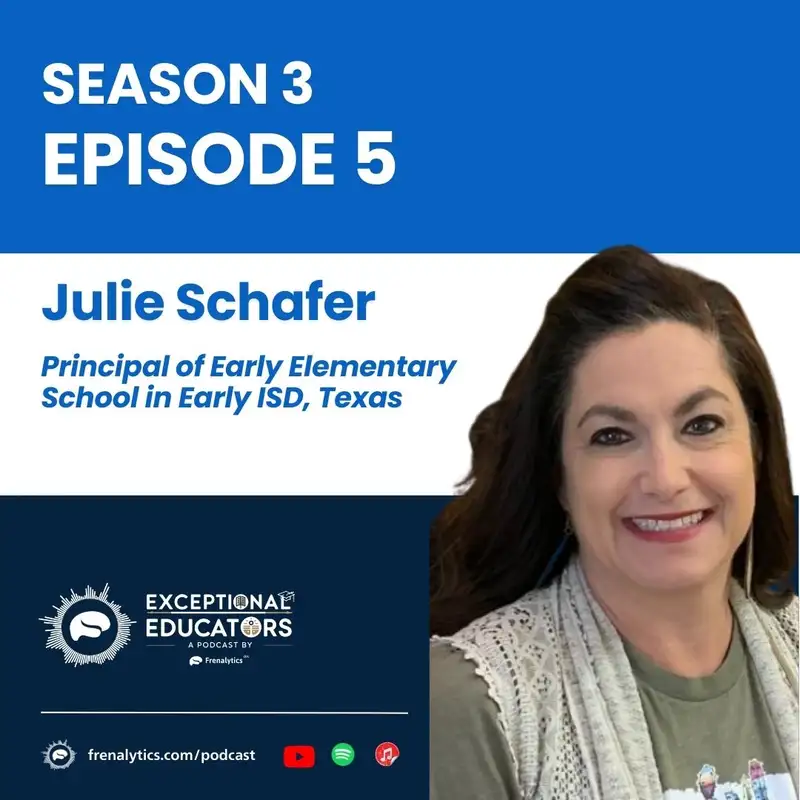
Screening for Success: Julie Schafer’s Unique Approaches to Dyslexia Screening and Student Well-Being Spaces
Welcome to the Exceptional Educators podcast by Friendlytics edu, where innovation meets inclusion in education. I'm your cohost, Matt Giovanello, the CEO and co founder of Friendlytics. At Friendlytics, we put special education and English language learners front and center. Our award winning Frenalytics edu platform streamlines progress monitoring, improves communication and compliance, and offers truly personalized learning for your students of all abilities. Each episode of our podcast features candid conversations with district and school leaders, classroom changemakers, ed tech founders, and industry executives, all dedicated to transforming learning for each student, especially our learners with unique abilities.
Matt Giovanniello:With a focus on extraordinary educators and the exceptional students they serve, we explore the latest in special education, accessible technology, and inclusive leadership. In this episode, Exceptional Educators is exceptionally thrilled to welcome Julie Schafer, the principal of Early Elementary School and Early ISD, about two and a half hours Southwest of the Dallas Fort Worth area in Texas. She previously taught dyslexia students at Early Primary School, and now in her twenty third year, all in the Early District, she reaches year seven as principal of Early ISD. Julie, thank you for joining us this morning. It's great to meet you.
Julie Schafer:Hey, thank you. I appreciate the offer and excited to be here.
Matt Giovanniello:Likewise. Likewise. Let's jump right into our podcast. Today's discussion is going to start around a question we ask all of our guests. That question for you Julie is what is your why?
Matt Giovanniello:Everybody has a story about what brought you into education and more importantly, what's keeping you here. What's yours?
Julie Schafer:So my why definitely goes way back. I grew up in a household with an educator and also my mom. I watched her spend many years actually serving special education students and just the exceptional, exceptional job she did. I saw, but didn't know exactly how exceptional it was to later on in life. When I started seeing kids that she had worked with, kids I was used to seeing at school every day, but they were coming back and they were saying, Hey, thank you for what you've done.
Julie Schafer:Thank you for what you did for me. Thank you for what you did for my mom and my family. Because not only did my mom educate those students, she got to know those families. And so that's a really big why of mine is not only do I need to know the kids that are on my campus now, I need to know background, I need to know their families. So, and the same goes for my staff.
Julie Schafer:I need to know who they are. I need to know their why, and I need to know what I can do for them to support them.
Matt Giovanniello:That's amazing. I love how it goes back to your days growing up as a child, getting the exposure from educators themselves for you to be inspired to be the next generation of an educator and now an administrator. That's really cool. I have a similar story. I come from a family of educators.
Matt Giovanniello:My grandma on my mom's side was a longtime remedial English teacher. She was here in New York city public schools forever before retiring and going into the complete opposite end pre kindergarten.
Julie Schafer:And my
Matt Giovanniello:aunt is a veteran special education teacher. She's been in the system for a really long time. I admire the work that she did and continues to do to support our students with really needs. And I'm glad that that had such a profound impact on you too, from your mom. In your early days, Julie, I know you started as a dyslexia teacher.
Matt Giovanniello:Let's get into that. What brought you to being a dyslexia teacher? What do you still hold onto that? What do still hold onto from that experience? Now that you're running a school of your own?
Julie Schafer:Sure, absolutely. I actually started, started in first grade and spent a lot of time in the first grade classroom using my specialization in reading, working with kids at all levels of reading abilities. And what I was noticing was really just kiddos that were struggling. Dyslexia was just becoming a hot topic and doing my own research prior to going into teaching it, using some tools from trainings and just my research that I was, I was seeing what, okay, now this is, this is helping these kiddos being able to figure out quickly in the classroom, how I could group the kiddos and really focus in on their needs and what their gaps were, what were they missing? Whether it was phonemic awareness or whether they had fluency issues really honing in on, Hey, I can group these kids and make a difference.
Julie Schafer:And then, quickly was asked, you know, Hey, do you want to jump into the dyslexia world? Oh, I jumped on it and then received further training, extensive training on that. And just, I feel like now all the years of first grade and then in dyslexia, I can come into the admin role, knowing what those kids need and supporting that those staff members. I'm very close and attend a lot of really good conversations, round table conversations with my dyslexia staff. And I still am able to give input, not just from an administrator side, but someone who has sat where they're sitting and meeting their needs allows us to meet our students' needs as well.
Julie Schafer:So I love, I love having that background to be able to support the staff members that way.
Matt Giovanniello:That's really well put knowing that you have armed with this knowledge and now you can instill it in your staff members to make sure that they're better servicing the needs of their students versus training maybe that you otherwise would not have just sharing it with them and not knowing how impactful or how rigorous or all encompassing it might be. Speaking of dyslexia, as you know, Julie, is not well understood, even with all the progress that we've done in research around students with reading challenges and writing challenges. You would be the expert to ask this question. And so I'm going to pose it to you. What has dyslexia screening looked like?
Matt Giovanniello:What has dyslexia training looked like? Twenty years ago, let's say compared to now? I know it's come a long way. But what do you see being the biggest differences in how staff are trained to diagnose and pick up on dyslexia and then how to deliver intervention services in consideration of a student who has such a challenge?
Julie Schafer:So I think the biggest thing is just that we are screening our kids at a young age. And of course, now the state has come in and there are some requirements, which thank goodness, those supports are there as well. But when we're able to train people, through our region centers and through professional trainings that hone in on specific things like dyslexia, our teachers are making sure, like we're screening kids in kindergarten, we're screening kids again in first grade, we're screening kids and getting them into programs. And I will say the program we use here between our primary and elementary, what we're able to do and what I love is we can have kids complete our program by the end of fifth grade. And they have those skills.
Julie Schafer:They have those strategies in place that they are beginning their middle school years. We're not having to pull them anymore. They still have accommodations and supports they need, but they are able to attend their core subjects and their extracurricular activities. They're not having to miss anything to go to intervention because we were able to screen them and get them into classes quickly enough that they are successful leaving our campus. That's our goal.
Julie Schafer:Not everybody does, but the majority of our students, if we can screen them in kinder and first and get them into those programs, we're seeing a great success there.
Matt Giovanniello:That is such a huge success because if I'm filling in the gaps of your sentences there, Julian, reading between the lines correctly, students don't necessarily need to have a full IEP or go to resource room or go into an environment that's more restricted than they would otherwise require because their dyslexia diagnosis for an IEP or a student's disability is better understood at an early age. Now they're not over service or miss service or mislabeled and getting the services that they require too late.
Julie Schafer:Correct. Dyslexia is under the sped umbrella now, but what we're seeing is we have a lot of our kiddos that just need that dyslexia intervention piece. They do not need reading language arts resource. Some of them do, but we have a big handful of kiddos that they are gen ed in their reading and language arts class. And they're able to do that due to us getting them in the program quickly and early and being able to get them through that program.
Julie Schafer:They're getting those skills through that class and not necessarily having to go to the resource class. So I love that. And I think it all goes back to proper training for our staff and getting those kids into a program quickly. We're not waiting until they're in fourth and fifth grade anymore, if we can help it.
Matt Giovanniello:Yeah, completely agree. And you know, just for some context, when we're talking about a district of about 1,100 students as early ISD is, when we're thinking about the elementary school, amounts to hundreds of students across those grades where you need to be screening for dyslexia each and every year. I think a takeaway for those listening to this is if you're a school or a district that does not have a dyslexia screener, here's a success story of a district that did not originally, but now does. And if you're in a school or district that mandates a dyslexia screener, here are the successes that you can hope to achieve by implementing that. Or if you already have it, what could come out of a properly implemented dyslexia screener for those young kiddos that so desperately need it.
Julie Schafer:Absolutely. We have lots of success stories and I have kids that still come back even now that are in high school or graduated and we see them so successful in what they're doing and they, they stop by and they say, thank you. And it's just that we got to them at a young age and we're not miracle workers, but we are getting them through a program that is, that is allowing those kids to be very, very successful. And so I would talk to anybody all day long, anytime they want to about dyslexia, because I am still very passionate about it and getting the support for our kids. And that support starts with supporting your staff.
Julie Schafer:Your staff have to know what they're doing. They have to be comfortable in a program. We went through a program change a couple of years ago, and that was an adjustment, but we got our people trained like they needed to be. And again, we, we never had a gap in that success. We're still seeing it on this campus alone.
Julie Schafer:We have three full time dyslexia teachers. So we keep our numbers small or our group small. That's another thing I think that's important is it needs to still be as individualized as possible. So you really have to plan your groupings of those kids before you ever even make your master schedule because you want to make sure their schedule fits with their intervention.
Matt Giovanniello:Absolutely. Especially in the elementary school age band, as we're talking about here today. Let's get into this a little bit more, Julie, because you're so passionate about dyslexia and you've seen it implemented so successfully at your school and now you're managing, you're running the show here. If we're thinking about a school that does not have a dyslexia screener, walk us through your blueprint a little bit more about what you're doing in your early elementary school. I know early primary is pre kindergarten through second.
Matt Giovanniello:So we're here primarily talking about grades three through five, but because of your exposure and experience at the primary school, at least in early two, I imagine you have a little bit of experience to draw from there, but if we have no dyslexia screener at all, what does your PD look like that you put together to better train staff on what dyslexia looks, sounds, and feels like? And then what physical screeners do you have in place right now that's helping you pick up on the needs of your students?
Julie Schafer:Okay. So we use a universal screener at the primary and they screen at the beginning of every year. Our kinders are first second graders. And then those kids that are a red flag obviously go into our RTI program, which is response to intervention, think that that's important. And so our kiddos that have some red flags, have some gaps there, go into our intervention programs for a period of at least six weeks.
Julie Schafer:Once we see we're not making gains here, then what we do, we've, let me backtrack a little bit. We have provided training at the beginning of the year for our teachers. Now, if they're a dyslexia staff member, obviously they've gone through some intense training through our region center. We're with region fifteen, shout out to them. They do a fabulous job on dyslexia training, super great job.
Julie Schafer:And so our teachers that are providing the intervention through dyslexia, they are well trained, also have, you know, they're helping with those screeners. And so primary we're trying to get them screened and in place for that. Then once they, we see, you know what, really this child, I really need this child to be fully tested for dyslexia. We push that to our co op and our co op comes in and does the formal testing. And then we go from there.
Julie Schafer:They either, we go to art, they either don't qualify or they do. We have an IEP. They begin their intervention in actual dyslexia group. Same thing really happens here if they come into us at the third grade level and they're either new to the district or they've come from the primary and we're just starting to see some gaps widen. We do a screener students at the beginning of the year as well.
Julie Schafer:And that's done by our dyslexia staff and same thing, same routine. We have meetings and that's something that I really encourage schools to do. Find that time that you can sit down and you can have those intervention meetings. You can have those grade level meetings. And I encourage administrators to be a part of that.
Julie Schafer:You have vital input and you learn about your kids that way. But we sit down and we look at those kids that really need more, like let's push them to formal testing. If not, hey, we see success in our intervention rooms and maybe they don't even need dyslexia therapy. Maybe they just had some gaps. So I actually have a retired teacher that is a retire rehire that is part time for me, is our reading interventionist.
Julie Schafer:And so she sees, she's able to do a lot through her classroom to where we have kids that just have some reading gaps, but it's not dyslexia. So I think it's just really, really digging in like we're doing here and knowing your kiddos and really looking at them individually and then getting them the help they need wherever it is.
Matt Giovanniello:Right. And I think that the needs of students are so diverse. It's only growing. And so the fact that you have those supports in place to know which services will best accommodate the needs of your students based on those universal screeners is huge. So you're a couple steps ahead of most districts in having that in place because some districts unfortunately don't necessarily have that more proactive stance just yet.
Matt Giovanniello:I know there's a broader push around the country, as you alluded to for universal screeners that would allow said districts to know a little bit more proactively what the needs of their kids are and try and administer those services as close to the beginning of each school year as possible so that they don't fall into assistance for special education where they may not necessarily need it, or they may need it for certain pieces, but not the full, you know, resource room or self contained special day class type environment that would unfortunately limit them because the services are more significant than what they need. Besides examples, you alluded to a couple of things that I want to unpack some more around MTSS, but before we get there, just for some context, the state of Texas, as you pointed out in your comment about universal screeners and what you have in place for dyslexia, has a bit of a unique setup as it relates to your regional ESCs and your co ops. So for those listening that aren't as intimately familiar with the ways that districts interface with your county ed offices, your regional ESCs and your, your cooperatives, tell us a little bit more about what those are, what those look like and how you contract with them.
Matt Giovanniello:Just for some background.
Julie Schafer:So we work hand in hand with our region center. Do a very big push. We just make sure that provide some really, really strong PD for our dyslexia teachers. Teachers go through training. They also do a plea touch base with our dyslexia staff.
Julie Schafer:Very, very good to jump in and just say, Hey, what can we do? What do you need help with? Are you struggling with anything? They do what's called a round table discussion, a lot of great discussions and support from other schools and us just saying, Hey, I've got this issue. How are you helping with this?
Matt Giovanniello:Basically getting at, you know, some of the services and supports that a relatively smaller district can receive to best meet the needs of your students through partnerships within your case and your call offs for, for, for purchasing. So like, you know, if early is a relatively smaller district, can't get those all in house. How are you still delivering them to your students? Those avenues are ways that you and other school districts in Texas are making that.
Julie Schafer:Sure. And I think another thing they do that's really cool is October is dyslexia awareness month. And so they provide a knot for parents and students to come. And it's just really great input and support that parents learn about. We also provide that here within our district.
Julie Schafer:We just housed it a couple of weeks ago here on the elementary campus where parents could come in and they can just find out the latest and greatest on dyslexia, as well as receive, you know, get their questions answered, receive input on how are you struggling with homework? I know homework's a big thing for our dyslexia parents. Like that's a, that's a hard thing. And if they don't have those tools or resources that they can gain that knowledge, you know, I, I hate that for them because they're just having a hard time at night with their kiddo. And so that's something our region center does a very good job about is pushing out those supports, not only for our staff and students, but for their families.
Matt Giovanniello:That's amazing. And it's, it's the full package deal of we need to support our administrators from the ESCs and then administrative team to support the teachers with training teachers need to support their students, course, but parents sometimes get forgotten in this equation. And it's amazing to hear that they are included in partnership with all of the work that each of these entities do as well. Very cool. Thank you for giving us some more color on that.
Matt Giovanniello:Let's expand now on MTSS because you brought it up a little bit before as a way to provide individualized interventions to your students who need it. I know we were talking a little bit before the recording about how there's been an increasingly growing push starting at the third grade with behavior specialists that are on staff and making sure that those screeners are in place to support the needs of students as they emerge starting at third grade. So tell us a little bit more about what MTSS looks like, how you've implemented it in third grade, how you hope that it grows into fourth and fifth as students phase out of the elementary school and what future steps we're growing MTSS look like maybe even primary years.
Julie Schafer:Sure, absolutely. So last year we started a pilot program in our third grade, just trying to reach those kids as soon as they get on our campus. And, we did it, we wanted to show a unified front for all the kids at third grade. So we kind of hit it in two different ways, individual or by like a homeroom class. So we're departmentalized, our kids move around, but we
Matt Giovanniello:have
Julie Schafer:homerooms base that they go to beginning of the day and end of the day. And so we have posters up in the third grade hall that are showing, hey, so and so got us up on the board or their individual name, the classroom name. And what we're trying to teach those kids through our program is positive equals positive. Your positivity and your choices that are positive, the consequence is positive. All consequences don't have to be negative.
Julie Schafer:We're, we're looking at the positive consequences here. And what are you going to do to help? Not only you as an individual, but when you help yourself as an individual, you're helping everybody around you. And we want you to become a good citizen and a good person. We're going to shout out and we even have it set up to where kids could shout out to other kids.
Julie Schafer:It's not just the grownups in the building are looking for good behavior. We're going to hold each other accountable as classmates. And here's what we're going to do, to get, I want to get your name on the board and, but I'm going to do the same thing in a sense, me shouting out to you is, is part of our PBIS too. Like, like you're, you're a good person, but I'm going to be a good person and recognize your good choices. So, and we're really pushing that in third grade, which we hope just moves into fourth and fifth as these kids, our fourth graders this year were in that third grade program last year.
Julie Schafer:And, you know, I can say, I don't have a lot fourth graders that come to the office for discipline. So we're seeing a positive push by doing this for sure.
Matt Giovanniello:That's huge. Especially again, just because I'm context in a district where students have increasingly grow, have growing behavioral challenges, mental health challenges, and SEL related challenges. It's awesome to hear that that you're actually reaching like a reverse trend on the number of incidences that you need to handle as a school. Thanks to this pilot program from last year. That sounds like it's going to continue to renew and to grow.
Matt Giovanniello:It also, Julie sounds like you're intermingling and I think a good way MTSS and PBIS. How do you see the difference between those two programs existing? Where do they overlap? How do you think of them as one? Tell us a little bit more about your philosophy on bringing MTSS and PBIS together.
Julie Schafer:So I really don't see a difference to be honest, because I think the focus is positive reinforcement and positive behaviors. And I think no matter what you want to call it in a school district, call it whatever you want. That's our goal. And that's where I think, because we're seeing such a need for social emotional lessons, we're seeing such a need for mental health support. I just think the funnel ends up heading the same direction, whether you call it PBIS, MTSS, whatever you're doing, whatever you're using in your school, positive, just a positive culture and a positive atmosphere starting with our students is just huge.
Julie Schafer:And so I really, I know that it's split on ideas that way, but that's my idea is just, I don't necessarily think they're totally different.
Matt Giovanniello:That makes sense when you think about it from a lens of students showing up to school, feeling opened up, ready to learn versus students who go up to school, feeling not safe and not ready to learn. You can give all the interventions in the world. But if that student is showing up, not ready to learn, you will not reach them. And so I think that that's what you're alluding to with existing mental health, SEL and related challenges. If we don't address those first, we can't unlock gains and academic needs and other types of needs because the student's just not ready for it.
Julie Schafer:Right. Right. When they, we have a lot of kiddos that we're seeing a need for system. Let's check-in and let's unpack before the day ever starts. And so a lot of where that started was through our pilot program in third grade was seeing, you know, teachers were reaching out saying, Hey, I've got this kiddo that just no matter what, no matter how the day's starting, they unpack.
Julie Schafer:And so that also led to another program that we're piloting this year and it's our success room. Kind of the brainchild of we have a district behavior specialist in our district. She's actually housed on my campus, a dear friend of mine. And she and I, over the summer, we're like, okay, we made it through another year, but we're just seeing this huge need. What can we do?
Julie Schafer:And so just kind of brainchild and a lot of spending just hours discussing whether it was on the phone or at each other's houses, or just, just those conversations we were having was like, we have to create something. And so over the summer we worked with our, my PTC was great to provide some, some needed tools, but we created a room. We're calling it the Success Room. Success stands for support, understanding, confidence, courage, empowerment, and then skills and strategies. And what it is, is just a place that we have made available to our students.
Julie Schafer:Every student has an opportunity if needed to go to the Success Room. Now, our goal is not for kids to go down there and hang out all day. Our goal is to provide a place that number one is teaching some of those skills and strategies that, hey, I just can't unpack once I get here in the morning. So it's a place to do check ins. It's a place that we have some kids that go check out in the afternoon.
Julie Schafer:Hey, how was your day? What was good about your day? What are you looking forward to after school? Or are you, is there something you're worried about? And we funnel those through a Google classroom that our counselor has access to as well as myself and behavior specialists to where we look for those red flags of, you know what, we need to intervene.
Julie Schafer:We need to step in here. We look at the check ins. I had a check-in come to me just yesterday and it was a super positive. They wanted me to see a student comment that was made that was like, okay, yes, we're getting through. We're making progress with this kiddo.
Julie Schafer:But I have another area that I see a big need is male role models. So in our success room, we have three staff members that are males and I love it. And I tell them all the time, I'm not trying to be creepy, but the fact that I have males on my campus is just phenomenal for these kiddos that do not have that male role model. And so, like I said, we provide those check-in, check out times, but we also provide a place for mentoring. Just, Hey man, let's talk about your decisions you're making.
Julie Schafer:Here are some things that maybe would be better. We have sensory tools. We see these kids that are struggling here and need to move their hands. So we provide sensory tools in that room, whether it's therapy, putty or puzzles, or just something they can use their hands to move. Deescalation, we have kids that just need to go down.
Julie Schafer:Hey, I'm getting super frustrated in class. I need a five minute break. So we have success room cards. The kids are able to turn those in, step out of the room. We also have communication set up to where I have a kiddo.
Julie Schafer:Maybe we've got some of our AU kids that can't really vocalize, I need to use a card, but the teacher can see it building. They communicate with one of our staff members, they come down and it's a simple nonverbal thumbs up or thumbs down, we're okay now, or maybe have a seat and just watch. Pretty good system in place there to allow for, we don't want loss of instruction happening and that classroom teacher having to deal with that. So just a lot of support in our classrooms of those guys coming in and making a very quick, hey, you wanna step out? Let's just go for a walk.
Julie Schafer:Kids go down there. Like I said, for breaks, we have kids that are not testers. Hey, I just need a quiet room to finish my test. That's an opportunity they have there as well. So just that big need for a safe place with some people that they can trust so that they're not necessarily coming here and getting confused with Ms.
Julie Schafer:Shafer is the principal. So that's discipline, but yet Ms. Schaefer's my safe person. I want to still be that, but I still have to have that separation of, I can go down to the, to the Success Room too, and just pop in and say, Hey, glad you're using the room. Glad you're making good choices and using break card.
Julie Schafer:You're not having to come to me. I haven't seen you. And that's what I want. High five on that. So.
Matt Giovanniello:Unless I see you in my principal's office, the better, the more I see you in the Success Room also the better.
Julie Schafer:Also the better. Yes. Correct.
Matt Giovanniello:And this Success Room concept is so fascinating to me. Seems super unique. I know other schools and districts have embraced something in differing ways, but I haven't heard anything quite like this. And I think that Julie, not only is it a safe room for students, but it's also incredibly versatile, Whatever the needs of that student is in that moment in time, the Success Room, because of how it literally and figuratively what it stands for, can accommodate those needs at any given moment in time. I think that's easier said than done, especially when you're hiring staff, especially that male role model where students want to identify and look up to somebody they can identify with is huge.
Matt Giovanniello:Again, really easier said than done. So I give you a lot of credit, you and your teams, lot of credit for successfully implementing this. I'm so glad that students make positive use out of it. Yeah.
Julie Schafer:Thank you. Thank you. We're seeing that and we have had some time where it's had to turn more into a behavior room, but we're back on track to where we're really just using it like it was meant to be. It comes down to staffing. It comes down to, you know, our schools are full.
Julie Schafer:And so, it was some growing pains for us to even find a location to do it, but our goal is to push that out to our other campuses as well. And our, behavior specialists, as I mentioned her earlier, she's done a phenomenal job to get these guys trained. And I'll go back to something I stated earlier. I think the key to anything working is finding the time, carve out that time to sit down and just talk it out. Like what's going good, What's not working.
Julie Schafer:What do we need to tweak here and supporting your staff in that. What can I do to make it better for you? We made sure these guys are good and trained up before we stuck them in a situation where, you know, they don't know from day to day what encounter they're going to have when having kids come in and just wanting to talk. There's things that are hard to hear. They're hard on your heart.
Julie Schafer:There's behaviors. One of them came with some background from working in a state school. He's been phenomenal with his knowledge of how they handle things, even a harder scenario than we're seeing here, but we're starting to see in public schools some of those trends lead that way. And if we can do something and provide something for our kiddos here, to where, you know what, I need to check-in and I'm good for the day, or I need to go several times a day. There's no set limits on how much time they're spending in there.
Julie Schafer:Our goal is to get less and less, but we know we have those kids that, hey, I may need to stay down there for Monday. My weekend was hard and I may need to do all my learning from here. We've gotten pretty good at our teachers doing their virtual lessons, recording themselves, and we can push it down there. And, you know, we've got kiddos that can learn from there if they need to.
Matt Giovanniello:That's awesome. I mean, you know, by means of quick background of why I think I'm particularly interested in this topic of conversation. My dad is a psychiatrist for multiple addictive personalities, multiple disorders. And so kind of what I'm getting at with that, Julie, is I give you all a lot of credit for identifying and addressing not only the behavioral, the mental health condition that a student is facing, but also the underlying root cause. Because as we know, and as research suggests, the earlier we're able to tackle it, better off that student will be at leading a successful life that they're not crippled or disabled or paralyzed by the nature of their mental health condition.
Matt Giovanniello:And if we pretend that it's not existing, then it's only going to get worse as time goes on. Opposite is also true. And so before that student reaches the pivotal middle school age before they reach their high school age, before they reach their college age, if they're presenting these issues at the elementary school, it is unfortunately a responsibility nowadays of educators to take on those additional hats and serve as a counselor or to serve as a therapist or to serve as someone to just let them kind of cry on their shoulders, and work through those challenges. And it's really cool to see and hear about the success stories of students making use of that space that you created for them. Because there was a very clear and unfortunately, increasing need.
Matt Giovanniello:I'm grateful that you shared all that with us today. And I do think that there's a really nice overlap between these MTSS and PBIS principles that are just kind of universally understood and expected to be implemented in schools nowadays.
Julie Schafer:Right. Right. Well, I think it goes back to just the culture, the culture all across and not, you know, we expect everybody to always be their best. And there's days that like I tell my staff there's days, I'm not my best. There's days that you're not your best.
Julie Schafer:And we have to remember that with our kiddos as well as our kids are struggling. Whether it's, like you said, it's the mental health piece. Like we have to know what's going on in their life. We have to be a team. And I tell parents that all the time, I'm on your side.
Julie Schafer:I want to work with you. And that's where it starts is, is our families need to know our school is a safe place and our kids have an opportunity. Our goal is for them to feel safe from the minute they walk in and out. And I have kids that, you know, struggle to get in the building some morning. And I tell the parents, get them in the building and we'll take care of them, get them in the building.
Julie Schafer:We don't want them absent. We want them here. If it's safe for them to be here, let's get them here. And we're going to support you in taking care of them when they're here. And I think that's where it starts.
Julie Schafer:You train your staff, you provide a space, you focus on mental health and SEL before you focus on academics and your academics do well.
Matt Giovanniello:And they'll follow exactly. Speaking of, I have one more kind of topic of conversation for you, very much related to what we were just discussing. Now that we're thinking about students who visit the success room for a myriad of reasons, tell us a little bit about the practices, the policies, the systems in place, how you're documenting visits, how you're documenting outcomes of interventions that are delivered in the Success Room. How does this data capital D word play a role in the service that you're providing in the success room? And how does that get disseminated back to the teachers who are working with that student for the majority of their school day?
Julie Schafer:So we have, we have paper documentation as well as computer documentation. Our kiddos that are for lack of better terms, frequent flyers that we've got a Google classroom where our staff in there, like we have specific staff that, Hey, your job is to document when that kid comes in. We would love for it to be the child checks in necessarily like when they walk in, like we have a computer there, they check-in, but you know, they're not always in the right frame of mind. So we have somebody that is part of their job is, Hey, so and so is in here. I'm gonna document the time they come in, the time they leave and what was done when they were in the room, whether it was just, they needed a break.
Julie Schafer:We literally left them alone. They sat in a bean bag in the corner and they, they were just there for five minutes or they couldn't complete their work because they were frustrated. So this is the work we worked on specifically. Like I helped them finish a math test, or we read the next chapter in their book because they were behind what they couldn't keep up with the class. Very well documented, very detailed.
Julie Schafer:And then that is always pushed to my behavior specialists and I have, it's a, it's a live document. And so we can go in at any time. What I love about it is we can specify a student and print that out as we go into an ARD meeting and we're looking at IEPs, or we're trying to decide, does this child need a BIP? Are we following BIPs? That's a big one because the documentation we share from there goes right into those meetings.
Julie Schafer:We also, it's great for when we go to intervention, RTI meetings or grade level meetings, and the teachers are saying, I'm seeing this. And we look back at that, okay, well, the child is going every day during reading to the Success Room, but they never go during math. Okay. Again, we can full circle that back to, Hey, do we need our reading interventionists to be pulling this kiddo? So our documentation is so valuable in every aspect of that child's education and personal life.
Julie Schafer:We've shared with parents, Hey, your child is going in. I want you to know your child this six weeks is going in every morning and just saying, Hey, I'm not getting enough sleep. I can't wake up. I'm waking up about 09:30. We look for patterns there.
Julie Schafer:Hey, I'm gonna reach out and just say, Hey mom, just so you know, something we're seeing at school that maybe your kiddo is not letting you know is maybe thirty minutes earlier to bed might be something great for this student. So the documentation is so valuable and what we let staff know is it's not a suggestion because what you're doing didn't happen unless it's on paper. And we know that it did happen and we know it's powerful, but we need to document for that student, for the success of that student, we need to know every piece of their puzzle. And that is the puzzle we're putting together. And that's how I like to look at data and documentation is it's a piece of every student's puzzle.
Julie Schafer:And we were trying to create a whole student there. And so if we leave anything out, we have holes.
Matt Giovanniello:Correct. Exactly. I couldn't agree more. Something that I share from time to time with some of the schools and districts that we support with is your educators and your support staff are doing so much in service of students. They're literally moving mountains sometimes.
Matt Giovanniello:But if it's not documented, you won't even know that it's being administered. And then if the service is being offered or documented, great. That's one thing. But now we also need to track the outcomes and see if it's helping those students. Because if we're getting like 98 of the way there, we identify the need, we service the need, those pieces are being documented, but then we're not documenting the improvement that the student is now able to achieve.
Matt Giovanniello:To that outpour of love and support of those trained educators, then we don't know the full circle picture of whether anything is effective. And then, you know, we're coming up short. And so the fact that you have such an emphasis on documentation is crucial and critical. And I'm glad that everybody's on the same page with that, because as much as you'd want it to be a suggestion, just to not add another thing to people's plates, it's not, it's a requirement. And now we have a full picture of how we are best servicing and supporting each of these students.
Julie Schafer:Right. And I think once educators see, staff see, I forgot I even put that down. Well, that is crucial. That's a crucial bit. If you hadn't have, where would we be?
Julie Schafer:And so it's just, they have to see the impact that that documentation they do for a whole year and then the next year and then the next year, like it's literally, it's completing a child's life. It's completing the. Who they are. So it's just, it's, I think it's all in how it's presented too. It's like,
Matt Giovanniello:think so too. It's the framing of all of this and making sure that the why of the work that you're doing is deeply embedded in that presentation.
Julie Schafer:Correct.
Matt Giovanniello:And very well said, Julie, as we wrap up today's discussion, this was such an enlightening conversation. So thank you for sharing all the tidbits that you've done so successfully at Early. As we wrap up our discussion today, one more final question we'd like to ask all of our guests. That question is what does being an exceptional educator and being an exceptional leader mean to
Julie Schafer:you? Support a 100%. I don't need to think about it. It's support. And tell my staff this every year.
Julie Schafer:If I support you, then you create those exceptional students and they have to feel supported to do their job, especially these days. And I think to sit in this position and not do that is just, it's a selfish thing to do. I feel like that's, that's where everything begins from the choice I make in the mornings and how many classrooms I go into and how many check ins I do. Not only do our kids needs check ins, our staff needs check ins. And that's what it means to me, supporting the campus and the district.
Matt Giovanniello:I think if you support the campus and all of the educators that you have on staff, everything else will follow, is what Absolutely. That
Julie Schafer:Yes, 100% it will.
Matt Giovanniello:I totally agree. Julie, thank you so much for your perspectives today. Thank you for joining us and sharing all of the success stories of Early. It was such a pleasure talking with you this morning. You are exceptional.
Matt Giovanniello:Your staff are exceptional. And I'm so glad that you're breeding the next generation of exceptional students who just with a little bit of support, they're going to get there. You Thank for joining us this morning. Was so great talking with you. Hi.
Julie Schafer:Thank you.
Matt Giovanniello:My gosh. My pleasure. My pleasure, really. For all of us listening today to this episode of the Exceptional Educators Podcast, thank you for joining us. We will catch you on the next one.