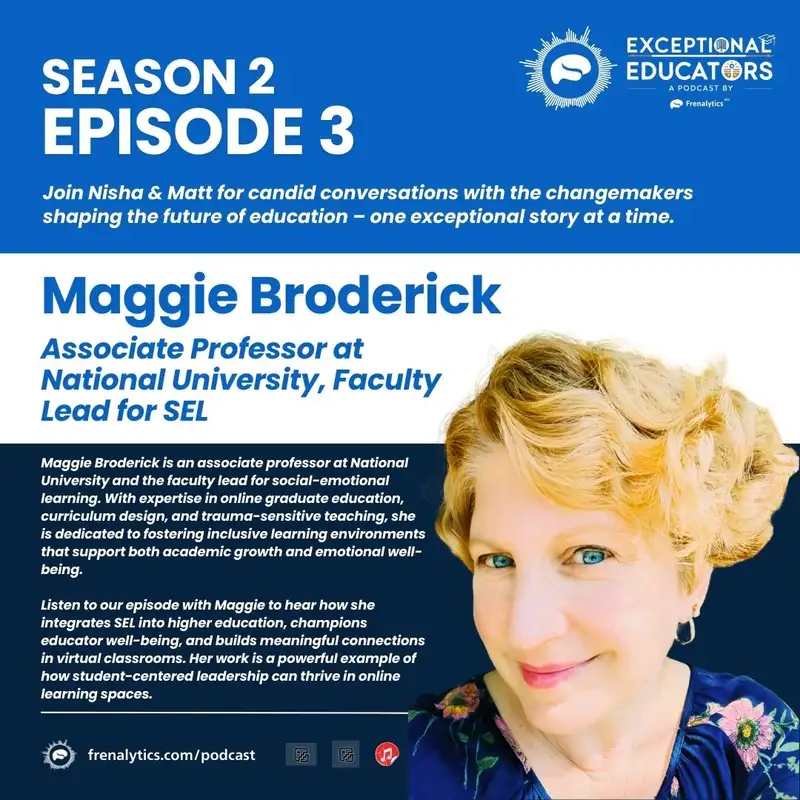
Teaching the Whole Human: Maggie Broderick on Embedding SEL to Create Exceptional Learning Environments
Welcome to the Exceptional Educators podcast by Friendlytics edu, where innovation meets inclusion in education. I'm your cohost, Nisha Srinivasa.
Matt Giovanniello:And I'm Matt Giovanello, the CEO and co founder of Friendlytics. At Frenalytics, we put special education and English language learners front and center. Our award winning Frenalytics EDU platform helps streamline progress monitoring, improve communication and compliance, and offers truly personalized learning to your students' abilities.
Nisha Srinivasa:Each episode of our podcast features candid conversations with district and school leaders, classroom changemakers, EdTech founders, and industry executives, all dedicated to transforming learning for each student, especially our learners with unique abilities. With a focus on extraordinary educators and the exceptional students they serve, we explore the latest in special education, accessible technology, and inclusive leadership. In this episode, Exceptional Educators is exceptionally thrilled to welcome Maggie Broderick. Maggie is an associate professor at National University who serves as the faculty lead for social emotional learning. With over twenty years of experience working in the field, Maggie's emphasis on SEL and serving the whole human has impacted the work she's done in schools and universities at large.
Nisha Srinivasa:Maggie, we are so thrilled to welcome you on the podcast today. Thank you so much for joining us.
Maggie Broderick:Thanks so much, Nisha and Matt. It's great to be here.
Nisha Srinivasa:We're really lucky to have you and so excited to dive into this conversation today. Just to get us started, I'm sure this is a question you as an educator are very familiar with, but it's a question we've been asking all of our guests at the start of our episodes, and that is what is your why? So what's brought you here and what continues to keep you here in the world of education?
Maggie Broderick:Well, I think about that a lot because, you know, times change and things as we grow different phases of life. Right? And it's that kind of heart of a teacher for me that's always been there. So through everything starting out as a musician, I found that, you know, I loved learning music. And then when somebody said, will you teach me that?
Maggie Broderick:How did you do that on your flute? How did you do that with your voice? How did you do that with your, you know, piano? I would feel really good. It felt really great to do that.
Maggie Broderick:And then through the rest of my life, you know, things like being a parent, a girl scout leader, professor, it wove them together. The why is that, you know, somebody else wants to learn something. I happen to have it and know it and I'm passionate about it. And I'm like, hey. That is super cool.
Maggie Broderick:Let let's do this. I would love to, you know, do that. And then to see that happening in others, if you teach someone and they teach someone else and so forth and to see that that growing and nurturing, I think that's pretty much why I'm here.
Nisha Srinivasa:Could you share a little bit more, Maggie, about sort of the pathway that got you from your pursuits in the world of music to kind of, like, how that transitioned you to the world of education and where you are right now.
Maggie Broderick:Sure. Sure. Well, as you mentioned, in the intro, one of the things I do at National University has to do with social emotional learning. And we're thinking a lot about that lately, especially since the pandemic and with some other things going on. It's it's a very deep topic to be thinking about.
Maggie Broderick:And so that's one of the things where I found that who I was growing up as a person and through music, had time to think about. So for example, you know, was a really shy child, super quiet, and a lot of people who are kind of blossoming in music classrooms, you'll hear a similar story. Right? You do hear for these ones who are extroverted, and, you know, my youngest is a musical theater person and has more of that persona for music. But for me, I was always kind of this shy, quiet person who was observing, listening, processing, you know, kind of cautious.
Maggie Broderick:Right? And music gave me confidence and kind of brought me out of my shell. And so I I got really fascinated with music and also with language. My other thing that I taught, I was at a German magnet school back in the nineties, and I taught German. And so I had music and German.
Maggie Broderick:And it's a fascination for me with both of those things. And then teaching that, I sort of started to realize that's about interpersonal and intrapersonal stuff. It's about both. And so if you picture what it takes, you know, you're both musicians. It doesn't matter what you play or if you're playing alone or with others, but particularly to make an ensemble work.
Maggie Broderick:You know, we've got teamwork. We've got listening. Like I was saying as a kid, I was just kinda listening all the time. Determination, passion, emotions, and then expression, being able to express yourself. Same is true for language learning and usage.
Maggie Broderick:When you think about what makes language interesting, people communicate. Right? They're communicating with each other. They're listening again. They're interpreting.
Maggie Broderick:They're trying to understand. They're trying to respond and hopefully with care, hopefully with caring and feelings and again expression. These things are like the foundations of social emotional learning. And I think about that too, like when I think about teachers who are really good at social emotional learning and understand these interpersonal, intrapersonal things, it's really if you think about the research, it's how the teacher made you feel. Right?
Maggie Broderick:A lot of research says this, and anybody you ask, I ask my students all the time, what was the most important thing about a teacher you remember twenty years ago, ten years ago? It's how they made you feel. And so for me, I think about that a lot. You know, SEL, social emotional learning, that's a framework for understanding some things that teachers just do if they have that interpersonal, intrapersonal, if they have that caring heart. And they just maybe didn't have a name for it before, but even back in the nineties, if you really are thinking and and listening and trying to deeply reflect on interpersonal, intrapersonal stuff, I think it's it's really what we're doing as as SEL.
Matt Giovanniello:I think you make a really good point there, Maggie, about the label of social emotional learning. It's been around for decades, if not longer, in k 12 but also in higher education and in the working world around us. But only until recently did it not have a name, and some of the controversies warranted or unwarranted that surround social emotional learning, and the necessity of teaching SEL as a part of our curriculum in schools became a hot button topic. Because you spent so long, nearly a decade, in Pittsburgh Public Schools and now over twenty years as an educator, I imagine SEL for you back in the day looked a little bit different than what it looks like right now. So walk us through some of the biggest changes that you've seen, not only in your teaching days, but also now in your academia and research days.
Matt Giovanniello:Let's start from the beginning of what it looked like back then, it's kind of evolvement. And then kind of as a follow-up question to that, I'm curious what the latest research that you're finding suggests about just how important embedding SEL into our curriculum is.
Maggie Broderick:Sure. And I know I love that your podcast focuses, you know, on diverse learners, learners, you know, who who maybe need us to give a different kind of support, a special kind of support, all these sorts of things. And so SEL absolutely has to do with that. When I look way back, you know, I started teaching, student teaching in '93 and then teaching in '95 and a lot has changed. That's thirty years ago.
Maggie Broderick:And so when I think back to those classrooms, even if teachers had these wonderful things inside of them, the interpersonal, the inter interpersonal stuff, and they were doing all of the good things, the frameworks of how we ran schools were different. When I was a student in the eighties, people were still paddling. They were still doing corporal punishment. Then in the nineties, we had more of this punishment reward stuff. Right?
Maggie Broderick:We've seen a lot of change recently toward, hey. Let's understand what's actually happening with this kid. What are we actually trying to help this with the growth of this person? I always think we're not just, you know, raising kids. We're raising grown ups.
Maggie Broderick:We're trying to get them to be really happy, hopefully, happy, functional people in the society. And so, yeah, you the idea of a framework, like you said, it it really kind of evolved. And in recent years, people started saying, okay. We wanna do things more in this positive way. Right?
Maggie Broderick:We wanna be more positive about things. And then, you know, we kind of went into too many rewards. Like, oh, I remember when my my 19 year old was in fourth grade. They're like, here's cookies. Here's prizes.
Maggie Broderick:Right? Okay. But now we're trying to go deeper. So now we have this framework. And, you know, for example, there is you're probably aware CASEL, c a s e l, and they really have a very solid framework for social emotional learning.
Maggie Broderick:There are others. They're a great starting point for how we look at things today. And like you said, you know, there are various political and social things going on, especially right now where if you bring up SEL in a place, it might be taken well or might not. Right? And so we have to think about it really carefully.
Maggie Broderick:But you can start very small. You can do different things as a teacher or as a leader in a school these days with that idea of the the positive in mind, creating that positive classroom climate and culture, that positive school climate and culture, and it can start in in lots of ways. But one thing I'd say to just, you know, make sure people understand is look for those primary sources like is a great website to really understand what it means because I think a lot of people get very confused. Most of us have very good intentions, but maybe they're not getting the true picture of what it is. I'd say go to those primary sources, really do research with those.
Maggie Broderick:And the research today is saying that when we do support people, whether they're children or adults and we meet their needs, then they are more responsive and that that makes complete sense, right? As a parent, that makes sense. It takes a lot of a lot of thought. It takes a lot of emotional labor and and it takes some some thoughtfulness and planning and just meeting somebody with
Matt Giovanniello:your
Maggie Broderick:heart.
Matt Giovanniello:I appreciate you sharing that perspective, Maggie. I personally agree with it, and I'm glad that the general sentiment is shifting maybe from one end of the pendulum or to the other and now a little bit maybe more in between. And that's just my own kind of view and sense of things here in New York at least. Maggie, your perspective in Pittsburgh does very much resonate here. But, Nisha, I'm curious if you're seeing a similar thing out west.
Matt Giovanniello:Does SEL have as big of a airtime in your schools? What does it look like for you?
Nisha Srinivasa:I would say it's, like, really critical component of our professional development and programming. There's a department that's dedicated to supporting and integrating SEL programs across the district, given through various different personnel and curriculums. But I still think that there is a long way to go considering the emerging needs that we continue to see, particularly in schools that are more underserved than others across the district. I'm actually really curious to hear from you, Maggie, what your take is on this. Have you seen success of any implementation of any programs that you think could be a springboard for a school that might be maybe a little bit more underserved, that has a student population that might have higher social emotional needs?
Maggie Broderick:National University there in San Diego, we're mostly online and we have everything from bachelor's through doctoral programs and so we actually partner with what's called Sanford Harmony and Harmony has a lot of programs that are mostly in K-six schools, a lot in California but elsewhere as well. And so that is a place to start. They have a lot of free professional development available on their site. They have some really great tools. And even if you're not a K-six teacher, you know, they do have things that apply.
Maggie Broderick:Even when I'm thinking about my doctoral students who are usually 40 years old, you know, the the basic core ideas are the same. The basic idea, you know, maybe you have a little morning meeting with your students and here are some types of ways that you can start conversations about our feelings and things. You know, all of these things are relevant for any human being, I would say.
Nisha Srinivasa:It's such an accessible resource that you're pointing out, and I'm really hoping that folks who are listening to our episode might be able to take something away. I know that you have also done some work in creating some program development and curriculums around CL. What has that looked like for you, and what has been sort of your focus in developing those programs and implementing them as
Maggie Broderick:Well, there's a lot of really interesting things going on. I partner a lot with Harmony. They are amazing there. And so a lot of our courses at National infuse their modules. And then we have other things going on there as well.
Maggie Broderick:When we have the doctoral programs in particular, we infuse SEL. So there is a program about SEL and that is like you can get a doctorate with a specialization in SEL, but we also have it sort of infused. So people in the Department of Special Education, people in Teacher Education and other courses, people who teach trauma informed educational practices. We have that specialization that dovetails exactly with SEL. Even in the curriculum courses, I have written and taught courses about developing curricula.
Maggie Broderick:We bring that in. And then I have the program that I'm directing at the moment is the Masters of Arts in Social Emotional Learning. We have a Masters program that just specifically focuses on SEL. And then we also have programs added on. So there's a lot of different ways you can do it.
Maggie Broderick:You can start small or you can decide, I'm all in on this and I'm getting a doctorate. So I enjoy doing that. I really enjoy thinking about the whole child or the whole human and their learning and development because it goes beyond sort of SEL as a buzzword. There's definitely programs in schools, we need those. But when I think about it, I kind of think even broader.
Maggie Broderick:I think about communication, and you mentioned Maslov's hierarchy of needs and and having our needs met. Being able to have cognition and having critical thinking, you can't have that unless you have this community of care. So I always think about that. I think about Bloom's taxonomy too because I I'm curriculum nerd. I like to think about that.
Maggie Broderick:So if if you want them way up here or if you want them, you know, analyzing and synthesizing, we we have to be able to build up, and we also have to meet our social emotional needs first. So thinking about that a lot. Even for adult learners, it's all across the board.
Matt Giovanniello:As a precursor to what will soon be my next question, I'm about to ask a maybe obvious one for somebody so closely entrenched in this work. But let's back up a little bit and really put a fine point on the sheer importance of embracing SEL at a school district for our youngest learners and, more importantly, as it relates to this podcast, our underserved learners as Nisha was talking about. Students in special education, English language learners, including newcomers coming to the country, those requiring special support, those who have severe behavior plans that need to be accommodated in schools, etcetera. Why is SEL so important for those particular subpopulations?
Maggie Broderick:Absolutely. We were just talking about the programs in trauma informed educational practices. So when we think about many of the students in groups that you're talking about, a lot of them have faced trauma. I think that intersection with trauma really, really fits the mold there when we think about using SEL and think about how do we use those interpersonal, intrapersonal skills. How do we put ourselves in someone's shoes, meet them where they are, and and calmly try to help.
Maggie Broderick:And then, you know, if we don't have the resource, language, something like that, find that resource and get it in the way we can. It might not be perfect, but showing that we care is absolutely important. We do the best we can even if you don't have the best possible resource to do it. I don't know every language, but I will try to do what I can and then show with your face, show with your expressions, show with your body language, show with how you slow down for to meet someone where they are. It really works wonders, I'd say.
Matt Giovanniello:Thank you. And also to your earlier example of Castle, in the friend analytics platform, we have a full SEL unit that is aligned to the five pillars of Castle as requested by our New York City school partners. And think I it's just a testament to them recognizing the need that they are at this point, that they are ready and hungry and eager for more resources to meet the needs of their students, and they recognize that SEL not only is necessary, but it's an obligation to their students, and they need it now. So I'm really glad you brought that up. It's a nice little testament to us aligning to the the right material in your professional opinion.
Matt Giovanniello:And it leads me to the next question, Maggie. For schools that are similarly in the shoes as that one example I brought of just now, they're like, okay. We're ready to integrate SEL more fully into the direct supplemental and assessment curriculums of our students. What else is required of them in order to embrace this idea and actually embed this whole child instruction when they're kind of starting from the beginning of this SEL journey, or maybe they're somewhere in between but have a lot to go?
Maggie Broderick:And like we said, it really will depend on where you are. I work with teachers all over the place. Maybe you're in a state like Florida, which is gonna be different than where I am in Pennsylvania and so forth. And then, like you said, urban versus other communities, rural, all these things. But I like to think of it with SEL only being part of it.
Maggie Broderick:Right? It's really important. We need to think about it. We need to understand SEL and really get what it is and then calm ourselves down and realize how important it is. And then thinking holistically really about that entire ecosystem.
Maggie Broderick:Right? There are bigger picture things within schools and, you know, classrooms, and there are smaller details. When we find ourselves in a place where maybe the administration isn't completely embracing it or maybe there's politically some reason, one educator can just take a few small baby steps, just a little something in their classroom because it really can grow outward. That nurturing really can spread that energy. People see it.
Maggie Broderick:People know, you know, even when things are really not going well, they see good positive energy spreading from somewhere. They hear music. They hear happy laughter. They hear language being shared that is happy and communication, and they want that. I like to garden.
Maggie Broderick:I think a lot about gardening this time of year, know, enjoying cucumbers and things and tomatoes in my yard. And I like to think about, you know, planting and tending that garden. Right? You have to be really thoughtful and proactive. So when it's the middle of winter here in Pittsburgh, February, I'm like, okay.
Maggie Broderick:Gotta make a little plan. Not perfect. Just just a little plan and kind of figure out my seeds that I'm gonna plant. And then, you know, you keep tending that garden, but maybe not overly so, you know, just the right amount thoughtfully, and it takes everybody. If my kids, hey.
Maggie Broderick:It didn't rain. The kids say, hey. Want me to help water the garden? Yes, please. Work together and tend the garden together because you might start the garden.
Maggie Broderick:You might be the one starting the seeds, but it really does take to to tend the garden.
Nisha Srinivasa:I really love that emphasis and focus on community and the power that community has to work together and really, like, uplift one another. And the way that that is so closely tied to the work of social emotional learning. It exists in context of community, and I really appreciate the way that you are thinking about the variety of communities that might engage with what SEL might look like or feel like in their space. Whether or not there are whole frameworks that exist around what that might look like within schools, or there might be individual folks who really, you know, are embracing the idea of wanting to foster community in their own classroom. To pivot a little bit, I'm actually really curious about something since you are somebody that's worked in multiple different educational settings and really dive into the work of SEL.
Nisha Srinivasa:Do you see any sort of through lines or points of connection across your work within maybe a setting like a school versus the current work that you're doing now?
Maggie Broderick:I wish we could just kind of connect it all. I would love to see it. I would love to see that happening because, you know, for example, there are doctoral students out there doing dissertations completely focused on SEL. There's that and there's the ones who are maybe in a master's program who might actually be in service teachers or all sorts of things. You might be an administrator.
Maggie Broderick:And we always say, we wanna connect research and practice. We wanna connect research, practice, and policy. It is a challenge. We have some real issues there. Teachers are really overburdened.
Maggie Broderick:We have terrible attrition rates. We have burnout. So it goes right into that. The emotional labor, I think about that a lot. My current study that I'm conducting right now with some colleagues is about emotional labor for teachers who teach less commonly taught content areas.
Maggie Broderick:So like the music teacher. Right? Maybe they are having this wonderful community, this band, this orchestra, this choir, and they for four years, they see the same students. They know their whole lives. There's really no one else in the building that's having quite that situation, and they can be often this very special oasis, for these these students.
Maggie Broderick:When we think about, you know, how to do that and how we can bring it together, bringing the research into practice is really challenging when teachers are already too busy. We don't wanna throw it at them like, here, read all this stuff. Here, here's a PD, a professional development that we'll never look at again. Right? You know, if we don't really mean what we say.
Maggie Broderick:So so we really have to pick carefully. There's so much out there and choose of which research are we gonna put into practice, which connection will we make, and so it actually is meaningful and deep because I think sometimes we get lost in the weeds there.
Matt Giovanniello:Well, speaking of meaning what you say, you brought up a point before about teacher attrition and the really scary statistics around teacher burnout across The United States, but especially in certain populations. In your professional opinion, based on what you've uncovered through research and your own academia at National and otherwise, Maggie, I'm curious if you're seeing any sort of connection between properly implemented SEL directly correlating with a positive uptick in teacher burnout statistics and reducing the amount of turnover in a particular school environment or a city or a state or a region. I'm curious if as a means for districts to, from a different lens, want to implement SEL for the purposes of saving their staff.
Maggie Broderick:I remember just, you know, full disclosure being, you know, very vulnerable, crying in the beginning. Right? Like, nineteen ninety four, ninety five, just going home and crying. It is very difficult. And I talked to new teachers, and a lot of them feel the same way.
Maggie Broderick:It's like, there's a whole lot on our shoulders. So if we don't support, you know, the teacher, if we don't fill their cup so to speak, how can we have them give that emotion labor? The research is really clear. I tend to see a lot more qualitative data on that than quantitative data, but it exists. So if anybody ever wants to kind of, geek out on that and go down that road and look at academic things, just look for a nice literature review about social emotional learning.
Maggie Broderick:You'll find that there are absolutely quantifiable things. But the things that really ring true to me, I guess, when I think about those moments of crying, you know, it was like, oh gosh. This is a lot today. You know? I hear the stories, and so we look at qualitative research.
Maggie Broderick:A lot of my students are doing that. A lot of my colleagues are doing that where you just get those voices of the teachers in an interview and something like that, and you hear in their own words, and then we really just need to listen to them. We really have to actually hear that and and, you take it to heart, understand the humanness behind all of that. So I would say looking at some of the qualitative research would be a really powerful thing if you if anybody would like to do that.
Matt Giovanniello:That's really powerful and thank you for giving that suggestion and confirming that there is a direct link there because I think that's important to make sure that we continue to underscore. What suggestions have you seen either researchers in your field, you yourself, the students that you're observing for dissertations, and otherwise recommending to districts, one, on the staff level, how do we better support our staff, including those that might be bawling their eyes out, threatening to leave, having, like, a walkout session, whatever it might be? And then second, there's this concept of making sure that every student in a district has at least one trusted enrolled member, hopefully more. How can we make sure that both staff are ubiquitously covered and supported in those needs? And then how do we make sure that every student has the resources, staff member, or otherwise that they need?
Matt Giovanniello:Any kind of best practices there that schools who don't have anything like that might be able to implement on the Sooner side?
Maggie Broderick:Sure. And it's exactly what we've been saying all along. You know, whole human education, it's not just for kids. Right? It's for everyone.
Maggie Broderick:And so and it's also not just in classrooms and schools. Right? If there's a whole lot happening in our communities, in our homes, we have to be cognizant of that. It's it's a phrase we've heard for many years, lifelong learner. Right?
Maggie Broderick:And it gets thrown around a lot, but I like to think about, you know, lifelong learning with a purpose and how, you know, we need to nurture that. And it's it's a human thing. Everybody today is talking about technology and AI, and it's cool. Right? It's super cool.
Maggie Broderick:I've used it. I like it, but it's not human. It's not what we need. And so I think we need to really take a step back and say, okay. Yeah.
Maggie Broderick:We'll use these cool tools. They're neat, but we also really have to understand that we have to nurture that heart and soul. The early childhood education people that I've worked with a lot, and I've written curriculum there and did a little teaching in early childhood, they they think this way all already. They think very holistically. They tend to think about, you know, your mind, your cognitive growth, and your physical growth, your gross motor, your fine motor skills.
Maggie Broderick:They think about your emotional growth, and they think about your mental health and all of these things and your development of of as a person. I don't I don't think that ends. And it's, you know, really understanding that the the learning environment with the humans in it. Sure. The technology is great and everything, but the people and the support there, encouragement, and truly connecting with each other is really what is going to make everyone from the teacher to the guidance counselor to, you know, the band director to the students and the administrators feel like they actually want to wake up in the morning and go there and learn and continue on that journey.
Nisha Srinivasa:I love the focus that you're bringing on necessary emphasis on humanity and the human connection amidst the sort of hustle and bustle and constant moving pieces that the world of education brings. I have recently been learning a lot more about the adult theory of learning, and one of the focuses of the adult learning theory is the fact that adults also need to have psychological safety in tandem with the work that they're doing, like the folks around them, between administrators, psychological safety in their classrooms as well. And so I find it really interesting that we have a lot more widely circulated frameworks around students' focus on social emotional learning and a little bit less of an emphasis on kind of that adult piece and the way that that's so necessary in contributing to a whole school or a whole institution level environment. I'm curious if you have any thoughts between those two different things, the adult learning theory and, you know, other frameworks that you've brought up before, like CASL, and the way that that maybe there's some conversation missing there between those two.
Maggie Broderick:You're totally right. Yeah. I think we tend to forget about the adults. What did they say on an airplane that you put your mask on first, right, and then you help the child next to you? We don't do that.
Maggie Broderick:I don't know why we really don't do that. I get it. You know, as a as a parent and as a a teacher, I understand why we we don't tend to think, oh, I'll put my mask on first and we just don't do it. I wrote a couple of book chapters with colleagues, doctor Amy Lynn and just recently doctor Emily Springer. We did a chapter that is exactly what you're talking about, Nisha, where we need to think about, a sense of belonging and these sorts of things like you mentioned, the psychological safety and the ways that, you know, an adult learner, especially in an online environment because a lot of us here focus at national and online adult learners.
Maggie Broderick:What makes them wanna get up and go to that classroom as opposed to that sense of dread? What makes them think, okay. I'm gonna turn on that computer, log in, and do the assignment mostly in isolation? I mean, what what is it that makes them want to be there, and how do we make them feel safe, make them feel engaged and excited to learn? How do we encourage it?
Maggie Broderick:How do we keep the momentum going? So Amy, Lynn, I did a book two years ago, motivation and momentum for adult online learners. Just the same idea.
Matt Giovanniello:That's awesome. That seems very necessary. You need to be shouting that from the rooftops because I certainly know in my undergraduate days, and I imagine that many colleagues of mine can attest to this too, whether it's an MBA, a master's, a PhD program. Like, you go in front of a Zoom camera, and all of a sudden, you're immediately disengaged. Disengaged.
Matt Giovanniello:Psychologically, I think there's a really different way that students and adult learners by default treat in person experiences versus virtual ones. And there needs to be continuity there. You're still learning. You're you still need to be engaged. The way in which that information is gonna disseminate over to you is kind of the same.
Matt Giovanniello:Don't act like it's because you're in front of a camera. Maggie, I have another question for you about something you brought up before. It's a kind of a different change of gears, and it has to do with PBIS. It's a little bit related to the comments that you made just a moment ago about incentivizing engagement, whether it's at the adult level or for PBIS oftentimes in K 12. PBIS is perhaps even more controversial than SEL in and of itself.
Matt Giovanniello:I'm curious what you found the merits and also the inherent drawbacks of PBIS to be and maybe what you would recommend in its place for students who need to be maybe more innately incentivized versus extrinsic motivations.
Maggie Broderick:Right. The intrinsic extrinsic is exactly what it is there. I I will never forget my, 19 year old, like I was saying earlier, coming home. I got a free cookie. I got a prize.
Maggie Broderick:Okay. That's all nice, but it was very superficial. Right? Do we wanna be intrinsic and deep, or do we wanna just kind of get through the day? Well, things can be okay, but one is more soulful and better than the other.
Maggie Broderick:Right? Having SEL actually being a sense of belonging, actually feeling like your soul and your heart are really in it. Are they terribly harmful? Some of my colleagues would say it's very harmful. I know some people like you could talk to who would say PBS is very harmful.
Maggie Broderick:I just think that it needs to go a lot deeper. I think that it's it's fine, but it's not enough. You know?
Nisha Srinivasa:What I'm hearing you touch on a lot is generally this sort of importance of the depth rather than necessarily having a surface level or a large breadth of tools related to deepening social emotional learning for students. I totally agree with you. I think it's really important that schools, institutions, universities, whatever it may be, folks who are engaging with one another really in any kind of setting, really are developing those really deep ways of promoting healthy engagement and finding happiness, joy, success in multiple ways. Not just kind of like through surface level means, especially when we're trying to work on, at least in my educational setting, working on having students develop their own means of intrinsic motivation rather than having extrinsic motivators be the sort of like determining means by which they're moving through. Where do you see the opportunity for maybe who an educator or somebody who might have a student that might be at that point of really being connected to extrinsic motivators?
Nisha Srinivasa:Where do you see that sort of continuation, that path to develop into like a more intrinsic motivation type.
Maggie Broderick:I remember getting some free prizes even in my third grade classroom and thinking that was fun, and I felt, like, more engaged by but, yeah, like we said, it's fun and can be positive and good. It can also feel bad to the person who doesn't get the prize. Right? There's so many different angles to this. And so a lot of people going different ways.
Maggie Broderick:For me, personally, I'm looking at those, like I said, an oasis, the hidden oasis in schools. And one angle I'm taking on that currently is with these less commonly taught content areas. What is happening in these classrooms? It doesn't have to be the band room or, you know, maybe it's a special sport where somebody is feeling really good about themselves in this sport or theater or, you know, sometimes it's a specialized STEM field. I am looking at that angle, but I think it's really any pocket that we are not seeing.
Maggie Broderick:You know, these are hidden. That is really the of the research I'm doing now with colleagues that, you know, in some classrooms somewhere, a teacher is getting through to a student, and and we're not hearing that story. So I'm just trying to uncover right now the stories of this particular brand of that. Right? But I feel like they're happening in English classrooms too and math classrooms too and, you know, maybe with the principal.
Maggie Broderick:Who knows? It could be all kinds of things. Where are these things happening? How do we tell those stories? Like we said, qualitative research.
Maggie Broderick:Can we hear the voices of people who are doing that? And and what are we doing, and can we try to to do the same thing? Because it gets about sort of, you know, spreading that, you know, nurturing thing. How will you maybe do the same thing in your own context, which might be different, but with the same heart?
Matt Giovanniello:Maggie, thank you again for reflecting on that in that way. I think it's very refreshing, and it's an excellent reminder of just how important research in the SEL space is. So you are impacting the lives of students everywhere. And and to that, we are very grateful for you. As we ask our final question to you, Maggie, it's a question that we ask all of our guests.
Matt Giovanniello:You can take a moment to reflect on it if you wish. It is, what does being an exceptional educator mean to you?
Maggie Broderick:Well, you know, thinking about being an exceptional educator really, to me goes back to what we said very early on about how that teacher makes you feel. Right? So I can remember teachers from 1987. I don't remember exactly what they taught me or how cool it was and interesting it was. I'm sure it was, and I'm sure I learned it.
Maggie Broderick:I remember how they made me feel. And so that seems to to hold true for almost anyone, I think. How did that teacher make you feel? And maybe think about why that is, and that would make an exceptional educator in my opinion.
Matt Giovanniello:I love that. You took the words out of my mouth. It's my kindergarten teacher all over again from embarrassingly many decades ago. But even the same for you, where it's not what they said. It's not even necessarily where or the way in which they said it.
Matt Giovanniello:It's how they made you feel. And to that, I think that encapsulates SEO perfectly. It goes to show you it has been alive and well for so long. And regardless of its labels and the connotations, good and bad, that come with it, however unnecessary some of us may think they are, it's really important that it continues to get embedded in support of ours all of our students, especially those who need it the most. Maggie, thank you again for your time today and for sharing all of our your insights and your resources with us.
Matt Giovanniello:We are all better off for it. Nisha, thank you again for joining me on today's episode.
Nisha Srinivasa:Thank you, Matt. Thank you so much. Thank you, Maggie, for joining us. We were so fortunate to be able to learn from you and learn alongside you. I'm really looking forward to using what you've shared and reflecting on my own practice and continuing to support students in ways that you've elevated so wonderfully today.
Nisha Srinivasa:So thank you so much for being here.
Maggie Broderick:Thank you both. It's really been a pleasure. I love the work that you're doing, so I appreciate it.
Matt Giovanniello:Thank you. Maggie, the students in San Francisco all the way to here in New York will be better off for your research and for your insights today. To all of us listening for today's episode of Exceptional Educators, thank you for joining us, and we will catch you
Maggie Broderick:at the
Matt Giovanniello:next one.
Maggie Broderick:I am Doctor. Maggie Broderick from National University, and I am a faculty member and the director of our Advanced Research Center. I nurture exceptional educators who nurture their students, and I hope that they enjoy that and find joy in that nurturing.